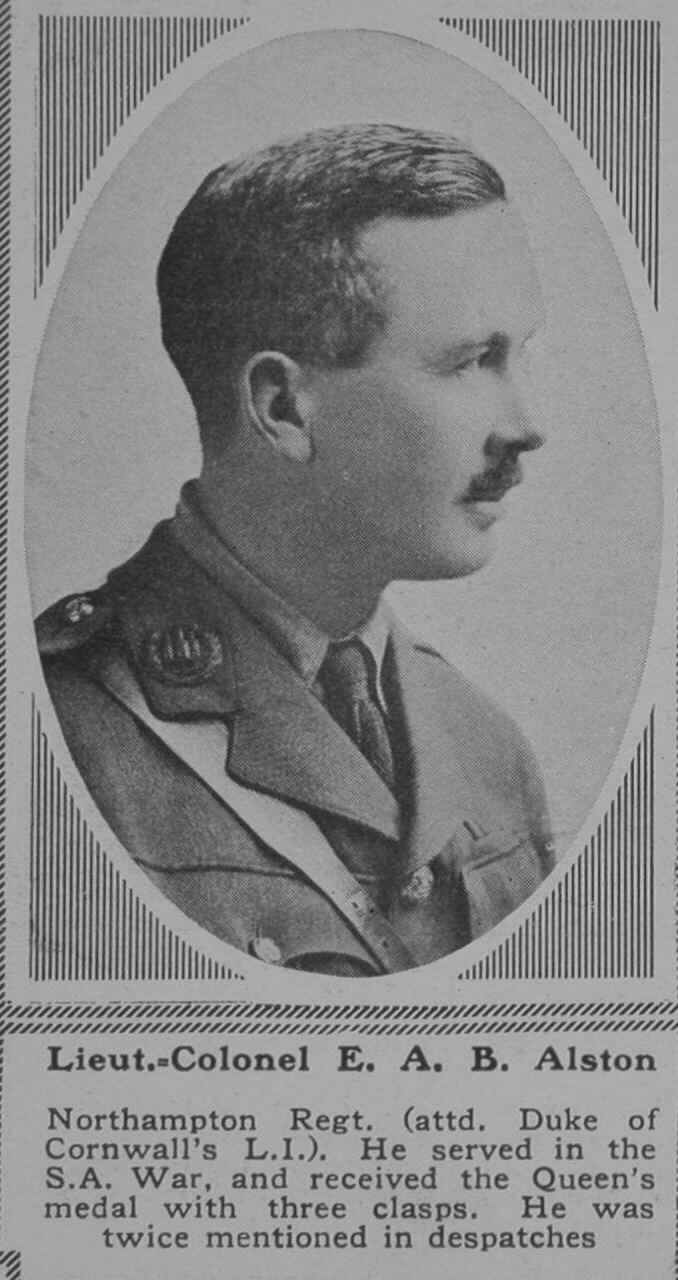
Alston E A B Lt Col Northants Regiment Attd Duke Of Cornwall’s Light Infantry
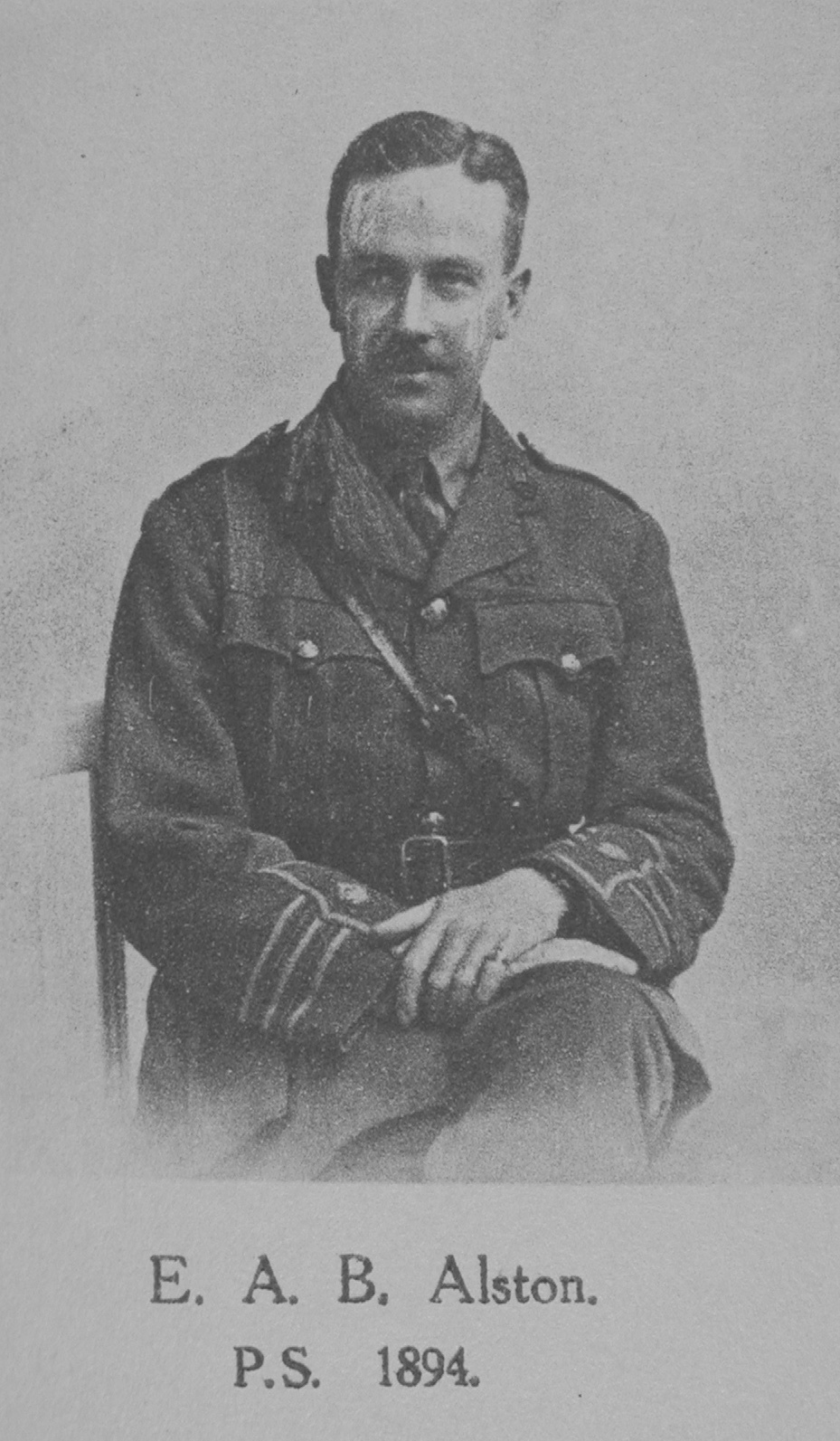
Alston A E Lt Col Northamptonshire Regiment Attd 10th Duke Of Cornwall’s Light Infantry
LIEUT.-COL. ERNEST ALFRED BROOKE ALSTON
MAJOR, NORTHAMPTONSHIRE REGT
O.C. 10TH BATTN. DUKE OF CORNWALL’S LIGHT INFANTRY.
KILLED IN ACTION NEAR DUNKIRK, AUGUST 11TH, 1917. AGED 39.
At the School 1893-94 (Parkside).
Lieut.-Col. E. A. B. Alston was the fourth son of the late Surg.-Major William Evelyn Alston and of Mrs. Alston, of East Cliffe House, Sandgate, Kent, and husband of Eileen Alston, formerly of 25, Iverna Court, Kensington, W., and now Mrs. Trevor Finnis, of 9, Kensington Crescent, W.
Entering the School in May, 1893, E. A. B. Alston left at the age of sixteen at Easter, 1894, and entered the Militia in the following year. At the outbreak of the South African War he was gazetted to a commission in the Northamptonshire Regiment, with which he served in South Africa, 1899-1900, being present at the Battles of Belmont, Graspan, and Modder River, and receiving the Queen’s Medal with three clasps.
He was promoted to his Captaincy in July, 1908, and soon after the outbreak of war was gazetted as Temporary Major, October 29th, 1914, to the 5th Battn. (Pioneers) of his own Regiment, and went to the Front with this Battalion in May, 1915. He was promoted to substantive rank as Major, September 1st, 1915, took part in the Actions of the Hohenzollern Redoubt in October, 1915, subsequent to the Battle of Loos, and was mentioned in Despatches for services in France in 1915.
On May 1st, 1916, he was appointed as Temporary Lieut.-Colonel to the command of the 10th (Service) Battn. of the Duke of Cornwall’s L.I. With the exception of six weeks in England after he took over this command, whilst his new Battalion were completing their training, he was on continuous active service abroad from May, 1915, till the day of his death. He commanded this Battalion in the Battles of the Somme, 1916, and in the Battles of Arras in April and May, 1917, and finally on the Belgian Coast, after being for a time in the neighbourhood of the Ypres Salient. He was again mentioned for distinguished services in Sir D. Haig’s Despatch dated November 11th, 1916, and published ou January 1st, 1917, and a third “mention ” appeared after his death, in the Despatch dated November 7th, 1917.
On August 11th, 1917, he and the Major, second in command, and the Adjutant, were asleep at the Battalion Headquarters, near Dunkirk, several miles behind the front line, when the hut was struck by two shells, and he and the Major were instantaneously killed, and the Adjutant mortally wounded. His last thought had been for the guard, whom he had ordered to take cover. He was buried in St. George’s Cemetery, Newport, Dunkirk. The Medical Officer wrote expressing the heartfelt sympathy of the whole Battalion and their great sense of loss, adding that he had been constantly with Col. Alston and had learned to know and to admire him as a true friend. Capt. H. L. Stanistreet, O.T. (P.H. 1914), who was one of his Company Commanders, after telling of their great loss, wrote:- “It is hardly necessary to add that the C.O. is a very sad loss to the Battalion as he was so popular amongst the officers and The C.O. of the 5th Northamptonshires, under whom he served for a year and a half-wrote:- “It seems incredible that one won’t see his genial, cheery face again. He was a gallant officer and nothing ever upset his natural cheerfulness. No one could possibly help liking him, and he was a general favourite with every one. When he was with us I have seen him in one or two pretty hot places, but he was always smiling and joking, and had a cheery word for every one a most gallant officer and a thorough gentleman.”
Source : Tonbridge School And The Great War Of 1914-1919