Abselling G H Major DSO 2nd Dragoon Guards
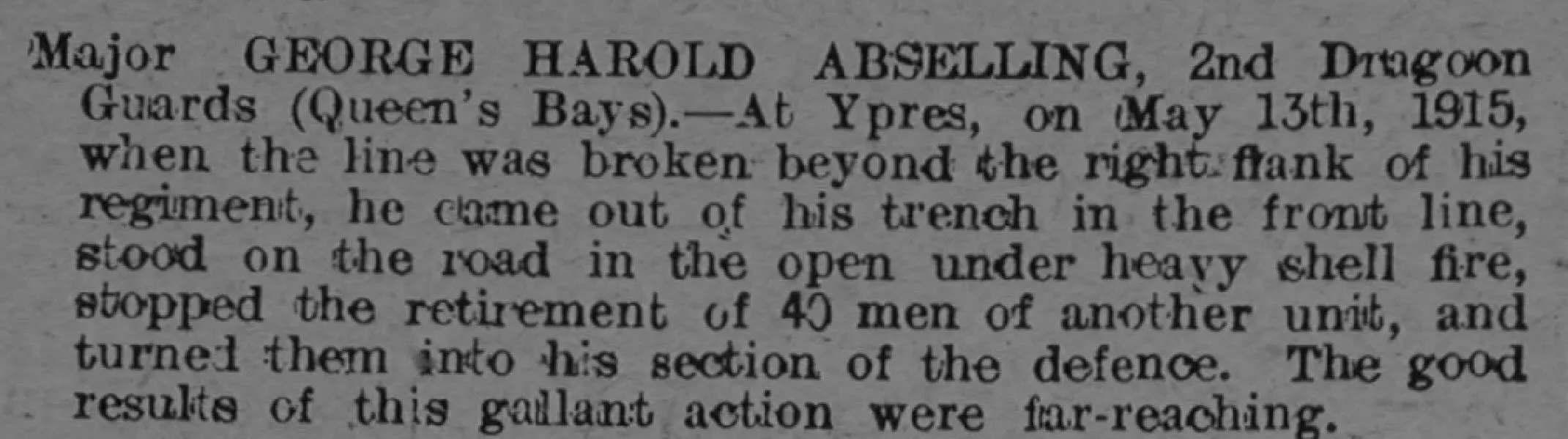
Major GEORGE HAROLD ABSELL ING, 2nd Dragoon Guards (Queen’s Bays). -At Ypres, on May 13th, 1915, when the line was broken beyond the right frank of his regiment, he came out of his trench in the front line, stood on the road in the open under heavy shell fire, stopped the retirement of 40 men of another unit, and turned them into his section of the defence. The good results of this gallant action were far-reaching.
Source : The Graphic 5th July 1915
War Diary Excerpt (13 May 1915)
“At 3am the Germans commenced a very violent bombardment of all the trench line in our vicinity. This bombardment continued until 7am by which time all telephone lines had been cut and the regiment was no longer in communication with the Brigade. Towards the latter part of the bombardment the 1st L G [Life Guards] retired owing to their trenches being completely blown in. Small parties of Germans occupied their trenches and also some [advanced] 300 yards to our right front but made no attempt to come on in any numbers. The trenches occupied by ‘B’ Company had been partially destroyed by the very heavy gunfire which included ‘Coal Boxes’ & ‘Jack Johnsons’ and a gap of 80 yards existed between our left and the right of the 5th Dragoon Guards.”
- Commission: Born on 24 March 1880, Ing was originally gazetted as a Second Lieutenant into the 2nd Dragoon Guards on 3 September 1900.
- South Africa: He deployed to the Second Boer War, where he was slightly wounded and had his horse shot/thrown from under him on 28 February 1902—an incident in which he was rescued under fire by Trooper Roberts. For his South African service, he received the Queen’s South Africa Medal with five clasps.
- Peacetime Promotions: Following the war, he steadily advanced through the regimental ranks, attaining the rank of Major by August 1911
- Outbreak & Retreat from Mons (August 1914): Deploying to France with the British Expeditionary Force (BEF) in August 1914, Major Ing took part in the grueling retreat from Le Cateau, becoming temporarily separated from the main column at Escaufort before rejoining his regiment on 28 August.
- Action at Néry (1 September 1914): During the famous cavalry engagement at Néry, Ing was wounded while leading a charge that captured the first enemy artillery guns abandoned to the BEF.
- Ypres & The D.S.O. (1915): After recovering from his wounds, he returned to the Western Front and was wounded a second time at Zillebeke in February 1915. Three months later, during the Second Battle of Ypres on 13 May 1915, he earned the Distinguished Service Order (DSO) for leaving his trench under heavy shellfire to rally 40 retreating soldiers and stabilize his sector’s line.
- Regimental Command (1918–1920): On 17 April 1918, Ing was promoted to Lieutenant-Colonel and appointed Commanding Officer of the 2nd Dragoon Guards (Queen’s Bays), leading the regiment through the final offensives of the war until 1920. For his wartime leadership, he was also appointed a Companion of the Order of St Michael and St George (CMG).
- Yeomanry & Civic Service: After retiring from regular army service, Ing remained active in the Territorial Army as Honorary Colonel of the North Somerset Yeomanry.
- Final Years: He settled in Dorset, where he served as High Sheriff of Dorset in 1948, and died in 1957 at the age of 77.