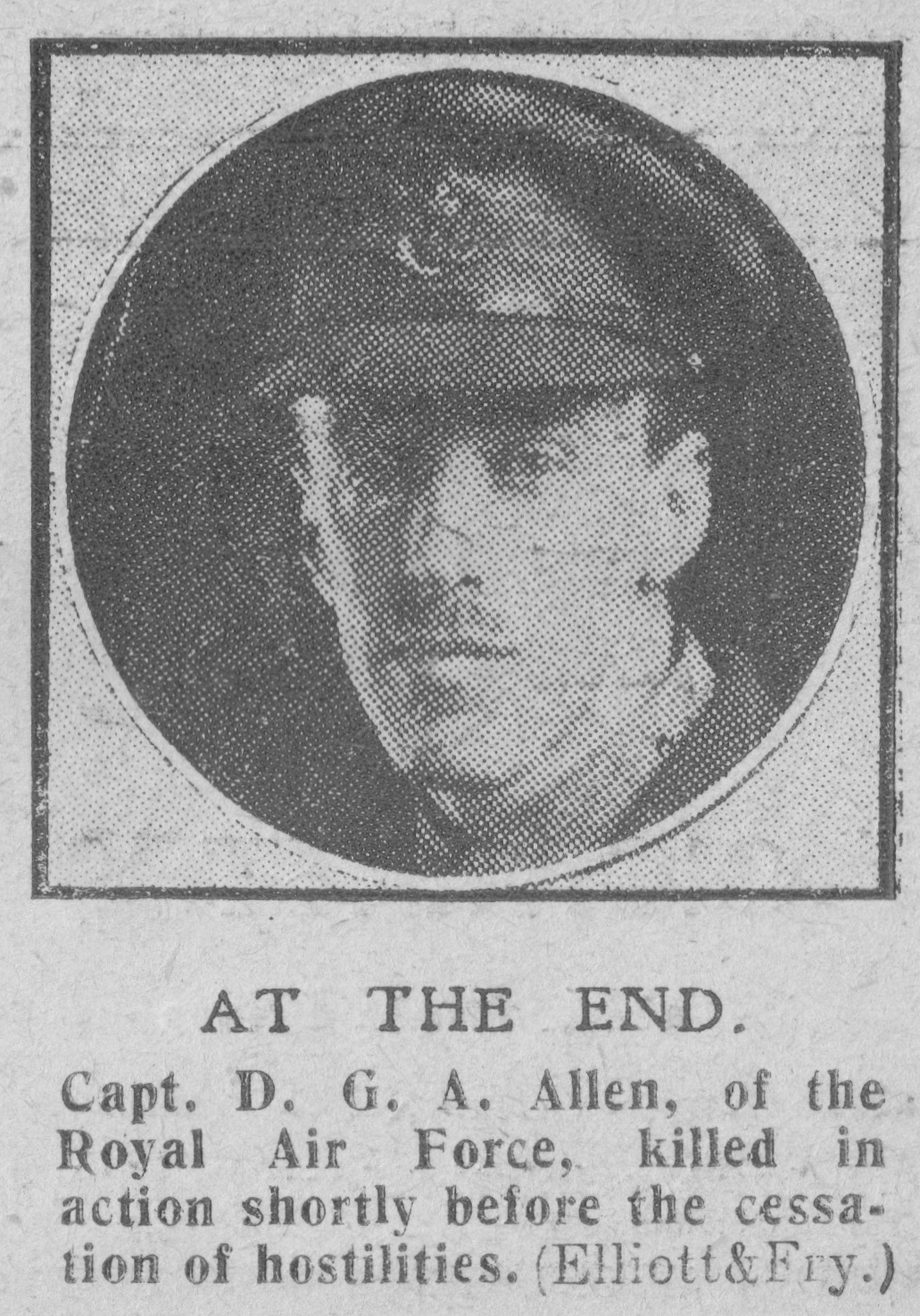
Allen D G A Captain Royal Air Force
AT THE END. Capt. D. G. A. Allen, of the Royal Air Force, killed in action shortly before the cessation of hostilities. (Elliott & Fry.)
Source : The Graphic 13th Nov 1918
- Name & Rank: Capt. Dudley George Antoine Allen (Royal Air Force, 209 Squadron; formerly Durham Light Infantry)
- Date of Death: 8 October 1918 (aged 28)
- Circumstances: Killed in action near Bourlon, France, when his Sopwith Camel collided mid-air with another aircraft from his squadron.
- Burial: Triangle Cemetery, Inchy-en-Artois, Pas-de-Calais, France.
Before his death in October 1918, Captain Dudley George Antoine Allen served for over three years across Sudan, England, and the Western Front as both an aerial observer and a qualified pilot.
- Enlistment: Having worked as a schoolmaster at Hazelwood School until July 1915, Allen was commissioned as a probationary 2nd Lieutenant in the 4th (Extra Reserve) Battalion, Durham Light Infantry on 13 August 1915.
- Royal Flying Corps: He was seconded to the RFC and appointed a Flying Officer (Observer) on 1 April 1916.
- Darfur Campaign (Sudan): Throughout spring 1916, he flew as an observer during the British expedition against Sultan Ali Dinar in Darfur. Operating from rough desert airstrips in primitive biplanes, his unit conducted long-range reconnaissance and light bombing across uncharted territory.
- Pilot Qualification: Returning to England in July 1916, Allen attended No. 1 School of Military Aeronautics and trained at the Military School in Ruislip. He earned his Royal Aero Club Aviator’s Certificate (No. 3631) on a Maurice Farman biplane on 14 September 1916.
- 70 Squadron (Western Front): After briefly serving with 28 Reserve Squadron, he was posted to France on 18 November 1916 to join No. 70 Squadron RFC. There, he flew Sopwith 1½ Strutters on long-range reconnaissance and photographic missions over German lines until June 1917.
-
- Home Establishment: Returning to England on 24 June 1917, Allen passed out as a scout (fighter) instructor at Gosport in September 1917.
- Promotion: On 27 August 1917, he was promoted to Temporary Captain and appointed Flight Commander.
- Training & Navigation Roles: Over the following year, he trained new aircrew and qualified on numerous aircraft types (including the BE2c, RE7, Nieuport two-seater, and Sopwith Camel). His postings included the School of Navigation and Bomb Dropping, 96 Squadron, 181 Squadron, 74 Training Squadron, and 26 Training Depot Squadron.
- 209 Squadron RAF: Allen returned to active duty in France on 29 September 1918, joining No. 209 Squadron in the field just nine days before the fatal mid-air collision on 8 October.
Summary of the Other Aircraft & Pilot
• Aircraft: Sopwith Camel F.1, serial number H7278. Both aircraft were destroyed in the crash near Bourlon, northern France, during a low-level patrol on the afternoon of 8 October 1918.
• Pilot: 2nd Lt. The Hon. Richard Gerald Ava Bingham (aged 22), the seventh son of John Bingham, 5th Baron Clanmorris. Before joining the RAF in January 1918, he had been an apprentice engineer and a member of the Cheltenham College Officers’ Training Corps.
• Burial: Both Bingham and Captain Allen were recovered from the wreckage and buried near each other in Triangle Cemetery, Inchy-en-Artois, France.
Captain Dudley George Antoine Allen is buried in France and is also commemorated on war memorials at his former school and university in England.
1. Grave Site (France)
• Triangle Cemetery, Inchy-en-Artois: He is buried in Row E, Grave 4 in this Commonwealth War Graves Commission (CWGC) cemetery in Pas-de-Calais, northern France. His personal headstone inscription, chosen by his parents, reads: “NEVER FORGOTTEN”.
2. War Memorials (United Kingdom)
• Merchant Taylors’ School (Northwood, London): His name is inscribed on the school’s Great War memorial, which honours former pupils (“Old Merchant Taylors”) who died in the conflict.
• St John’s College, Oxford: He is commemorated on the college war memorial where he studied prior to the war.