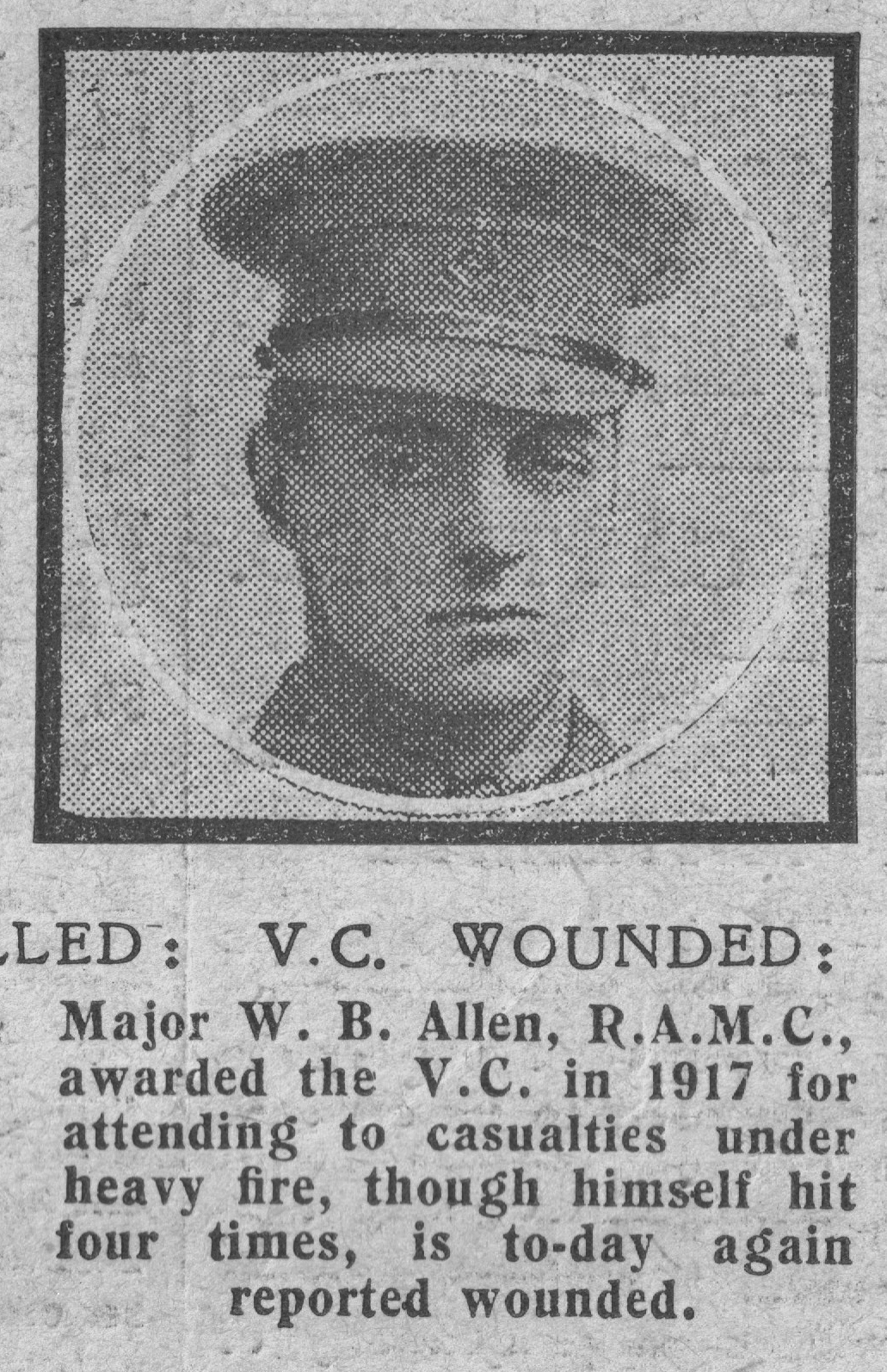
Allen W B Major VC Royal Army Medical Corps
V.C. WOUNDED:
Major W. B. Allen, R.A.М.С., awarded the V.C. in 1917 for attending to casualties under heavy fire, though himself hit four times, is to-day again reported wounded.
Source : The Graphic 1st Nov 1918
Major William Barnsley Allen, VC, DSO, MC & Bar, a First World War medical officer in the Royal Army Medical Corps (R.A.M.C.) who was wounded multiple times during his service.
Who He Was & Why He Won the V.C.
- Victoria Cross Action (September 3, 1916): Near Mesnil on the Somme, then-Captain Allen ran across open ground under heavy shellfire to treat men wounded when an ammunition limber exploded.
- Wounded Four Times: Despite being hit four times by shell fragments during the first hour—including one blow that fractured two ribs—he continued treating and evacuating the wounded before reporting his own injuries.
- Award & Later Service: His Victoria Cross was gazetted in 1917. He also earned a Military Cross with Bar and a Distinguished Service Order (DSO) for further acts of bravery and tending wounded under heavy fire and gas attacks, surviving the war after being wounded several times.
Post-War Military Career (1918–1923)
- Regular Commission & Overseas Postings: Having been wounded or gassed seven times during the war—including being blinded for six months and sustaining severe chest injuries—he transferred to a regular Royal Army Medical Corps commission in December 1918 and became an Acting Major in July 1919.
- India and Aden: He was posted to Rawalpindi, India, where he served on the staff of the Prince of Wales and the Duke of Connaught, before moving to Aden in January 1923.
- Medical Discharge: Already weakened by his wartime wounds, he contracted both malaria and dysentery overseas. He was invalided home and discharged from the army on 26 September 1923 with the rank of Major due to ill health.
- General Practice: Returning to civilian medicine, Allen entered general practice in Hounslow, Middlesex, before later relocating to the Sussex coast near Chichester. There, he practiced as a GP in East Wittering and also established the Bracklesham Bay Riding School.
- Chronic Pain & Illness: His wartime injuries caused persistent physical pain and severe insomnia. In 1924, he also contracted encephalitis lethargica (sleeping sickness) during the post-war epidemic, which further affected his health and personality.
His first marriage ended in divorce, and he remarried in 1925. To cope with his constant pain and sleeplessness, he became reliant on alcohol and heavy sedatives such as opium, morphia, and veronal. On 27 August 1933, at the age of 41, he died of an accidental overdose at his home in Bracklesham Bay, Sussex—a death ruled by a coroner’s inquest as misadventure. He is buried in Earnley Parish Churchyard.
Where His Medals Are Held
• Original Medal Group: His Victoria Cross—alongside his Distinguished Service Order (DSO), Military Cross & Bar (MC*), and First World War campaign medals—is part of the Museum of Military Medicine collection (formerly the Army Medical Services Museum in Mytchett, Surrey, relocating to Whittington Barracks, Lichfield).
• Replica Display in Sheffield: At Somme Barracks in Sheffield—home of the Sheffield University Officers’ Training Corps (UOTC), where Allen trained as a medical student—an ante-room named the Allen VC Room displays a framed photograph, his VC citation, and a copy of his Victoria Cross and other medals.
Memorials & Commemorations
• Sheffield City Centre: A commemorative paving stone and plaque in his honour were unveiled on 3 September 2016 (the centenary of his VC action) at the Sheffield War Memorial (Cenotaph) in Barkers’ Pool.
• Earnley Parish Churchyard, West Sussex: His grave and headstone are located at St. Mary’s Church, Clappers Lane, Earnley, near Bracklesham Bay, where he lived and practiced medicine before his death in 1933.
• Worksop College, Nottinghamshire: His former school commemorates him with an annual sixth-form prize awarded in his honour.
• National & Local Honours Plaques: He is also named on the Victoria Cross Honours Plaque at Hounslow Civic Centre in West London (where he worked as a GP after the war) and commemorated at the National Memorial Arboretum in Alrewas, Staffordshire.