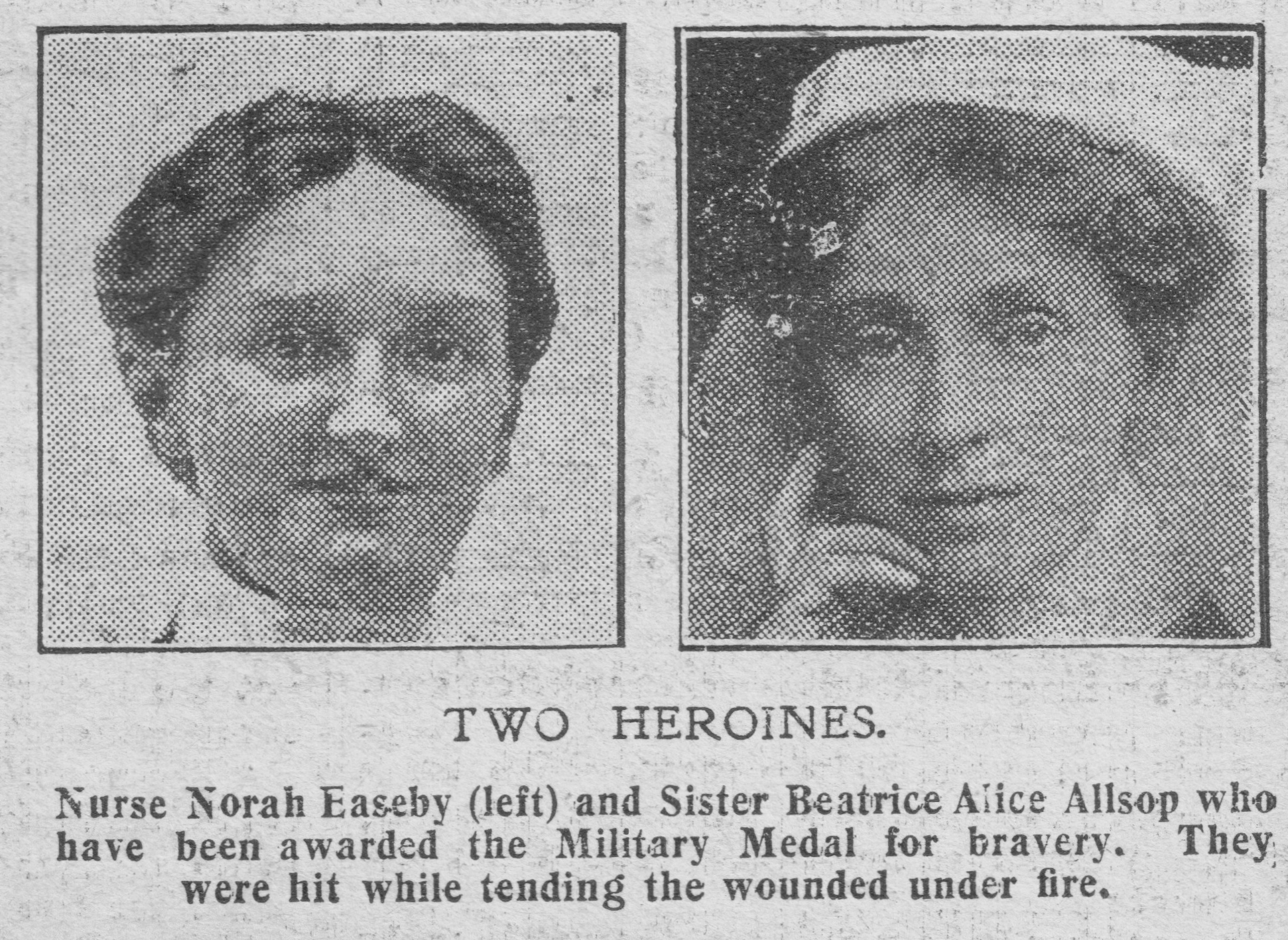
Allsop B A Sister MM And Easeby N Nurse MM
TWO HEROINES.
Nurse Norah Easeby (left) and Sister Beatrice Alice Allsop who have been awarded the Military Medal for bravery. They were hit while tending the wounded under fire.
Source : The Graphic 5th Sep 1916
Sister Norah Easeby (often spelled Nora Easby in early military records) served in Queen Alexandra’s Imperial Military Nursing Service Reserve (QAIMNSR) during the First World War, becoming one of the first women in British history to receive the Military Medal.
Early Mobilisation & Service
• Outbreak of War: Mobilised through the Civil Hospital Reserve, she embarked for France with the British Expeditionary Force (BEF) in August 1914, qualifying for the 1914 Star.
• Frontline Unit: By 1916, she was serving as a Nursing Sister at No. 33 Casualty Clearing Station (CCS) in Béthune, France, a frontline medical facility positioned close to the trenches
Action at Béthune & The Military Medal
• 7 August 1916 Bombardment: During heavy German shelling of Béthune, a shell exploded just outside the operating theatre of No. 33 CCS.
• Wounded on Duty: Easeby was struck by flying glass and splinters. Despite her injuries, she remained at her post alongside colleagues Beatrice Alice Allsop, Mabel Mary Tunley, Ethel Hutchinson, and Jean Strachan Whyte, helping evacuate 260 patients to safety in the cellars and continuing to tend the wounded throughout a three-hour bombardment.
• Historic Award: Following the King’s June 1916 amendment allowing women to receive the Military Medal, Easeby and her fellow nurses were among the very first group of female recipients gazetted on 1 September 1916 (London Gazette Issue 29731)
- Additional Decorations: Alongside her Military Medal (MM), Easeby’s sustained wartime service earned her the Royal Red Cross (RRC)—awarded specifically to military nurses for exceptional devotion and competency—as well as appointment as an Officer of the Order of the British Empire (OBE).
- Sidcup Roots: She was the daughter of Mrs. Easby of the Yorkshire Dairy on Longlands Parade in Sidcup, Kent.
- Hospital Training: She trained and worked at St Thomas’ Hospital in London—the same prestigious institution where her future Béthune colleague Beatrice Alice Allsop also trained
- Military Nursing Reserves: Before 1914, she enrolled in Princess Christian’s Army Nursing Service (Reserve) and was vetted for the Civil Hospital Reserve (CHR)—a scheme established by the War Office in 1909 to earmark top civilian hospital nurses for immediate mobilization.
- First Balkan War (1912–1913): In late 1912, Easeby was selected as one of just six fully trained nurses in the very first female nursing unit dispatched abroad by the British Red Cross Society. Stationed at a small base hospital in Antivari (Bar), Montenegro, under Surgeon General Bourke, she tended casualties of the Balkan conflict and was awarded two medals for her service before returning to Britain ahead of the Great War
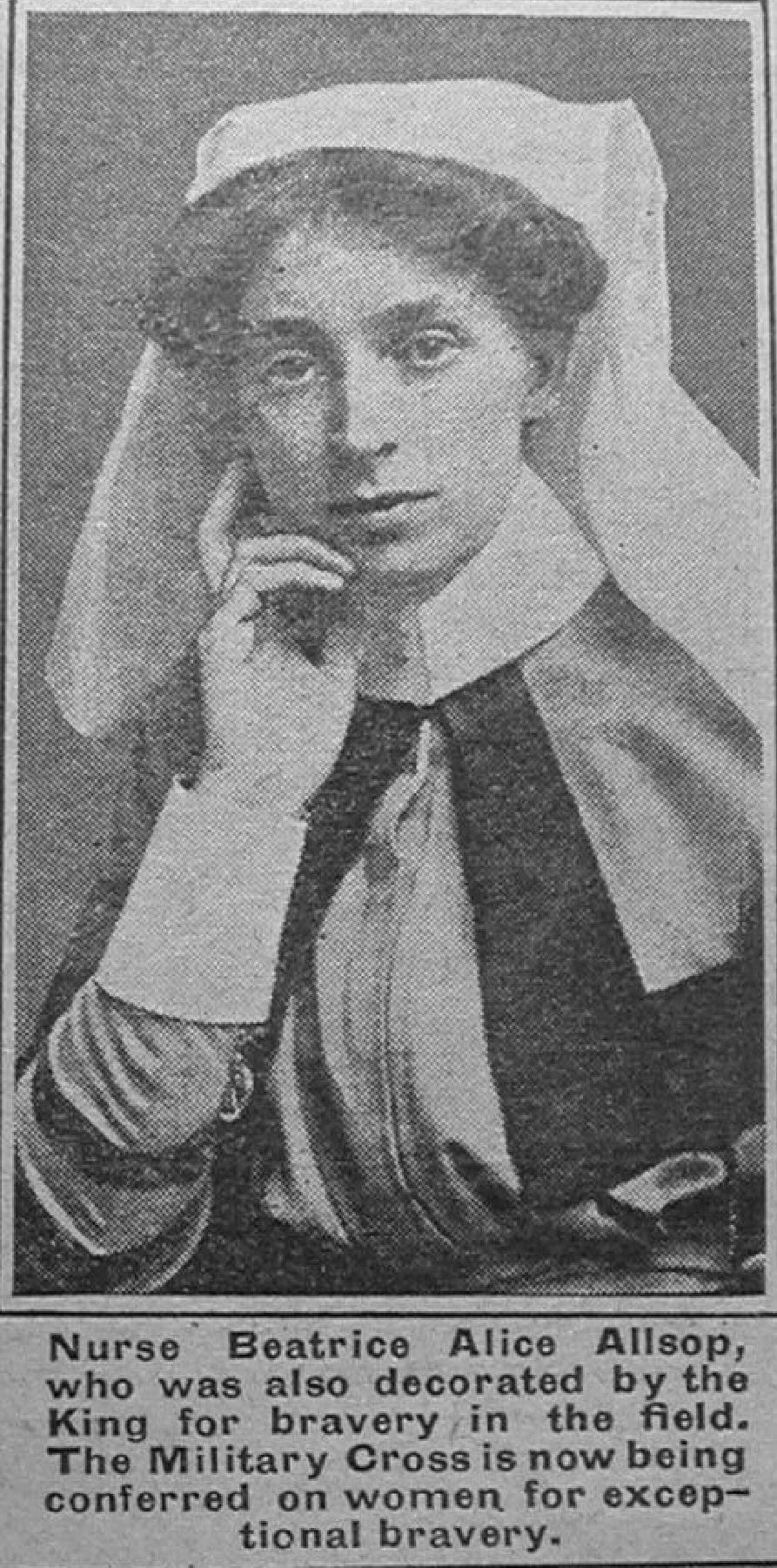
Allsop B A Sister MM
Nurse Beatrice Alice Allsop, who was also decorated by the King for bravery in the field. The Military Cross is now being conferred on women for exceptional bravery.
Source : The War Illustrated 23rd September 1916
Her Real Award (Military Medal): Sister Beatrice Alice Allsop of the Queen Alexandra’s Imperial Military Nursing Service Reserve was awarded the Military Medal (MM)—gazetted on 1 September 1916—for her bravery when No. 33 Casualty Clearing Station in Béthune was shelled on 7 August 1916. Despite being wounded in the operating theatre, she helped move patients to safety under heavy bombardment.
The newspaper article wrongly states Sister B A Allsop was awarded the Military Cross.
- Early Life. Born on 16 April 1882 in Wandsworth, Surrey (London), the only child of Henry Allsop, and educated at Clapham School.
- Nursing Training. Trained at the Nightingale Training School at St Thomas’s Hospital, London, from 1906 to 1910.
- Civilian Career. Worked as a Sister at the Seamen’s Hospital in Greenwich before returning to St Thomas’s Hospital as a Charge Nurse in November 1913
- Mobilisation (August 1914). Mobilised on 8 August 1914 (as part of the Civil Hospital Reserve joining the QAIMNSR) and embarked for France the following week with No. 7 General Hospital.
- Frontline Duties. Served as a Sister in charge of surgical wards and, for the final three years of the war, in charge of the operating theatre across Casualty Clearing Stations and Base Hospitals in France.
- Béthune Bombardment (7 August 1916). While stationed at No. 33 Casualty Clearing Station in Béthune, a German 15-inch shell struck the hospital and wrecked the operating theatre. Although slightly wounded by the blast, Allsop stayed at her post for five hours under continued shelling, helping move 260 patients to safety in the cellars and tending to the wounded.
- End of War (November 1918). By November 1918, she was serving as Night Superintendent at a General Hospital. A superior’s report dated 24 November 1918 noted she was “very conscientious & a good disciplinarian & gets on well with her fellow workers”
- Military Medal (MM). Gazetted on 1 September 1916 (London Gazette No. 29731, p. 8653), making her one of the first six women ever awarded the decoration.
- 1914 Star. Awarded for her service in France prior to 22 November 1914.
- British War Medal & Victory Medal. Standard campaign medals recorded on her Medal Index Card.
- Serbian Gold Medal. Awarded by the Allied Serbian government for her wartime medical service.
- Service Chevrons. Entitled to 9 blue overseas service chevrons
Post War Career
- Post-War Nursing Career. Having served throughout the war in France—including as Night Superintendent by November 1918—she left military reserve service after demobilisation and continued her career in hospital administration, rising to serve as matron of a hospital in Penzance, Cornwall.
- Personal Life. She never married, remaining known by her maiden name throughout her life, and was remembered by younger relatives as “Auntie Bea”.
- Death and Burial. She died on 12 March 1954 in the Penzance district at the age of 71. She is buried in the churchyard of St Piran & St Michael Church in the coastal village of Perranuthnoe, just east of Penzance, Cornwal
Imperial War Museum (London). As one of the first six women awarded the Military Medal, Allsop was included in the museum’s official Women’s War Work Collection, which preserves her wartime portrait alongside biographical notes on her bravery at Béthune.