Turner T E Lt 13th London Regiment

Turner T E Lt 13th London Regiment

LIEUTENANT T. E. TURNER

13TH (COUNTY OF LONDON) PRINCESS LOUISE’S KENSINGTON BATTALION, THE LONDON REGIMENT, T.F.

THOMAS EDWIN TURNER was the second son of Charles Walter and Ellen Clara Turner, of Selwyn Lodge, Solihull, and Surbiton.

He entered the School in 1903, and left in 1905. He then studied for the profession of Architect, winning both a Birmingham and a Royal Academy Studentship.

He obtained a Commission in October, 1914, was promoted Lieutenant in the following February, when he went out with a draft to join his Battalion.

He went through the Second Battle of Neuve Chapelle, but was killed while leading his men in the attack of the Ridge of Aubers, on May 9th, 1915. Age 25.

Source : Memorials Of Rugbeians Who Fell In The Great War Vol 1

Leigh-Pemberton T E G Lt 13th London Regiment

Leigh-Pemberton T E G Lt 13th London Regiment

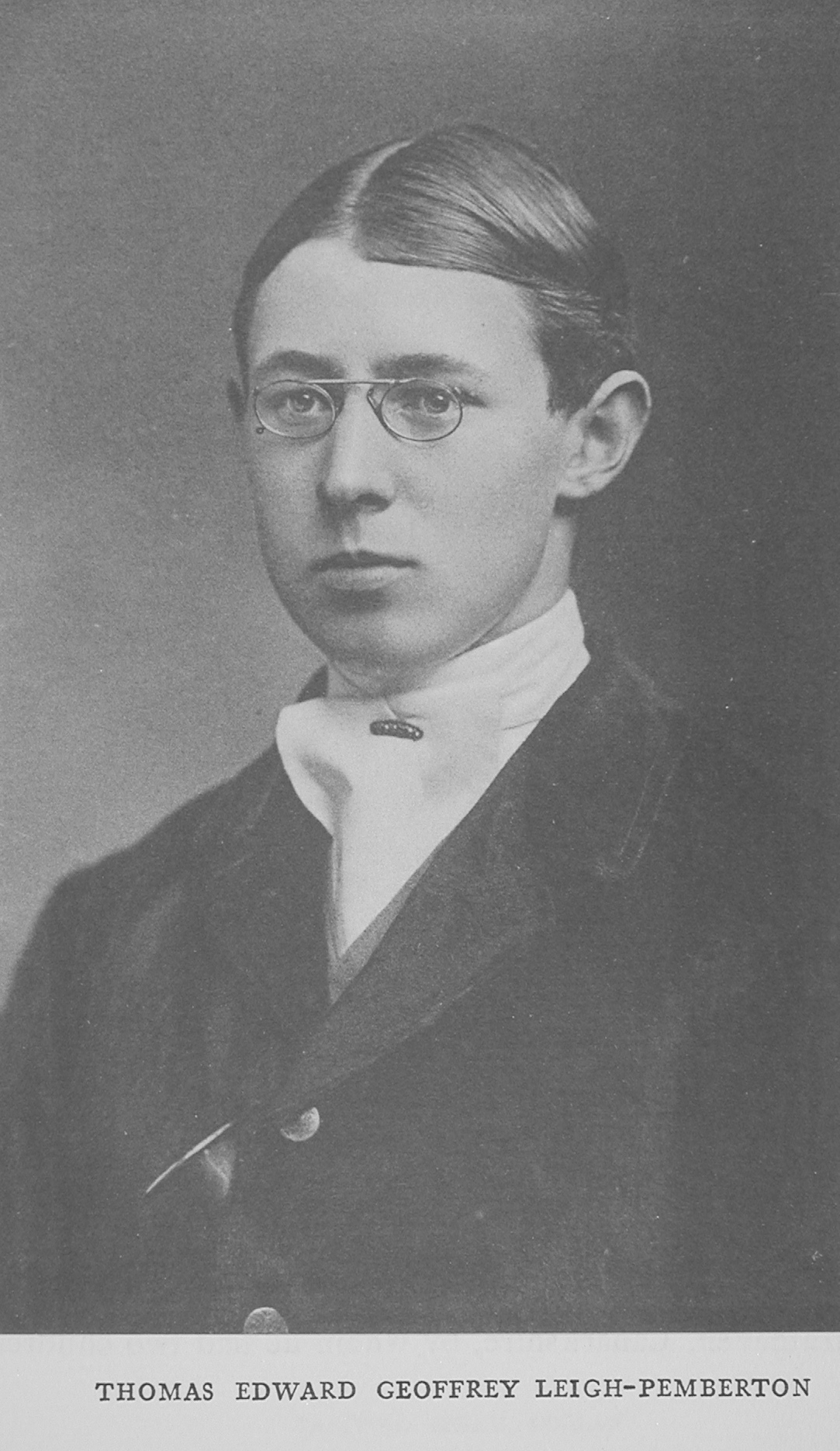
LIEUTENANT T. E. G. LEIGH-PEMBERTON

13TH (COUNTY OF LONDON) PRINCESS LOUISE’S KENSINGTON BATTALION, THE LONDON REGIMENT, T.F.

THOMAS EDWARD GEOFFREY LEIGH-PEMBERTON was the only son of Wilfred and Alice Augusta Leigh-Pemberton, of Wrinstead Court, Sittingbourne.

He entered the School in 1907. He left in 1911 and went to Christ Church, Oxford, for about a year and a half, and then entered the firm of Anthony Gibbs and Sons to learn business.

He received his Commission in May, 1914, was promoted Lieutenant on September 1st, 1914, and went to the Front in November. He was shot while doing duty in a very exposed part of the trenches near Laventie, N. France, on January 11th, 1915. Age 21.

The Officer Commanding the 25th Infantry Brigade, 8th Division, wrote:-

“It will be a comfort to you to know how highly he was esteemed as an Officer in this Brigade. He had done excellent work in stimulating the energy of his men; his loss is a genuine one to his Regiment and Country.”

Source : Memorials Of Rugbeians Who Fell In The Great War Vol 1

LEIGH-PEMBERTON, THOMAS EDWARD GEOFFREY, Lieut., 13th Battn. (Princess Louise’s Kensington) The London Regt. (T.F.), only s. of Wilfred Leigh-Pemberton, of Wrinsted Court, Sittingbourne, Barrister-at-Law, by his wife, Alice Augusta, dau. of the late Capt. David Rolland Erskine, 92nd Highlanders [2nd s. of Sir David Erskine, of Cambo, 1st Bart.], and grandson of Sir Edward Leigh-Pemberton, of Torry Hill and Wrinsted, co. Kent, K.C.B.; b. Wrinsted Court aforesaid, 15 Nov. 1893; educ. Rugby and Christ Church, Oxford, where he was in the O.T.C.; was, at the outbreak of war, learning business with the firm of Antony Gibbs & Sons; appointed 2nd Lieut. in the Kensingtons, 12 May, 1914, and promoted Lieut. 1 Sept. following; volunteered for foreign service on the outbreak of war in Aug.; went to France at the beginning of Nov., and was killed in action near Laventie, 11 Jan. 1915; unm. Buried at Estaires. His commanding officer, Lieut. Col. F. G. Lewis, wrote: “I feel I must write and tell you how all my officers will mourn his loss most deeply. His capacity and his popularity made everybody ike him; he was a real good fellow in everyway, and he has made a gap which we can never quite fill. I am sorrier than I can say”; and Major-Gen. Sir A. Turner:
“He was a most excellent and conscientious young officer, and a great loss to his battn., in which he was a great favourite.” Capt. Thompson also wrote: “He was a really good officer, always cheerful, and of the very greatest assistance to me in the trying work of the trenches. The battn. has lost a good officer and all the officers a valued friend”; and Sergt. Stiles: “Lieut. Leigh-Pemberton was very much liked and respected by every man he came in touch with. One of our bravest officers; he considered his men; in fact, he used to take four hours duty whilst his sergeant slept, and the sergeant used to take two hours’ duty whilst he (the Lieut.) slept. He would at any time carry the pack of any man who was knocked up. I’m sure any of our men would have followed him through fire and water. His death was a great shock to the whole battn.” He was fond of sports of all kinds and hunted a small pack of harriers of his own.

Source : De Ruvigny’s Roll Of Honour Vol 1

Thompson G Captain 13th London Regiment

Thompson G Captain 13th London Regiment

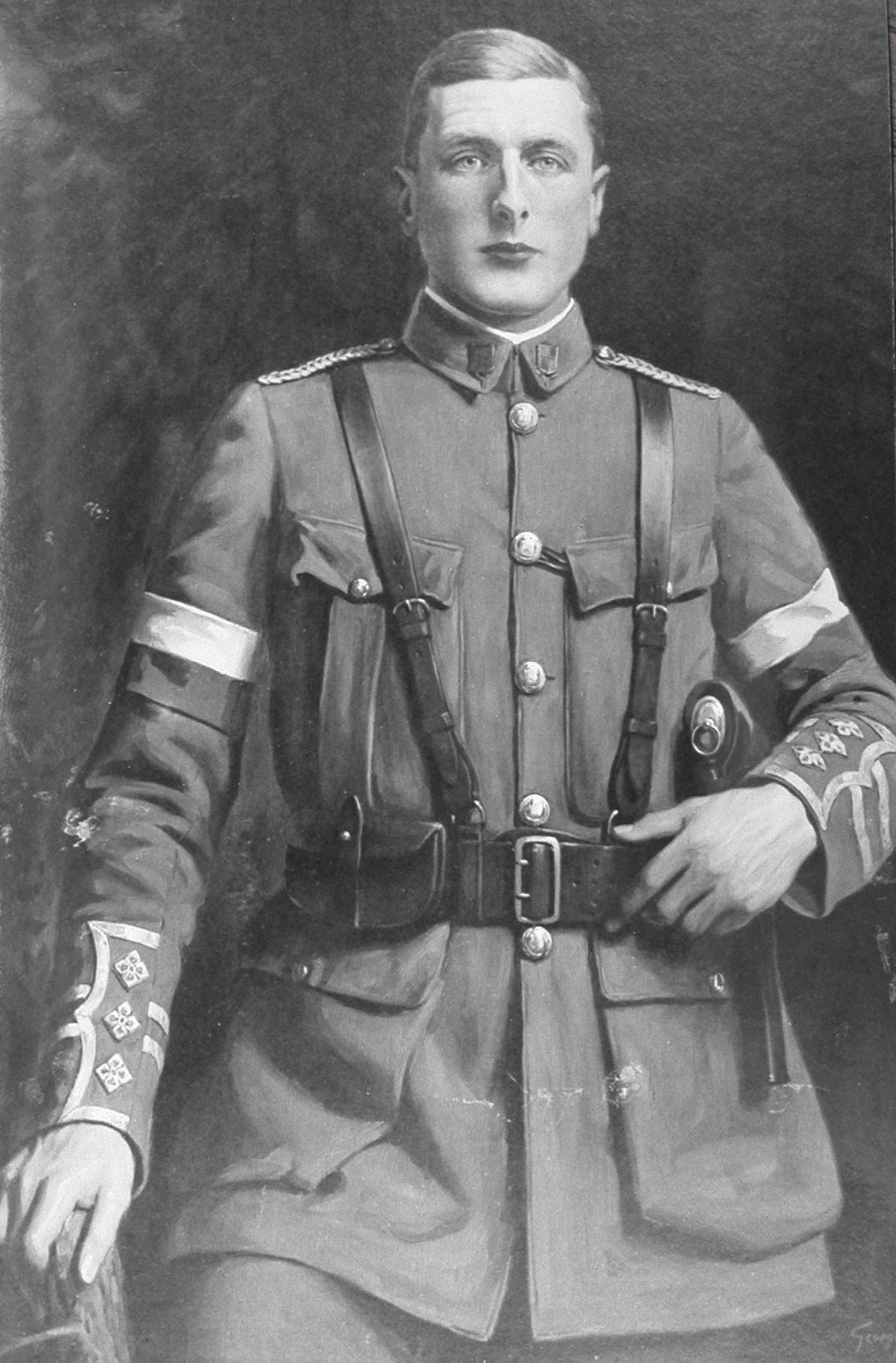
THOMPSON, GILBERT, Capt., 2nd Battn. Connaught Rangers, attd. as Adjutant 13th Battn. (Princess Louise’s Kensington) The London Regt. (T.F.), 2nd s. of Reginald Thompson, of Loftus Hill, Knaresborough, Col. 2nd Vol. Battn. West York Regt., by his wife, Frances Harriet, 4th dau. of the Rev. Charles Smith Royds, of Haughton, co. Stafford, and Heysham, co. Lancaster, J.P., and gdson. of Sir Matthews William Thompson, of Guiseley, 1st Bart.; b. Baildon Lodge, 22 June, 1877; educ. Yarlet near Stafford, afterwards privately; gazetted 2nd Lieut., 2nd Connaught Rangers, from the Militia, 20 May, 1899, and promoted Lieut. 24 July, 1900, and Capt. 29 Nov. 1905; served eight years with them in India; appointed Adjutant to the Kensingtons, 1 Jan. 1913; left for France with them 3 Nov. 1914, and was killed in action at Laventie, 24 Feb. 1915. Buried at Picantin. One of the men, writing home, said of him: “We have lost one of our best officers. Capt. Thompson, the Adjutant. He was showing the General round, and he was shot in the head. He was one of the best; he thought of the men first and himself last. Every man is sorry at his death. . . . The men have lost their best friend.”

Another man wrote: “Out in the trenches he was splendid. He would come along and ask how we were and always have something cheery to say. He got his feet frost-bitten and asked what he should do. “See the doctor, sir,” I said. “Not I,” he replied. “He’ll want a few toes off and put me on the sick list.” And he wouldn’t, with all my persuasion. When my feet got very bad, I rode back three miles on his horse and the next morning he came round to see me. He’s splendid.” He was buried in the little cemetery behind the firing-line. His last request was: “Bury me with the boys, not beside the officers,” and this wish was carried out. He was mentioned in F.M. Sir John (now Lord) French’s Despatch of 5 April and 31 May [London Gazette, 22 June], 1915. Capt. Thompson m. at Finghall, Yorkshire, 7 June, 1906, Ethel Isabella, 2nd dau. of Marmaduke D’Arcy Wyvill, of Constable Burton and Denton Park, Yorkshire, J.P., D.L., and had three children: Christopher Smith Byron, b. 19 April, 1907; Laura Barbara Frances, b. 10 Nov. 1908, and Naomi Isabella, b. 23 Oct. 1912.

Source : De Ruvigny’s Roll Of Honour Vol 1


Herbert R B Captain 13th London Regiment Attd Royal Engineers

Herbert R B Captain 13th London Regiment Attd Royal Engineers

Source : Croydon Roll Of Honour 1914-1918

Herbert R B Captain 13th London Regiment Attd Royal Engineers

Source : The Sphere 6th Nov 1915

CAPTAIN ROBERT BINGLEY HERBERT, London Regiment, was the fourth son of Edward Herbert, a member of the Stock Exchange.

Born at Croydon in 1882, he was educated at Bradfield College. He became a member of the Stock Exchange in 1907, and joined the firm founded by his grandfather, G. S. Herbert and Sons.

For some years before the war he had held a commission in the 13th London Regiment (Kensingtons). He had specialized in signalling, and soon after the outbreak of war was seconded to the Royal Engineers, and placed in command of a section of the 47th Divisional Signal Company.

He was killed at the battle of Loos on 30 September 1915. His Divisional General wrote: “He has proved himself through out regardless of danger and only anxious to perform his duties to the utmost of his power. He was certain, had he lived, of advancement and distinction.”

His Brigadier wrote: “He gained the devotion of his men as well as the love and admiration of his colleagues. We shall always think of him as a fine type of British officer.”

The men of his section have placed an In Memoriam notice in the “Times” every year on the anniversary of his death in these terms: “In loyal and loving memory of our gallant officer, Captain R. B. Herbert. His Boys.’

Captain Herbert married in 1913 Margery, daughter of Richard Joseph Grant of Croydon, and left two children, a girl and a boy.

Source : The Stock Exchange War Memorial 1914-1918

Harper E Pte 492503 28th Attd 13th London Regiment

Harper E Pte 492503 28th Attd 13th London Regiment

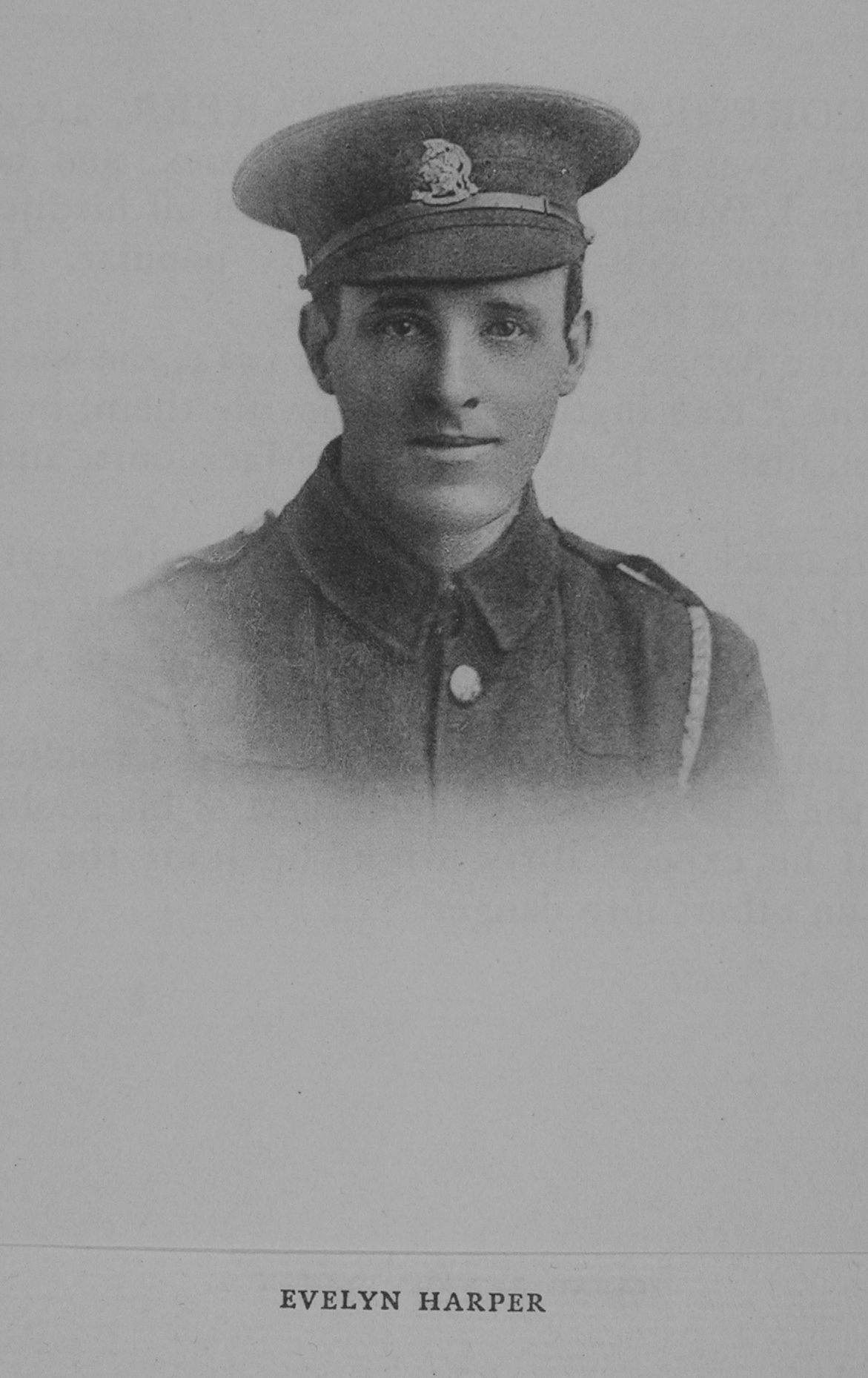
LANCE CORPORAL EVELYN HARPER 2/13th London Regiment, was born at Woodford, Essex, and educated at Bancroft’s School, Woodford Wells. He lived all his life in Woodford, where he was well-known and very popular. In 1904 he became a member of the Stock Exchange.

He joined the Artists’ Rifles in August 1914, and was afterwards attached to the “Kensingtons,” going with them, in the famous 60th Division, first to France, then to Macedonia, and finally to Palestine.

In a dawn attack on the Turks on 7 December 1917, he was wounded and lay for half a day on the ground half frozen before he was picked up and taken by slow stages back to Cairo. Here he died on 28 December.

Writing just before his last action an old schoolfellow of his said: “All the boys speak well of Harper, of his coolness and unselfishness; if he expects dirty work, he leads the way himself rather than run others into danger.”

Source : The Stock Exchange War Memorial 1914-1918

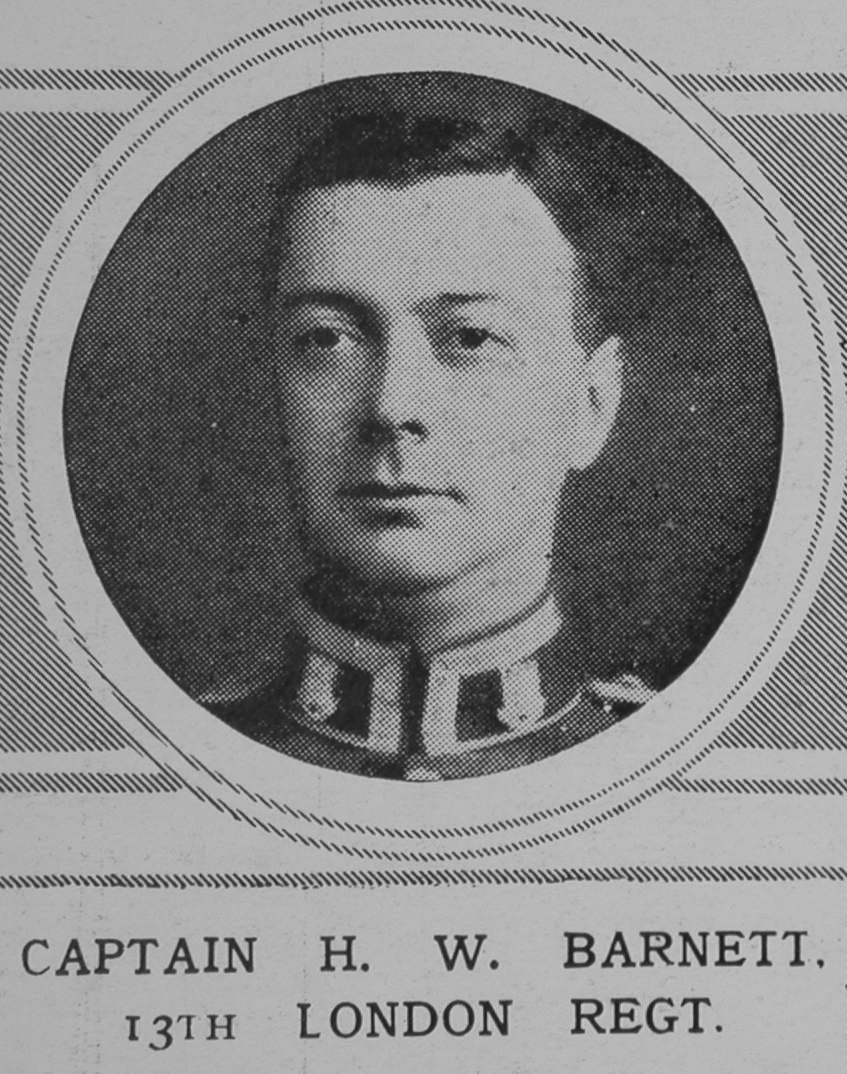
Barnett H W Captain 13th London Regiment

Barnett H W Captain 13th London Regiment

Barnett H W Captain 13th London Regiment

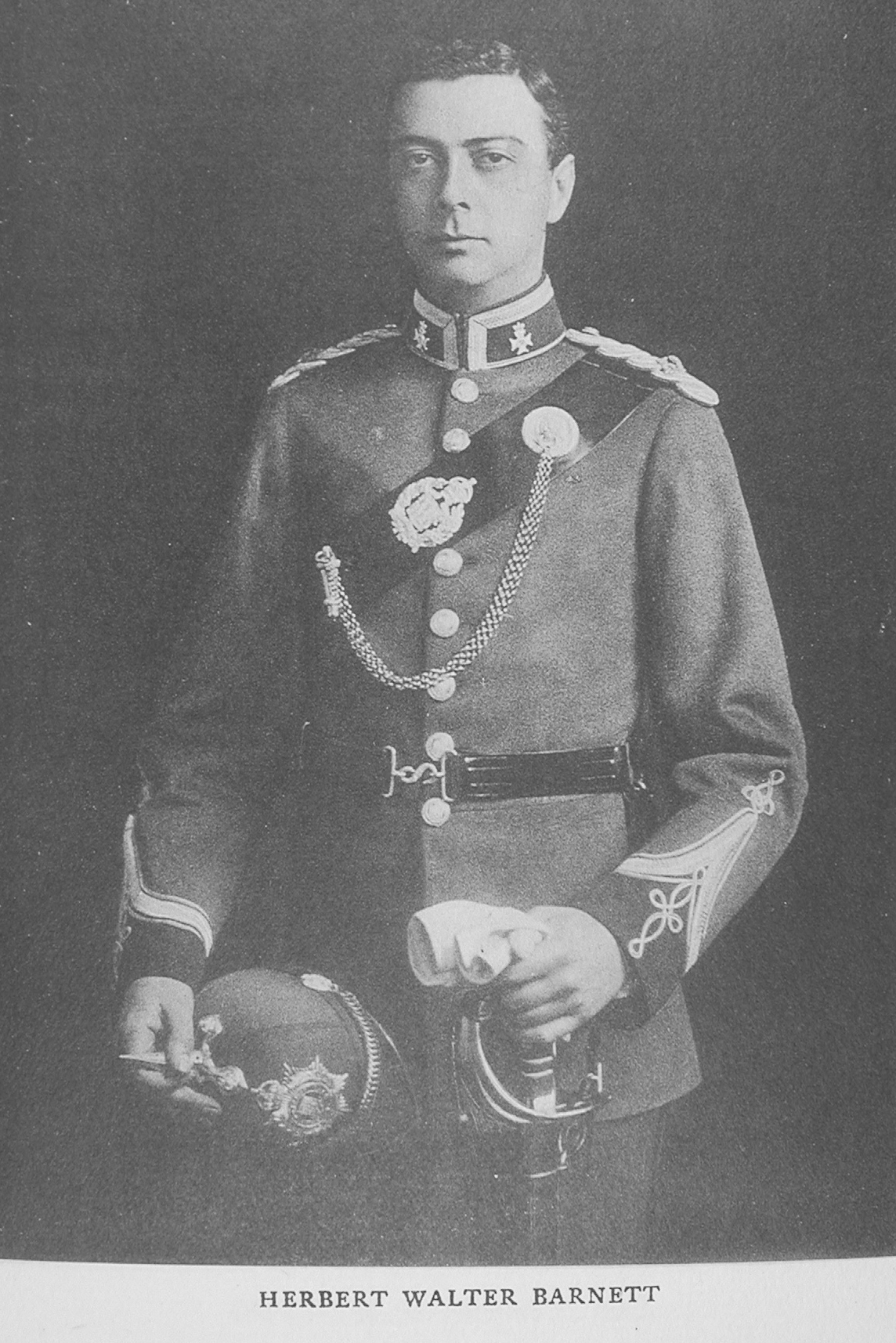
CAPTAIN HERBERT WALTER BARNETT, 13th Battalion, London Regiment, was the son of Maurice H. Barnett, and was born in 1879. Educated at University College School, he joined the Stock Exchange at the age of twenty, and five years later became a member. For some years he was a junior partner in the firm of Bensinger and Co.

He was given a commission in 1907 in the 4th Middlesex Volunteer Rifle Corps, which, on the formation of the Territorial Force, was converted into the 13th (Kensington) Battalion, London Regiment. He was promoted Captain in 1912. From the time of joining the Regiment he devoted himself with the greatest keenness to the promotion of its well-being and efficiency and in so doing became a most efficient and popular officer.

His Battalion went to France in November 1914 and he took part in its activities through those critical months in which little was left of the Old Army, and the New Armies were not yet in being. He was killed at the head of his men in the attack on Aubers Ridge of 9 May 1915, an historic engagement in which his battalion played a notable part.

“He died,” wrote his Major, “leading his men in the true British way, and under the most exacting conditions that any troops could be called on to face.” And his Colonel wrote: “His memory will remain with us as a keen and capable English gentleman, always ready to do his share.”

The work of the Kensingtons on that day was described by General Sir Henry Rawlinson, then commanding the 4th Army Corps, as “a feat of arms surpassed by no battalion in this great war.”

Source : The Stock Exchange War Memorial 1914-1918

Barnett H W Captain 13th London Regiment

Source : The Illustrated London News 29th May 1915

Stern L H 2nd Lt 13th London Regiment

Stern L H 2nd Lt 13th London Regiment

SEC.-LIEUT. LEONARD H. STERN, OF THE 13th LONDON REGIMENT.

A brilliant student, as well as a fine and promising Officer, was lost to the country by the death in action at the Battle of Fromelles, Flanders, of Second-Lieutenant Leonard H. Stern.

Born at Synagogue House, Stepney, September 12th, 1891, Second-Lieutenant Stern was the elder son of the Rev. J. F. Stern, the minister of the East London Synagogue, Stepney, and Mrs. Stern.

He was educated at the Preparatory School, Holly Hill, Hampstead, and University College School. Proceeding to Cambridge in 1910 as an Exhibitioner in Classics of Magdalene College, he was elected a Scholar of his College, in the following year. He also held the Cambridge Jewish Exhibition. In June, 1913, he graduated B.A.,taking a First Class in the Classical Tripos in that year, and in the following year a Second Class in the History Tripos.

An athlete as well as a scholar, he obtained his College Football Colours in 1912, and in the same year played for his College against Magdalene College, Oxford. He was a member of his school Cadet Corps, and subsequently joined the Cambridge O. T. C. He was also a member of the Cambridge Union Society.

During the whole time that he was at the University, Second-Lieutenant Stern took an active part in the affairs of the Cambridge Hebrew Congregation, and held in succession the several Synagogue offices. He was an occasional speaker at the Union, and read several papers at College Societies.

A young man always keenly interested in the welfare of others, he devoted a considerable part of his vacations to social work in East London, and was a manager of the Stepney Jewish Lads’ Club and the Oxford and St. George’s Jewish Lads’ Club. He also took a great interest in the Boy Scouts’ movement, and became a Scout Master of the seventh Stepney Troop, B. P. Scouts.

When war broke out he co-operated with other Toynbee Hall workers in the organisation of the East London Scouts for public service in the Metropolis. He enlisted as a private in the 13th County of London (Kensington) Regiment, and, a thorough soldier from the first, was not long before he was promoted to the rank of Sergeant.

In February, 1915, he obtained his Commission, and went to the front in the following month. On Sunday, May 9th, this young soldier, who, had his life been spared, would assuredly have accomplished much noble and useful work, met his heroic death. The Battle of Fromelles, which is the subject of a graphic letter contributed to the “Times” of June 19th, 1915, by an Officer who took part in the engagement, and which appears under the headlines “Kensingtons in Action,” “Imperishable Glory,” and “A famous Sunday described,” will live for ever in history, and though the bitterest sorrow must have been experienced by those who mourn the loss of the gallant men who fell that day, they must also have felt intense pride at the thought of the manner in which they fell.

A Service in memory of Lieutenant Stern was held on May 30th at the East London Synagogue, of which his father has been minister for more than a quarter of a century, when an eloquent tribute to the life and character of his “Son of the Sanctuary” was paid by the Rev. S. Levy, M.A., Minister of the New Synagogue, Stamford Hill, who had known him from his childhood.

How greatly Lieutenant Stern’s courage was admired, and how much he was loved by Officers and men of his Regiment alike, is shown by the following extracts from letters received after his death by his parents.

Col. Fred W. Lewis wrote:-

“You can indeed take consolation in the way your son met his death- he fell gallantly. He had a dangerous job, but he went through with it, setting a fine example to his men. I grieve to think it cost him his life. We have lost a promising Officer.”

Major H. G. Stafford wrote:-

“It may be some small consolation to you to know that he met his death leading his men in the true British way. Although he had only been with us a short time he had already won the esteem of his brother-officers, and gave great promise as an Officer. He was put in charge of the bombers and he showed zeal and initiative in his work. Col. Lewis… desires me to express his great regret at the loss of so promising an Officer.”

And from Captain Kimber, D.S.O., the following frank and sincere tribute was received:

“What splendid work he did with Knight. He was probably coming to tell me what had happened, but as he was hit just before he reached me, of course he had no opportunity…. He was a brave and splendid lad.”

Private Robert Knight, in a letter to his own parents, thus describes the last heroic deed by which Lieutenant Stern met his death:

“The scrap started at 5 a.m. on Sunday and I was a bomber. There was a forty minutes bombardment of their trenches, and then the mine which had been dug under their trench was let off. That was the signal for us to be up and doing. Over the parapet we went, right through their first line and then their second. Alas! they got their machine guns working and then the poor Kensingtons went down like chaff. We got to the third line of German trenches and our job was to bomb them out by walking along the trench. I was carrying the bombs and one bullet amongst them would have meant picking up the pieces. They were in a bag on my back. We got into a trench and could see the heads of five Germans coming along towards us. Mr. Stern (he is the Officer) handed me a bomb and then lit it. I threw it and it went up with four and a half Germans with it, but the other half accounted for me.. As we passed, Mr. Stern yelled, ‘look out,’ and shot off his revolver. This German had got up on his elbow and fired at my back. Mr. Stern’s shot was a fraction of a second earlier and so spoilt his aim. The bullet slid between the bag of bombs from the middle of my back along my ribs, out at my shoulder blade, and then through my left arm. It felt as though someone had hit me with a big stick. Mr. Stern took the bombs and went on alone. Poor fellow, he was seriously wounded further on and was unable to move. We took and held the third line, but supports could not get up in time. Of all the Kensingtons there are but forty-seven left unharmed. Poor 16th Platoon led the charge and were all wiped out. It was terrible. It took me seven hours to crawl out The swines of German snipers were potting at any wounded they saw move.”

The following very short extract, taken from a letter written by Private J. R. Lansberg, sums up, in a few words, the true character of this gallant

English-Jew, who so willingly gave his life for his Country :-

“He was wounded several times and died a hero’s death, thinking of others all the time.”

Source : The British Roll Of Honour Vol 1


Stern L H 2nd Lt 13th London Regiment

STERN, LEONARD HERMAN, 2nd Lieut. 13th Battn. (Princess Louise’s Kensington Battn.) The London Regt. (T.F.), elder s. of the Rev. Joseph Frederick Stern, Minister of the East London Synagogue, Stepney, since 1887; b. Synagogue House, Stepney, 12 Sept. 1891; educ. at The Preparatory School, Holly Hill, Hampstead, and University College School. Proceeding to Cambridge in 1910 as an Exhibitioner in Classics of Magdalene College, he was elected a Scholar of his College in the following year. He also held the Cambridge Jewish Exhibition. He graduated B.A. in 1913, taking a First-Class in the Honours Classical Tripos in that year. In the following year he gained Second-Class Honours in the History Tripos. He obtained his college football colours in 1912, in which year he played in the College team against Magdalen College, Oxford. He was a member of his school Cadet Corps, and subsequently joined the Cambridge O.T.C., in which he obtained the rank of Sergt. Throughout his stay at the University he took an active part in the affairs of the Cambridge Hebrew Congregation, holding in succession the several Synagogue offices. He was an occasional speaker at the Union Society, and read several papers at college societies. He devoted a considerable part of his vacations to social work in East London, being a manager of the Stepney Jewish Lads’ Club and the Oxford and St. George’s Lads’ Club. He also took a keen interest in the Boy Scouts movement, and became a scoutmaster of the 7th Stepney Troop B.P. Scouts.

On the outbreak of war he cooperated with other Toynbee Hall workers in the organisation of the East London Scouts for public service in the Metropolis. He enlisted in the ranks of the Kensington Battn. of The London Regt. with a number of the lads of his troop, and shortly after was made a sergt. of his company. He obtained his commission as 2nd Lieut. in the same regt. 6 Feb. 1915, and left for France on 7 March, was wounded several times, and was killed in action at the Battle of Fromelles, 9 May, 1915; unm. Col. Fred E. Lewis wrote: “He fell gallantly. He had a dangerous job, but he went through with it, setting a fine example to his men. I grieve to think it cost him his life. We have lost a promising officer.” And Major N. E. Stafford, in notifying his death to the Depot Officer of the regt., said: “He met his death leading his men in the true British way. Although he had only been with us a short time, he had already won the esteem of his brother officers, and gave great promise as an officer. He was put in charge of the bombers, and he showed zeal and initiative in his work. Col. Lewis, who has gone to hospital very ill, desires me to express his great regret at the loss of so promising an officer.”

Source : De Ruvigny’s Roll Of Honour Vol 1