Fargus F B A Lt 9th London Regiment

Fargus F B A Lt 9th London Regiment

LIEUTENANT F. B. A. FARGUS

9ти (COUNTY OF LONDON) BATTALION, THE LONDON REGIMENT (QUEEN VICTORIA’S RIFLES), T.F.

FREDERICK BRIAN ARTHUR FARGUS was the younger son of Henry Robert Fargus, to Lancaster Place, Strand, and of Milton House, Strawberry Hill, Middlesex.

He entered the School in 1901, and left in 1904.

Having been articled to his father he was admitted to the Roll of Solicitors in 1911. He was gazetted Second Lieutenant in the 9th Battalion of the London Regiment in 1911, and Lieutenant in 1912. He proceeded with his Battalion to the Front on November 4th, 1914, as Senior Subaltern in command of the Machine Gun Section.

He was shot in the forehead by a German sniper on January 1st, 1915, at La Petite Douve, Wolverghem, Flanders. Age 27.

The Officer Commanding his Battalion wrote:-

“One and all of us will miss his cheerful, bright presence, and his devotion to his duties has been a bright example to us all, and as for his gun team, they absolutely loved him, in fact worshipped him. He was so devoid of fear that he was invaluable in patrolling and reconnoitring.”

A Non-Commissioned Officer of his section wrote:-

“He was absolutely a man after our own hearts, and we are proud to know that he died in wandering about among his Infantry, putting courage into them under shell fire.”

And another soldier said:-

“Not only have we lost a man who was an ideal Officer and a good soldier, but we have lost a personal friend, for he was never so happy as when he was with the section or doing something for us.”

Source : Memorials Of Rugbeians Who Fell In The Great War Vol 1

Stubbs B C Pte 2655 9th London Regiment

Stubbs B C Pte 2655 9th London Regiment

STUBBS, BERNARD CASTLE, Private, No. 2655, 9th Battn. (Queen Victoria Rifles) The London Regt. (T.F.), 3rd s. of the late Charles Stubbs, of 20, Grafton Road, Worthing, by his wife, Kate Marian (141, Gladstone Road, Watford, Herts.), dau. of Thomas Henry Castle; b. Worthing, 6 March, 1891; educ. Slough School (1899- 1907), and on leaving there entered the London offices of the Union Castle Line; volunteered on the outbreak of war and joined the Queen Victoria Rifles, Sept. 1914; went to France with a draft for the 1st Battn. in Feb., and was sent direct to the firing line; took part in the fight on Hill 60, during the night of 20-21 April, under Lieut. G. H. Woolley, who then gained the first Victoria Cross conferred on a Territorial officer; was wounded in the head by a piece of shell, 22 June, 1915, and died in the Receiving Hospital, Bailleul, without recovering consciousness; unm. At Slough he was head boy of the school during his last few terms, the holder of a cup for the school championship at “fives,” and the winner of the swimming medal of the school. He later captained the Old Boys’ Football Team.

Source : De Ruvigny’s Roll Of Honour Vol 1

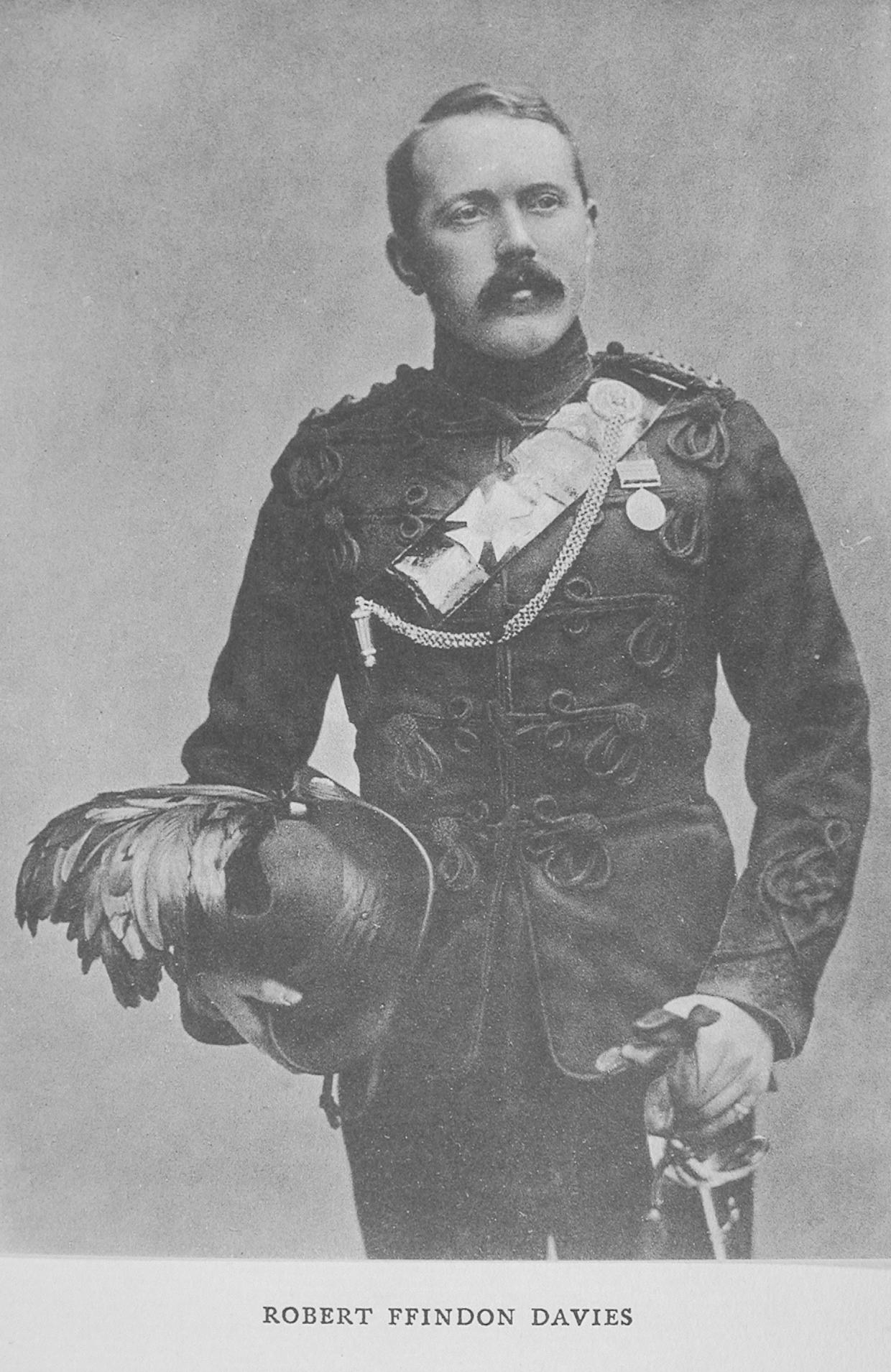
Davies R F Captain 9th London Regiment

Davies R F Captain 9th London Regiment

MAJOR ROBERT FFINDON DAVIES London Regiment was the son of Frederick Herbert Davies, a member of the Stock Exchange. He was born in 1877 and educated at Marlborough College. On leaving school he joined that famous shooting corps, the 1st Middlesex V.R.C. and fought in the South African War, where his company was attached to a battalion of the King’s Royal Rifle Corps. He was awarded the South African medal with four clasps.

He became a member of the Stock Exchange in 1898. Though he had already given great proof of his skill as a rifle shot, his victory in the King’s Prize at Bisley in 1906 was a surprise to everyone except his friends. From that time onward he was recognized as one of the finest and most enthusiastic marksmen in the country. He did much to keep alive interest in rifle shooting before the opening of Lord Roberts’ campaign, and he helped greatly to make the Bisley meeting an enjoyable social event.

He reached the final stages of the King’s Prize on four occasions, shot for England in 1910 and 1911 at Bisley and represented his country at the Olympic games at Stockholm in 1912.

Major Davies had retired with an Honorary Captaincy in the regular army in 1908, but he rejoined at the outbreak of war, served for two years in England and went to the Front in 1916. He was killed at the head of his men on 9 September of that year.

Source : The Stock Exchange War Memorial 1914-1918

Cornfoot D H H Captain 9th London Regiment

Cornfoot D H H Captain 9th London Regiment

CAPTAIN DAVID HENRY HARMAN CORNFOOT, 9th Battalion London Regiment (Queen Victoria’s Rifles), was the eldest son of the late David Cornfoot of Tonbridge, and was born in 1870. Educated at Tonbridge, he left school at the age 17 and became a member of the Stock Exchange in 1895.

Always keen on soldiering, he joined the Artists Rifles as a private and rose to the rank of Sergeant. Later he took a commission in the Bloomsbury Rifles which, under the Territorial Scheme, became merged in the Queen Victoria’s Rifles. He attained the rank of Captain in this battalion, and subsequently resigned his commission; but on the outbreak of war rejoined his old regiment, being gazetted Lieutenant in September and promoted Captain in November 1914, in the second line battalion.

For many months he was engaged in training drafts at home for the 1st Battalion, but, despite his age, he urgently requested to go to the Front. In July 1915 he went to France and joined the 4th Entrenching Battalion of which, in February 1916, he took command.

Under the severe conditions of the winter of 1915-16 his health broke down, and eventually he contracted pleurisy and was invalided home in April. He died at Netley Red Cross Hospital on 2 May 1916.

A brother officer wrote of him thus: “In France one finds out a man’s worth very quickly, and I can’t say how much I admired him and the splendid way he stuck to his work. He was a sportsman in every way, and I feel I have lost a lifelong pal, though I only served with him for three months.”

He married in 1900 Olive, the second daughter of the late Arthur Houston, K.C.

Source : The Stock Exchange War Memorial 1914-1918

CAPT. DAVID HENRY HARMAN CORNFOOT,

9TH (COUNTY OF LONDON) BATTN. LONDON REGT. (QUEEN VICTORIA’S RIFLES) (T.F.).

DIED AT NETLEY RED CROSS HOSPITAL, MAY 2ND, 1916, OF ILLNESS CONTRACTED ON ACTIVE SERVICE IN FRANCE. AGED 46.

At the School 1883-86 (Day Boy).

Capt. D. H. H. Cornfoot was the eldest son of the late David Cornfoot, of 20, Lancaster Gate, W., formerly of the Manor House, Tonbridge. He married in 1900 Olive, the second daughter of the late Arthur Houston, K.C., of 22, Lancaster Gate, W. Leaving School young, at the age of 17, he commenced work in the City with a firm of stockbrokers, and later became a member of the Stock Exchange. Always keen on soldiering, he joined the 20th Middlesex (Artists) Rifles, now the 28th (County of London) Battn. London Regt. (Artists Rifles) (T.F.), as a private, and served for many years in this Corps, rising to the rank of Sergeant. Later on he took a commission in the 19th Middlesex (Bloomsbury) Rifles, which in 1908, under the Territorial scheme, were merged with the 1st Middlesex (St. George’s) Rifles and be- came the 9th (County of London) Battn., the London Regt. (Queen Victoria’s Rifles) (T.F.), and rose to the rank of Captain. He subsequently resigned his commission, but on the outbreak of war he rejoined, was gazetted September 6th, 1914, Temporary Lieutenant in the 2/9th London Regt., and was promoted Temporary Captain November 21st, 1914. For many months he did splendid work in training drafts for the 1st Battn., but urgently petitioned to be allowed to go to the Front, in spite of his age. In July, 1915, he went to France and joined the 4th Entrenching Battn., of which as Senior Captain he took command in February, 1916. Hard work, and the severe conditions under which it was performed during the winter of 1915-16, told upon his health, and eventually resulted in acute pleurisy, which necessitated his being invalided home on April 10th, and he died at Netley Red Cross Hospital, Southampton, on May 2nd, 1916.

He was a capable officer and popular alike with his brother officers and with the men. A brother officer, writing to Capt. Cornfoot’s widow, says :-

“In France one finds out a man’s worth very quickly, and I can’t say how much I admired your husband and the splendid way he stuck to his work. He was a sportsman in every way, and I feel I have lost a life- long pal, though I only served with him for three months.”

Source : Tonbridge School And The Great War Of 1914-1919