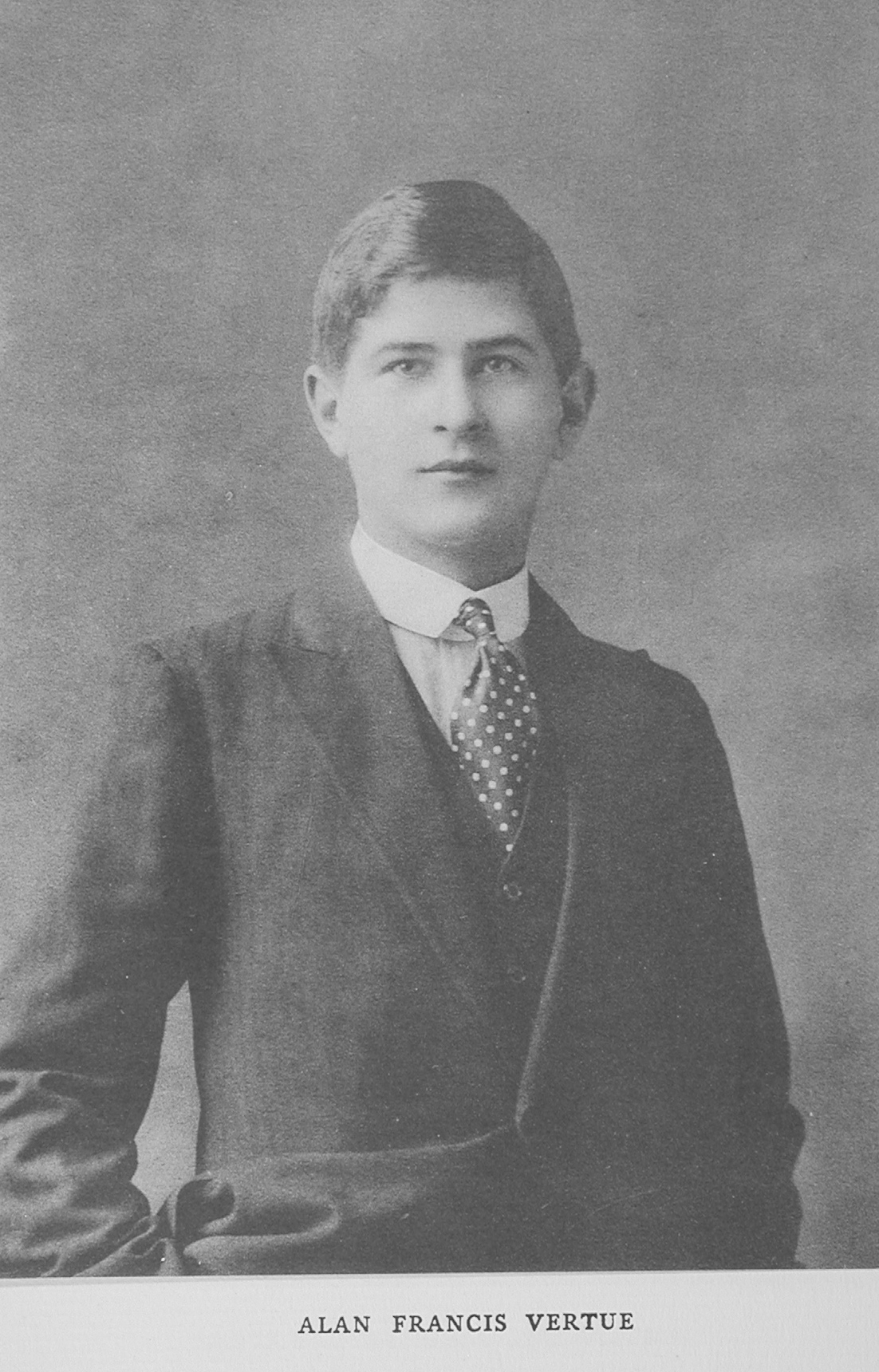
Vertue A F Cpl 797 1st Honourable Artillery Company

Vertue A F Cpl 1st Honourable Artillery Company

CORPORAL A. F. VERTUE

IST BATTALION HONOURABLE ARTILLERY COMPANY

ALAN FRANCIS VERTUE was the younger son of Alfred and Mina Grace Vertue, of Richmond, Surrey.

He entered the School in 1908. On leaving in 1913 he joined a firm of Stockbrokers and became a member of the H.A.C. He was sent to the Front with the 1st Battalion in September, 1914, and quickly gained his two stripes. He was wounded in the head at St. Eloi, on April 21st, never recovered consciousness, and died twenty-four hours later in hospital at La Clytte, and was buried there in a little cemetery set apart for British soldiers. Age 21.

The Officer Commanding wrote:-

“It will perhaps be some consolation to you to know that from the moment he first came under fire until the end, he never showed any sign of fear. He was always cheerful in the trenches and ready to do anything he might be asked. He was loved and respected by all who knew him, and his example to the men of his section was magnificent.”

The Platoon Commander wrote:-

“As an illustration of the devotion of his comrades practically everyone in the platoon volunteered to help to carry him down to the dressing station in daylight, in spite of the danger of the undertaking.”

Source : Memorials Of Rugbeians Who Fell In The Great War Vol 1

Powell K Pte 1832 1st Honourable Artillery Company

Powell K Pte 1st Honourable Artillery Company

PRIVATE KENNETH POWELL

1ST INFANTRY BATTALION, 4TH COMPANY, HONOURABLE ARTILLERY COMPANY

KENNETH POWELL Was the second son of James and Mary Powell, of Reigate, Surrey.

He entered the School in 1899, was in the XV in 1902, 1903, and was Captain in the Spring Term of 1904. He represented the School in Racquets in 1903, 1904, and held the first Athletic Cup in both these years.

From Rugby he went, in 1904, to King’s College, Cambridge, and took a Second Class in the History Tripos. He represented his University in the Hurdles against Oxford for four years (1905-08), in the last year making the inter-University record. In the year 1907 he was elected President of the Cambridge University Athletic Club. He represented Great Britain twice in the Hurdles, once in the Olympic Games in London, 1908, and again at Stockholm in 1912, where he reached the Final out of 60 Competitors, and was only beaten by two feet. He also reecived his blue at Cambridge for Lawn Tennis for three years, and was in the first flight of players in the All England Lawn Tennis Championships at Wimbledon.

When the War broke out he was among the first of the prominent athletes to respond to the national call. He left Southampton with the H.A.C. 1st Battalion in September, 1914, and was soon at the Front, where he endured the rigours of the cold, wet weather in the advanced trenches until his death in February. He was hit by a chance bullet at 10 p.m. on the 17th when returning from fatigue work in the advanced trenches. He was brought after some inevitable delay to No. 7 Field Ambulance, near Locre, Flanders, and an operation was performed about 8.45 a.m., but he sank and died about 9.35 on February 18th, 1915. He was buried in the little churchyard at Locre. Age 29.

In a notice of him which appeared in the “Meteor,” of March 19th, 1915 (No. 583), it is said that

“No man ever changed so little in the fifteen years from his arrival at a Public School. From first to last he was the same entirely simple, straight and unassuming fellow, whom all respected, most liked, and many loved. To anyone who knew him, the idea of Kenneth Powell showing arrogance or swagger is simply an absurdity. Yet no one could follow more unswervingly his own straight path, all unconscious of what others might think, and quite unsuspecting the influence he exercised. It is not very uncommon to see a nature that instinctively attracts to itself others of a like fashion. But he had the rarer and far more subtle magnetism that drew to itself what was good in natures of little excellence; so that many of us, wholly below his calibre, honestly called him friend and were unreservedly admitted to his friendship. To refrain from ill-temper, or ill-language, or coarseness in word or act these are common and negative virtues; a very few men carry that gentle power which unconsciously curbs the tongues and, what is more, the thoughts of others. Of these few he was one. No one in all this war hated more heartily the whole business of killing and wounding. Yet just before his death he was chosen as one of a volunteer party of ‘snipers’ to ply their dangerous work in the posts most exposed to fire. Previously rather a theoretical ‘pacifist’ he was in the trenches because he thought he ought to be, and for no other reason. Because he thought that, and gave his life to prove it, not only is there unaffected grief in Rugby and his own town of Reigate, but in many a future gathering at Queen’s Club and Wimbledon, on the Harlequins’ Football Ground at Twickenham, in the Rugby Mission Clubs, and in City houses, where business had made him known, men will realise that a unique personality has been taken away; and in the hearts of a few closer friends there is something like despair that one so gifted and so lovable is gone, yet a great joy and encouragement to know that gentleness and simplicity and mere goodness can effect what cannot be achieved by natures more powerful or intellects keener and more ambitious than his.”

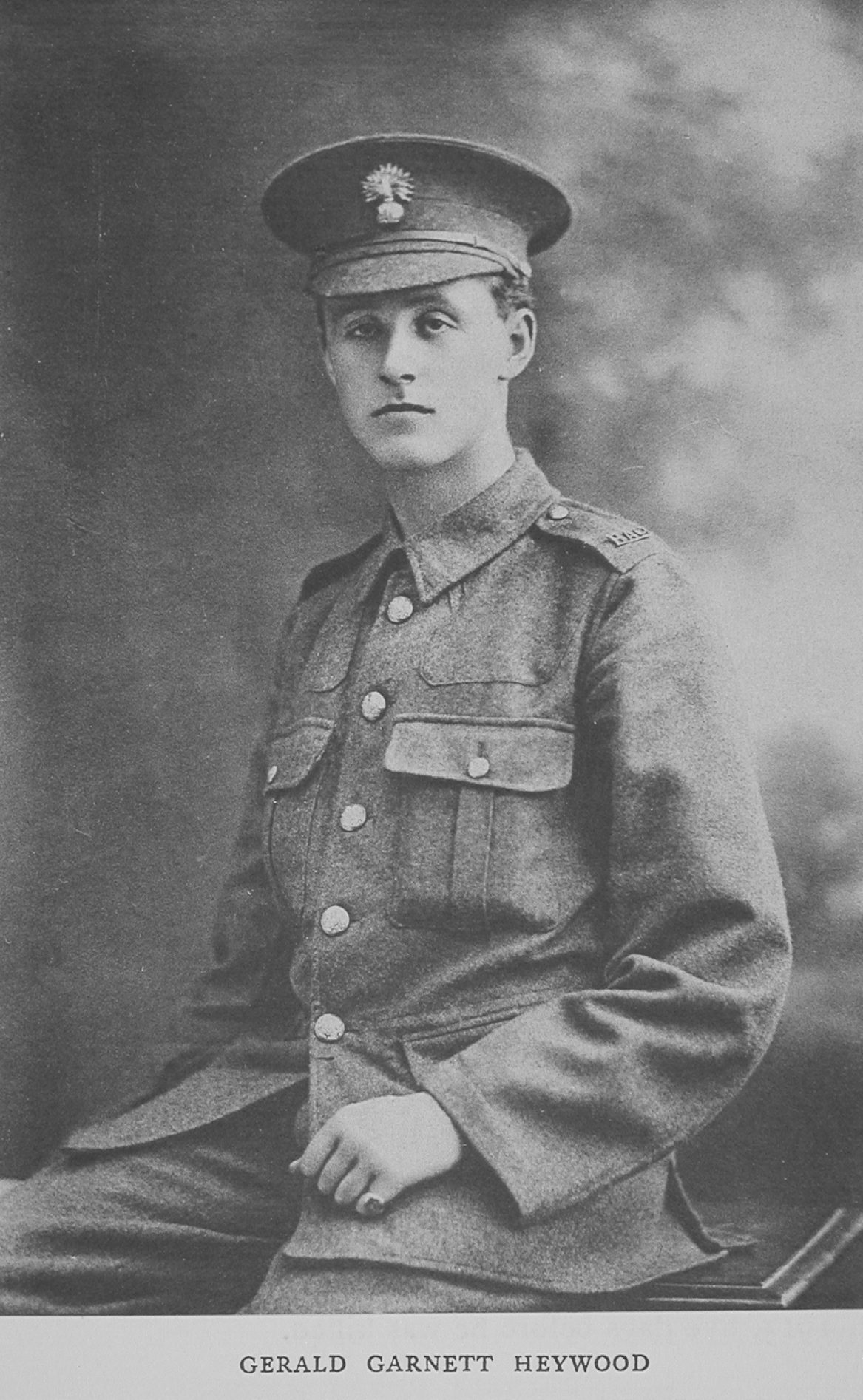
Heywood G G Pte 1218 1st Honourable Artillery Company

Heywood G G Pte 1st Honourable Artillery Company

PRIVATE G. G. HEYWOOD

1ST BATTALION HONOURABLE ARTILLERY COMPANY

GERALD GARNETT HEYWOOD was the second son of James Garnett and Alice M. de Quincey Heywood, of Chislehurst. He entered the School in 1906, and left in 1910 for Hertford College,

Oxford, taking a Second Class in the Modern History School, in June, 1914. He joined the H.A.C. on August 8th, 1914, and was sent to the Front in September.

While in the front trenches near Ypres he was wounded by shrapnel in the head, on February 15th, 1915. He was sent back to England on March 5th, and died in Derby Infirmary, on March 12th. Age 23.

His Lieutenant wrote of him:-

“Gerald has been perfect over here. Always cheerful and willing to do anything, he has borne the hardships as well as the toughest. He has never missed going up to the firing line, and has been the heart and soul of the section under most trying conditions.”

The Chaplain of the Hospital at Bailleul wrote:-

“We all feel his loss keenly, because we were filled with admiration for one who showed us a glorious example of the patience and courage of a British soldier and gentleman.”

Source : Memorials Of Rugbeians Who Fell In The Great War Vol 1

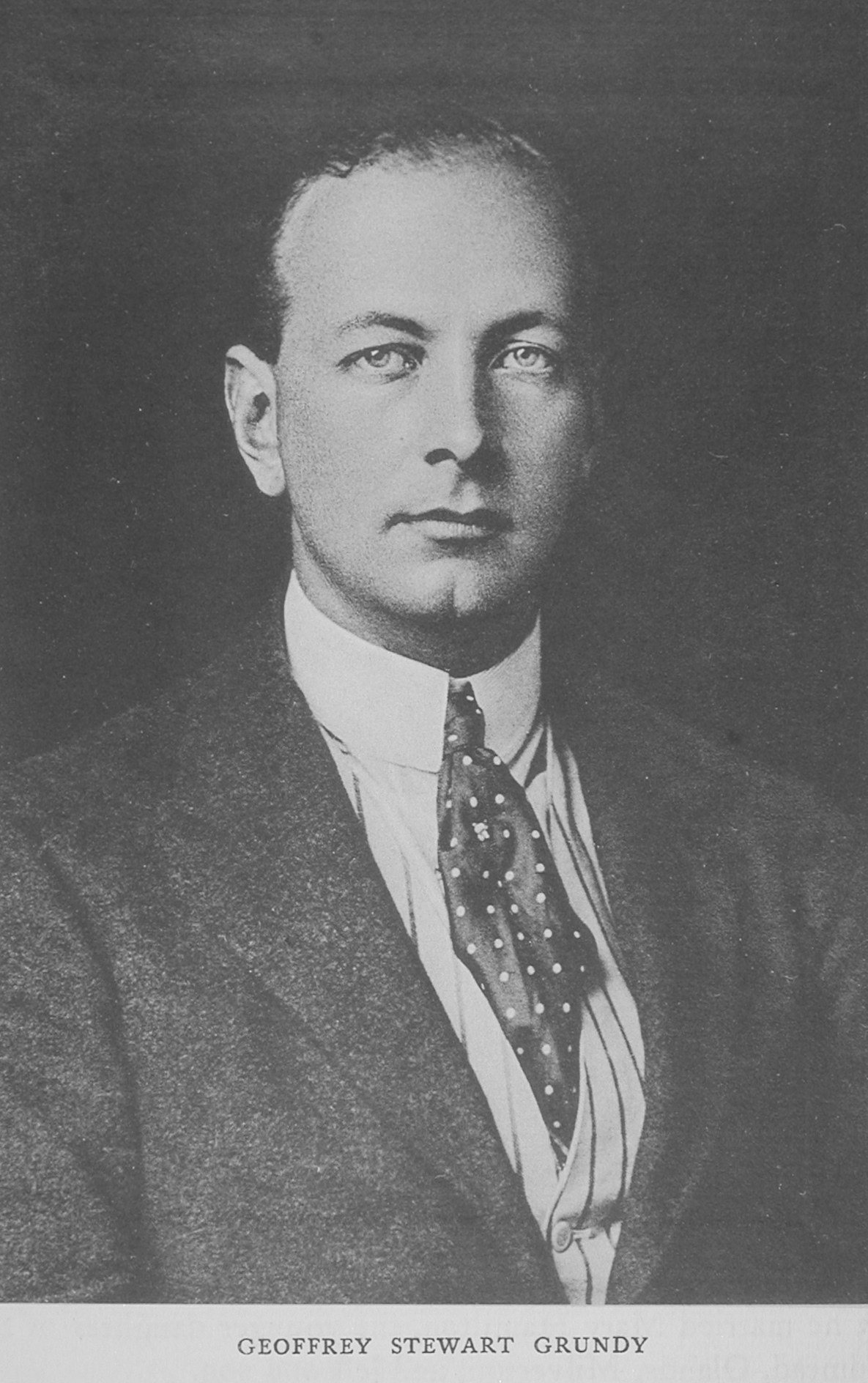
Grundy G S Pte 1362 1st Honourable Artillery Company

Grundy G S Pte 1362 1st Honourable Artillery Company

PRIVATE G. S. GRUNDY

1ST BATTALION HONOURABLE ARTILLERY COMPANY

GEOFFREY STEWART GRUNDY was the only son of Gordon Graham Stewart Grundy, of Headingley, Leeds.

He entered the School in 1900. After leaving School he served his Articles as a Solicitor in Leeds, and eventually joined the firm of Messrs. Spyer and Sons, Austin Friars House, London.

He joined the H.A.C. on August 6th, 1914, and sailed for France in September, landing at St. Nazaire. After being employed in guarding lines of communication, and important stations, and on a short spell of military police duty in Paris, he was moved up to the Front in November, and was killed in action near St. Eloi, on the night of April 14th, 1915. He was buried in the grounds of Château Elzenwalle by Voormezeele. Age 28.

A comrade wrote:

“On the night of the action in which he was killed he was engaged in watching the German trenches, which necessitated the exposure of the head from time to time over the parapet of the trench. Owing to the accuracy of the German shooting this is one of the most dangerous duties involved in trench work.”

Another wrote:-

“He was a great favourite in the Regiment there was no crouching below the parapet when on guard: he stood up square and kept his watch conscientiously, in spite of the bullets.”

Source : Memorials Of Rugbeians Who Fell In The Great War Vol 1

GRUNDY, GEOFFREY STEWART, Private, No. 1362, No. 1 Coy. Honourable Artillery Coy., onlys. of George Graham Stewart Grundy, of Whernside, Headingley, Leeds, Iron and Steel Merchant, by his wife, Joanna, only dau. of George Taylor, of Leeds and Ripon, and grandson of the late Edmund Grundy, of Bridge Hall, Bury; b. Leeds, co. York, 1 Dec. 1886; educ. Rugby, and on leaving there was articled to Messrs. Barr, Nelson & Co., Solicitors, of Leeds. He was admitted a Solicitor in Jan. 1911, and at the time war broke out was with Messrs. Spyer & Sons, Austin Friars, E.C. Ηe immediately volunteered and joined the H.A.C., 6 Aug. 1914; went to France, 19 Sept. 1914, and was killed in action near Ypres, 14 April, 1915; unm.

He was buried in the grounds of the Château Elzenwalle, Voormezeele. His Platoon Commander, Capt. M. M. Schiff, wrote: “He was a great favourite, as he was always so cheerful and bright, under the worst conditions. He was on guard at the time, in the trench, that is, standing with his head above the parapet, keeping a look-out against the Germans. Unfortunately, a shot caught him, and his death was practically instantaneous. He suffered no pain at all. He was taken down by the stretcher bearers, and was buried next evening in the grounds of a chateau, some distance behind the line”; and a comrade (Private M. Phillips, who was killed exactly one month later, 14 May): “We had a most terrible time on the above-mentioned night, the Huns mined a trench on our left, and that started it, rifles, machine guns, artillery, trench mortars and a few other atrocities, and for about three-quarters of an hour we were very lively. It died down after a bit ; but, unfortunately, during that time poor old Grundy went under (my special chum, of whom I was very fond, and I have mentioned him many times to you in my letters); he was on the ‘look-out’ and took a bullet straight through the head, dying instantaneously; it was perfectly awful, as he was next to me in the trench, and was joking and laughing up to the very minute. He was such a topping good fellow.”

Source : De Ruvigny’s Roll Of Honour Vol 1
 

Hedderwick R Y Pte 1113 Honourable Artillery Company

Hedderwick R Y Pte 1113 Honourable Artillery Company

PRIVATE RONALD YOUNG HEDDERWICK, Honourable Artillery Company was the son of Robert Hunter Hedderwick of the Stock Exchange. He was born in 1888, and educated at Haileybury College and London University. He played for his school at cricket and was a keen Rugby half-back.

A member of the Blackheath Amateur Dramatic Society he wrote several plays in which he himself took part.

He became a member of the Stock Exchange in 1914.

On the outbreak of war he joined the H.A.C. and went to France with them in November 1914.

He was killed 16 May 1915, the day before he was to have gone back to be trained for his commission.

Through getting up concerts and entertainments in which he himself took a leading part, “Bunny,” as he was called, was well . known in his own and other regiments. His genial and cheerful disposition made him a very general favourite.

His platoon officer wrote: ” Every man in the regiment knew him, and those who were privileged to come directly in touch with him loved him.”

One of his comrades wrote: “Popular and admired more than any man in the regiment; it was the privilege of his chosen friend to understand his heroism and unselfishness. We have lost one of the most lovable and unselfish men in the world. I shall never forget how in the winter’s appalling times it was always he who volunteered to lead parties to the trenches.”

Source : The Stock Exchange War Memorial 1914-1918

Frymann G A Sergt 624817 2nd Honourable Artillery Company

Frymann G A Sergt 624817 2nd Honourable Artillery Company

ERGEANT GUSTAV ALBERT FRYMANN, Honourable Artillery Company, was born and educated in London.

He began his Stock Exchange career with T. J. Ive and later joined the firm of Albert A. Bendon and Co., becoming a member in 1912.

Ón the outbreak of war he made several attempts to join up, but was each time rejected as unfit. He succeeded at last in joining the H.A.C. as a driver. He rose to the rank of sergeant, but refused a commission, though offered it several times.

After three years service at home he went to the front in June 1917, and was killed by a shell on 4 October, during an attack on the Passchendaele Ridge. He was Acting-Sergeant-Major at the time of his death.

His Captain wrote: “He was a splendid soldier and died a noble death. I could tell you countless incidents when he has shown the utmost contempt of danger. I cannot speak too highly of his courage and devotion to duty. He had earned a decoration many times over. He told the men who were dressing his wounds to leave him and attend to the other men who had more chance of life.”

Source :