Bickerton W 2nd Lt Machine Gun Corps

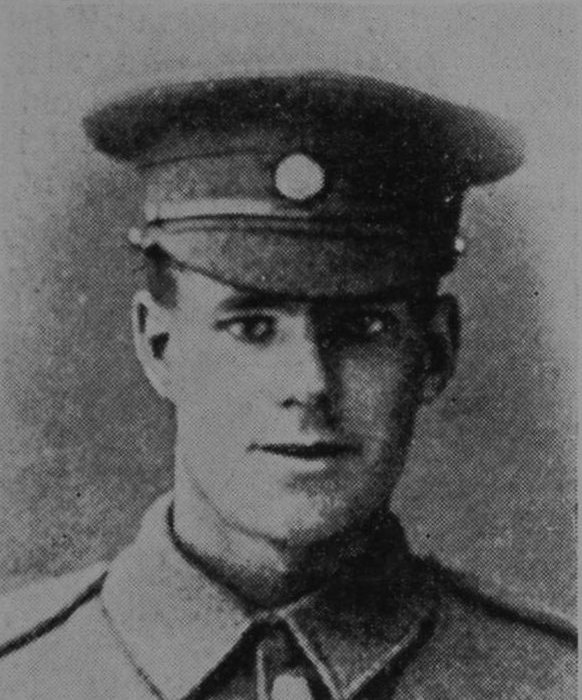
BICKERTON, WILLIAM, 2nd Lieut., Machine Gun Corps, 3rd s. of Thomas Bickerton, of Longhoughton, near Alnwick, co. Northumberland, by his wife, Mary, dau. of J. J. Robinson; b. Longhoughton aforesaid, in 1888; educ. Duke’s School, Alnwick; was a Grocer; joined the Northumberland Fusiliers early in June, 1915; quickly attained the rank of Sergt., and served as Machine Gun Instructor in various training camps in England; obtained a commission as 2nd Lieut. 28 March, 1917, being attached to the Machine Gun Corps; served with the Expeditionary Force in France and Flanders from 3 June, and was killed in action at Hollebeke 20 Sept. following. Buried there in the Fusiliers’ Wood. His Captain wrote: “Your son was killed in the early morning of 20 Sept., shortly after the commencement of the great battle in which we took part. He was killed instantly by a shell, whilst gallantly commanding his guns. Our machine guns did a lot of execution, and the enemy did his best to find us. I cannot tell you how deeply sorry I am personally at the death of your son. William was one of my best officers and highly popular with all of us. Our part of the attack involved a great deal of preparation. He was a keen and gallant fellow. I am sure you must be proud of him. His place here in this company will be difficult to fill,” and Lieut. Eckersley: “He was an excellent and fearless officer, and was highly esteemed by both officers and men.” Unm.

Source : De Ruvigny’s Roll Of Honour Vol 5
Bell A V Pte 82316 Machine Gun Corps

BELL, ALBERT VICTOR, Private, No. 82316, Machine Gun Corps, s. of the late William Bell, Ship Smith for the Mersey Dock and Harbour Board, by his wife, Mary (33, Mostyn Street, Poulton, Wallasey); b. Liverpool, 20 Oct. 1897; educ. St. Michael’s in the Hamlet there was employed as an Assistant with the Ureca Cereal Company; enlisted in Sept. 1916; served with the Expeditionary Force in France and Flanders from Feb. 1917, and died at No. 11 Casualty Clearing Station 15 Oct. 1918. Buried in Duhollow A.W.S. Cemetery, Ypres. Sergt. P. Stewart wrote: “Your brother had been under me since last March, and I have had every opportunity of testing him, and I must say I could trust him better than I could trust myself. I had him recommended for promotion. We all miss him very much.” Unm.

Source : De Ruvigny’s Roll Of Honour Vol 5

Barnes W A L/Cpl 104325 Machine Gun Corps

Barnes W A L/Cpl 104325 Machine Gun Corps

BARNES, WILLIAM ALFRED, L.-Corpl., No. 104325, 8th Battn. Machine Gun Corps, yst. s. of the late Herbert George Barnes, by his wife, Harriet (-); enlisted in the Machine Gun Corps 10 March, 1917; served with the Expeditionary Force in France and Flanders from 2 Aug. following, and died in hospital 31 March, 1918, of wounds received in action at Leaucourt, Somme. His Commanding Officer wrote: He was such a fine soldier, and a great favourite with all who knew him. I can speak of your husband personally, as I had been with him ever since he joined the company. He was one of the most reliable and efficient of N.C.O.’s, and it is a tremendous loss to the company.” He m. at Tottenham, 1 Aug. 1915, Dorothy Grace (8, Elizabeth Road, Seven Sisters Road, Tottenham, N.), dau. of Edwin Tonner, and had a dau. Dorothy Florence, b. 4 Aug. 1916.

Source : De Ruvigny’s Roll Of Honour Vol 5

Briggs-Gooderham E J R 2nd Lt 3rd Royal Irish Regiment Attd Machine Gun Corps

Briggs-Gooderham E J R 2nd Lt 3rd Royal Irish Regiment Attd Machine Gun Corps

2nd Lieut. the Reverend ERNEST JOHN ROBINSON BRIGGS GOODERHAM.

3rd Royal Irish Rifles, was the son of J. R. Briggs Gooderham, Esq., and nephew of the Rev. A. Gooderham, Vicar of Chillingham. He was born in 1889, and entered the School House in September, 1903. He left in July, 1908, for Caius College, Cambridge, where he took his B.A. (2nd Class Theological Tripos) in 1911. He was ordained Deacon in 1912, and was Curate of Christ Church, Crouch End. In April, 1915, he enlisted in the Norfolk Regiment, and he received his commission in the Royal Irish Rifles in that year. Whilst serving in France he was attached to the Machine Gun Corps, and he was killed in action on the 13th December, 1916.

Source : The War Record Of Old Dunelmians 1914-1919

Arthur A Pte 32699 Machine Gun Corps

ARTHUR, ALEXANDER, Private, No. 32699, Machine Gun Corps, 3rd s. of the late David Arthur, by his wife, Ann Ferguson (118, Bonnygate, Cupar); b. Kingask, Cupar, co. Fife, 28 April, 1886; educ. Cupar; was a Draper; enlisted in the 9th Royal Scots 6 Aug. 1915; transferred to the Machine Gun Corps in 1916; served with the Salonika Army from the end of May, 1916, and died at No. 64 General Hospital, Salonika, 6 Aug. 1918, of acute atrophy of the liver, contracted while on active service. Buried in Salonika Cemetery. His Commanding Officer, Lieut. P. Campbell, wrote: “I feel his loss keenly; he was always so cheerful, was a good soldier, and a great favourite in the section.” Unm.

Source : De Ruvigny’s Roll Of Honour Vol 5

Friend P E 2nd Lt Machine Gun Corps

Friend P E 2nd Lt Machine Gun Corps

SECOND LIEUTENANT PHILIP EMLYN FRIEND, East Lancashire Regiment, was the only surviving son of the late W. Latton Friend, of Beckenham, and Mrs. Friend, of 6, Lexham Gardens.

Before the war he was with his uncle, Dale Womersley, on the Stock Exchange, having become a member in 1904.

He had always been a keen rider and on the outbreak of war enlisted in the 11th Hussars. Shortly after he was transferred to the Royal Scots Greys, with whom he trained at Dunbar. In April 1915 he was gazetted to the 3rd East Lancashire Regiment.

He went out in August to the 2nd Battalion, and served with them till January 1916, when he was transferred to the Machine Gun Corps. He was killed on 7 July 1916.

His Colonel wrote to his widow: “I put special value on his courage and constancy. During the heavy fighting last September, after a great part of the defensive works had been demolished by shell fire, he retained such power of command that his platoon manned what remained of the parapet with great gallantry and opened an effective flank fire which drove back every attempt to counter-attack from that quarter. He was always cheerful, and a great favourite.”

A brother officer wrote: “I wish you to know that both the officers and men of this Machine Gun Company feel his loss beyond words. I always thought him a soldier and a gentleman. I never wish to have a finer man under me.”

Source : The Stock Exchange War Memorial 1914-1918