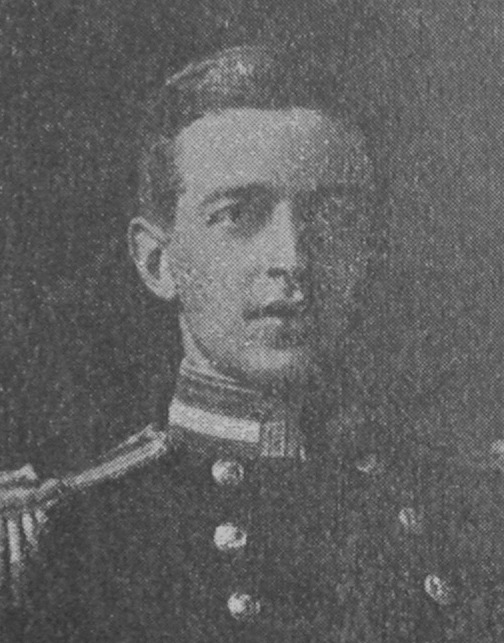
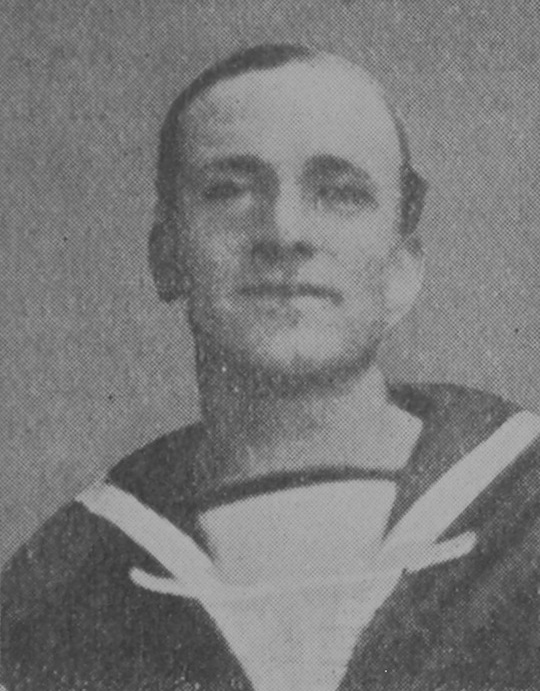
Batson A W Ord Seaman J/19683 HMS Inflexible Royal Navy

Batson A W Ord Seaman HMS Inflexible Royal Navy

Batson A W Ord Seaman J/19683 HMS Inflexible Royal Navy

Of Tooting

Source : The Vivid 6th Mar 1915

Born 21st Nov 1896

Address 57 Kenlor Road, Tooting S W

Enlisted in navy 12th Aug 1912 Aged 15 HMS Impregnable

On outbreak of war aboard HMS Inflexible

Killed in an explosion aboard HMS Ettrick 7th Jul 1917

Commemorated on Chatham Naval Memorial

Todderingham W 1st Class Stoker K/12824 HMS Monmouth Royal Navy

TODDERINGHAM, WILLIAM, 1st Class Stoker, No. K. 12824, R.N., eldest s. of the late William Todderingham, Seaman, by his wife, Bridget (40, Tredegar Street, Cardiff), dau. of (-) Landers, of Cardiff; b. Cardiff, 10 May, 1892; educ. St. Peter’s R.C. Schools there; entered the Navy, 1909, and was lost when H.M.S. Monmouth was sunk in the Battle off Coronel, on the coast of Chili, 1 Nov. 1914; unm.

Source : De Ruvigny’s Roll Of Honour

Tatham T H H S Lt HMS Formidable Royal Navy

Tatham T H H S Lt HMS Formidable Royal Navy

TATHAM, TREVOR HODGSON STAN- LEY, Lieut., Royal Royal Navy, eldest s. of Stanley Tatham, of Montana, Bournemouth, member of the Institute of Naval Architects, by his wife, Frances Emma Constance (Montana, Branksome Park, Bournemouth), dau. of Michael Hodgson Tatham; b. Newcastle- on-Tyne, 16 Nov. 1887; educ. The Old Ride, Branksome Park, Bournemouth; Stubbington House, Fareham, and H.M.S. Britannia; entered the Navy and became Midshipman, 15 Feb. 1904; Sub-Lieut. 15 April, 1907, and Lieut. 15 July, 1908; served six years on H.M. ships Formidable, Duncan and Barham; was A.D.C. to Capt. Walker while a Midshipman on the Formidable; took part in the Somaliland Expedition, 1909 (medal); re-appointed to the Formidable (his first ship), 9 Aug. 1913; and was lost when that ship was torpedoed in the English Channel, 1 Jan. 1915.

Source : De Ruvigny’s Roll Of Honour Vol 1

Tarn M A Engine Room Articifer HMS Aquarius Royal Navy

Tarn M A Engine Room Articifer HMS Aquarius Royal Navy

TARN, MARK AITCHISON, Engine-Room Artificer, H.M.S. Aquarius, R.N., only s. of John Tarn, of Hornby Road, Bootle, Liverpool (formerly of Alston, Cumberland), Foreman Joiner, Messrs. J. Ellerman’s Engine Works, Liverpool, by his wife, Mary, eldest dau. of James Aitchison, of Melrose; b. Jarrow-on-Tyne, 1 Aug. 1894; educ. Christ Church Higher Grade and the Junior Technical Schools, Bootle, and was nominated by the local authority for training as Engine-Room Artificer on board H.M.S. Fisgard, Portsmouth, 31 Dec. 1909. Here he won the high esteem of his officers and comrades by his attention to duty and proficiency. On the outbreak of war he was appointed to H.M.S. Vernon, and later to H.M.S. Aquarius, and while serving on the latter at the Dardanelles was taken ill with acute dysentery. He was transferred to No. 15 Stationary Hospital, Mudros, Lemnos Island, and died 31 Aug. 1915, being buried in the cemetery there. Tarn was an all-round sportsman, being elected captain of the Rugby football team for three years, and won his cup in the final at Devonport. A memorial tablet was placed in St. Matthew’s Church, Bootle, where he served as a choir boy.

Source : De Ruvigny’s Roll Of Honour Vol 1

Stubbs J D Midshipman HMS Aboukir Royal Navy

Stubbs J D Midshipman HMS Aboukir Royal Navy

STUBBS, JOHN DUNCAN, Midshipman, R.N., elder s. of Thomas Duncan Henlock Stubbs, of Nunthorpe, Yorkshire, Major, North Riding Heavy Battery, 13th Brigade, R.G.A. (now on active service in France), by his wife, Margaret Isobel, dau. of Arthur Buchannan, of Guisborough, Yorkshire; b. Coatham, Redcar, co. York, 24 June, 1899; educ. Coatham Grammar School; Pembroke Lodge, Southbourne, and the Osborne (entered May, 1912), and Dartmouth Royal Naval Colleges, and had just completed one term at the latter college when war broke out, and the Cadets from the college were sent to various ships on active service. As senior he took a party of nine Cadets of his term to Chatham, where they joined the Aboukir, and in a few days time he went to sea as acting Midshipman. Shortly afterwards the Cadets were all promoted Midshipmen. He was attd. to the Gunnery Lieut., and was in charge of four 12-pr. guns. Life on board was much to his liking, writing home he described it as “the most glorious time of my life.”

On 22 Sept. the Aboukir was the first ship to be torpedoed; everyone came on deck, as it was obvious that the vessel was sinking. Stubbs noticing that one of the other Midshipmen was not on deck went below to look for him, he found the boy asleep (he had just come off watch), woke him up, and brought him on deck. As one of the officers wrote: “It took some pluck to do this with the ship heeling over and likely to go at any moment.” Stubbs swam in the direction of the. Hogue, but before he reached her she was torpedoed also and sank very quickly. He then swam towards the Cressy, and while in the water in company with another Midshipman of the Aboukir, they came across a drowning man calling for help. They went to his assistance and succeeded in holding him up for some time, telling him what to do to help himself, but as the man was unable to do as they told him, they were obliged to leave him as they could hold him up no longer. They got to the Cressy where they received dry clothes and hot cocoa, and were in the sick bay when the Cressy was struck the first time. They went on deck, and when the second torpedo struck the ship they took to the water again. Stubbs was seen in the water clinging to some wreckage some time afterwards, but when the rescuing boats came along he had disappeared.

According to an Artificer of the Hogue the following incident took place after the Cressy was sunk: A man was calling for help some distance away, the Artificer saw two Midshipmen on a plank not far from the man, later he saw the boys leave the plank they were on and swim towards the man. The latter seized the boys, then there was a short struggle and all three disappeared. The Artificer was then only a few yards away, he saw the boys clearly, and from his description and from the fact that all the other Midshipmen were accounted for, it is thought that almost certainly the boys referred to were Midshipmen Stubbs and Riley. One of the officers of the Aboukir wrote saying of Stubbs: “He was of the greatest assistance to me, in fact I could not have done without him. It was impossible for him to tell a lie. He was always cheerful no matter what time of day or night, nor how rough the sea was.” And again he wrote: “There were many fine things done that day, but none finer than his. He was one of the best and truest boys I ever met.” He early showed signs of great promise; at Pembroke Lodge he held a high place in the school, and was also good at all games. He played for the school in both the cricket and football teams, and in the school sports won every open event, taking the Sports Challenge Cup with the maximum number of marks. In the words of his headmaster: “He was one of God’s perfect little gentlemen.” At the R.N.C., Osborne, he was promoted Cadet captain on completion of his third term at the college, he played for the college at cricket, being given his colours in 1913, and won the prize for the best field in the college. He passed out of the college head of his term, being awarded the Admiralty’s prize for the Cadet obtaining the highest aggregate number of marks in all subjects, including engineering and seamanship.

Source : De Ruvigny’s Roll Of Honour Vol 1

Stirling W D Lt HMS Monmouth Royal Navy

Stirling W D Lt HMS Monmouth Royal Navy

STIRLING, WILFRED DIXON, Lieut., Royal Navy, s. of Col. James Wilfrid Stirling, of The Grange, Rockbeare, Devon, now commanding 72nd Brigade, Royal Field Artillery, by his wife, Cecil Mary, dau. of Major-Gen. Dixon Edward Hoste, C.B., R.A.; b. Pennycross, near Devonport, 12 Sept. 1886; educ. Cheltenham College, and passed direct into H.M.S. Britannia in 1901 and passed out 5th in his term in Dec. 1902, having been awarded the Diploma of Honour as selected Candidate of his term for His Majesty’s medal; entered the Navy as Midshipman, 16 Dec. 1902; promoted Sub- Lieut., 15 March, 1906, and Lieut., 16 June, 1907; served as Midshipman in H.M.S. Bacchante, under Capt. (afterwards Admiral Sir) Christopher Cradock; qualified as Navigating Officer in 1907, and acted in that capacity successively in H.M. ships Ringdove, Media, Attentive and Grafton; was Instructor in Navigation to Cadets at Dartmouth, Jan. 1913, to Aug. 1914; appointed Navigating Lieut., H.M.S. Monmouth (Capt. Brandt), Aug. 1914, and was lost when that ship was sunk in the battle off Coronel, on the coast of Chili, 1 Nov. 1914; unm.

From many appreciative letters the following sentence is taken from that of a brother officer: “His was a glorious example, and if anything can lessen the terrible sorrow you and Col. Stirling are suffering it must be the knowledge that his life was well lived and his duty nobly done.”

Source : De Ruvigny’s Roll Of Honour Vol 1


Stiling W C H Sig 216012 HMS Monmouth Royal Navy

Stiling W C H Sig 216012 HMS Monmouth Royal Navy

STILING, WILLIAM CHARLES HENRY, Signalman, No. 216012, Royal Navy, H.M.S. Monmouth, eldest s. of the late Charles Henry Stiling, of The Minories, by his wife, Phoebe (7, Circus, Minories, Aldgate, E.), dau. of William Thomas Pugh; b. St. George’s, E., 1 Dec. 1885; educ. Sir John Cass’ School, Minories; enlisted in the Devonshire Regt., 25 June, 1901, but was claimed out by his mother (29 June), being only 15, and then in the 5th Battn. Rifle Brigade, but was again claimed out; joined the Navy as a Boy (2nd class), 19 July, 1901; became Boy (1st class), 5 June, 1902; Signalman, 2 Dec. 1903; Ordinary Signalman, 1 Oct. 1907; Signalman, 26 Nov. 1907; served in H.M.S. Impregnable, Vivid, Royal Oak, Cambridge, Hogue, Cornwall, Mars, Hibernia, Crescent, Orontes, Egmont, Sutlej and Monmouth (appointed 30 July, 1914), and was lost on H.M.S. Monmouth when that ship was sunk in the battle off Coronel, on the coast of Chili, 1 Nov. 1914; unm. His brother, Thomas Edward, Leading Seaman, served at the Dardanelles on the Swiftshire, and is now (1916) on active service on H.M.S. Royal Oak in the North Sea.

Source : De Ruvigny’s Roll Of Honour Vol 1