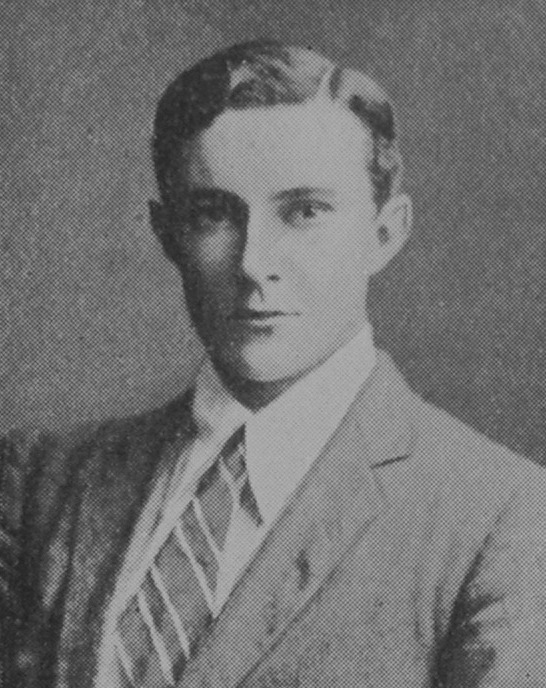
Bagnall J C Pte 15410 8th South Staffordshire Regiment

BAGNALL, JOHN CHARLES, Private, No. 15410, The South Staffordshire Regt., 8. of Charles Bagnall, of 22, Oxford Street, Pleck, Walsall, by his wife, Louisa Matilda, dau. of Peter Powell; b. Walsall, co. Stafford, 29 Oct. 1891; educ. Wisemoor Schools there was a Caster: enlisted in the South Staffordshire Regt. 2 Nov. 1914; served with the Mediterranean Expeditionary Force in Gallipoli from April, 1915; was invalided home in Dec. on recovery served with the Expeditionary Force in France and Flanders from March, 1916, and was killed in action 12 Oct. 1917. Buried where he fell. He m. at Pleck, Walsall, 13 Ang. 1913, Lydia, dau. of Edward Walters, and had a son, Charles Edward. b. 19 Dec. 1914.

Source : De Ruvigny’s Roll Of Honour Vol 5

Vallentin J F Captain VC 1st South Staffordshire Regiment

Vallentin J F Captain VC 1st South Staffordshire Regiment

CAPTAIN JOHN FRANKS VALLENTIN VC

1ST BATTALION SOUTH STAFFORDSHIRE REGIMENT

A man whose motto through life was “Thorough”, Captain John Franks Vallentin, of the first Battalion South Staffordshire Regiment won the VC at Villebeke on November 7th 1914, by the heroic deed which cost him his life.

the only son of the late Mr Grimble Vallentin and Mrs Grimble Vallentin of 33, Prince of Wales Mansions S.W.  Captain Vallentin was born on May the 14th 1882. Educated at the great school which has been the Alma Mater of so many of our soldier heroes, Wellington College, he passed into the army through the Militia, with which he was embodied for nearly three years, and joined the Royal Garrison Regiment on July 29th 1903, serving with it until June 7th 1905, when he became Second Lieutenant in the 1st Battalion South Staffordshire Regiment. He was promoted Lieutenant two years later and gained company on June 12 1909.  From 1901 to 1902 he served with the Militia in the Boer war taking part in the operations in Orange River Colony from April to December 1901, and in the operations in the Transvaal from that time until May 1902. The future VC then greatly distinguished himself, and was awarded the Queen’s Medal, with five clasps.

Captain J. F. Vallentin was the best polo player in his Regiment, captaining his team, and it was due to his energy and efforts that Pietermaritzburg, while his Regiment was stationed there, became a centre for polo in South Africa. He was a specialist in musketry, and, as Lieutenant-Colonel R. M. Ovens, C.M.G., the Commanding Officer of the 1st Battalion South Staffordshire Regiment, said of him, “a first-rate all-round man at his work.”

The manner in which this gallant Officer met his heroic death is eloquently described by Colonel Ovens, in the following letter :-

“Captain Vallentin’s splendid heroism, unfaltering courage and determination have been justly rewarded with the Victoria Cross, the highest and noblest reward to be won in His Majesty’s Army. To his family and to his Regiment it will ever be a source of intense gratification that this keen and able young Officer should have had his name recorded in England’s famous roll of heroes. We, his brother Officers, who knew him well, know that his heart’s desire was to do his best for his dear old Regiment, and in peace and war alike he worked his hardest and gave of his best for the service he was so devoted to and wrapped up in. His motto was ‘Thorough’ and his abilities were most marked.

He was a warm-hearted, generous-minded young Officer, for whom I felt the greatest regard and affection. He was wounded and in hospital at Ypres on November 6th last, and hearing the Regiment were making an attack that night, he came out of hospital and took command. He was again wounded whilst leading his men forward, but notwithstanding his two wounds he again advanced and was instantaneously killed by five or six shots. But, whilst regretting that he is lost to us in this world, we shall ever love to dwell upon the glorious fighting done by him at Ypres against the Prussian Guards, whereby he has earned immortal fame and added fresh honours to the South Staffordshire Regiment.

I feel certain that our brave and devoted Staffordshire soldiers who are so magnificently keeping up Staffordshire’s great name will feel strengthened and encouraged by Captain Vallentin’s noble example.”

Captain Vallentin’s grandfather, the late Colonel Finnis, 11th Bengal Native Infantry, was the first victim of the Indian Mutiny, being killed at Meerut, May 10th, 1857.

Source : The British Roll Of Honour Vol 1

Vallentin J F Captain VC 1st South Staffordshire Regiment


Vallentin J F Captain VC 1st South Staffordshire Regiment

VALLENTIN, JOHN FRANKS, V.C., Capt., 1st Battn. South Staffordshire Regt., only s. of the late Grimble Vallentin, of The Manor House, Walthamstow, by his wife, Lucy (33, Prince of Wales Mansions, S.W.), dau. of Col. John Finnis, 11th Bengal Native Infantry Regt. (killed at Meerut, 10 May, 1857, the first victim of the Mutiny); b. in London, 14 May, 1882; educ. Wellington College; served in the South African War, 1901-2, with the Sussex Militia, taking part in the operations in Orange River Colony, April to Dec. 1901, and in the Transvaal from that time until May, 1902 (Queen’s medal with five clasps); gazetted 2nd Lieut. to the Royal Garrison Regt., 29 July, 1903; trans- ferred to 1st South Staffords, 7 June, 1905, and promoted Lieut. 7 Sept. 1907, and Capt. 12 June, 1909. He went to France, 5 Oct. 1914, and was wounded on 31 Oct. at Ypres, and taken to hospital, where he was detained. On 2 Nov., on hearing Major Loder Symonds had been killed, he insisted on coming out of hospital to take command of what was left of the regt., the Col. having been seriously wounded on 31 Oct. He was killed in action at Zillebeke, 7 Nov. following; unm.

The regt. on this occasion, with the remains of the Queen’s Regt.. captured six machine guns, and recaptured the trenches which had previously been lost by the French. The machine guns captured on this occasion were destroyed and buried. He was awarded the V.C. posthumously “for conspicuous bravery on 7 Nov., at Zillebeke, when leading the attack against the Prussian Guard under a very heavy fire, he was struck down, and on rising to continue the attack, was immediately killed. The capture of the enemy’s trenches which followed was in a good measure due to the confidence which the men had in their captain, arising from his many previous acts of great bravery and ability.” Lieut.-Col. Ovens, C.M. G., commanding 1st South Staffords, wrote: Capt. Vallentin’s splendid heroism and unfaltering courage and determination have been justly rewarded with the Victoria Cross. He was Captain of our Polo Club, and the best player in the regt. He was a specialist in musketry, and a first-rate all-round man. At manœuvres and in the field General Officers have commented on the excellence of his work. The Chief Engineer of the 7th Division told me Capt. Vallentin’s scheme of defence and his trenches were the best he had seen. He was wounded and in hospital at Ypres on 6 Nov, 1914, and hearing the regt. was making an attack that night, he came out of hospital and took command. He was again wounded whilst leading his men forward, and was instantly killed. His is a great loss to his splendid old regt., and is deeply regretted by all who knew him.”

Source : De Ruvigny’s Roll Of Honour Vol 1
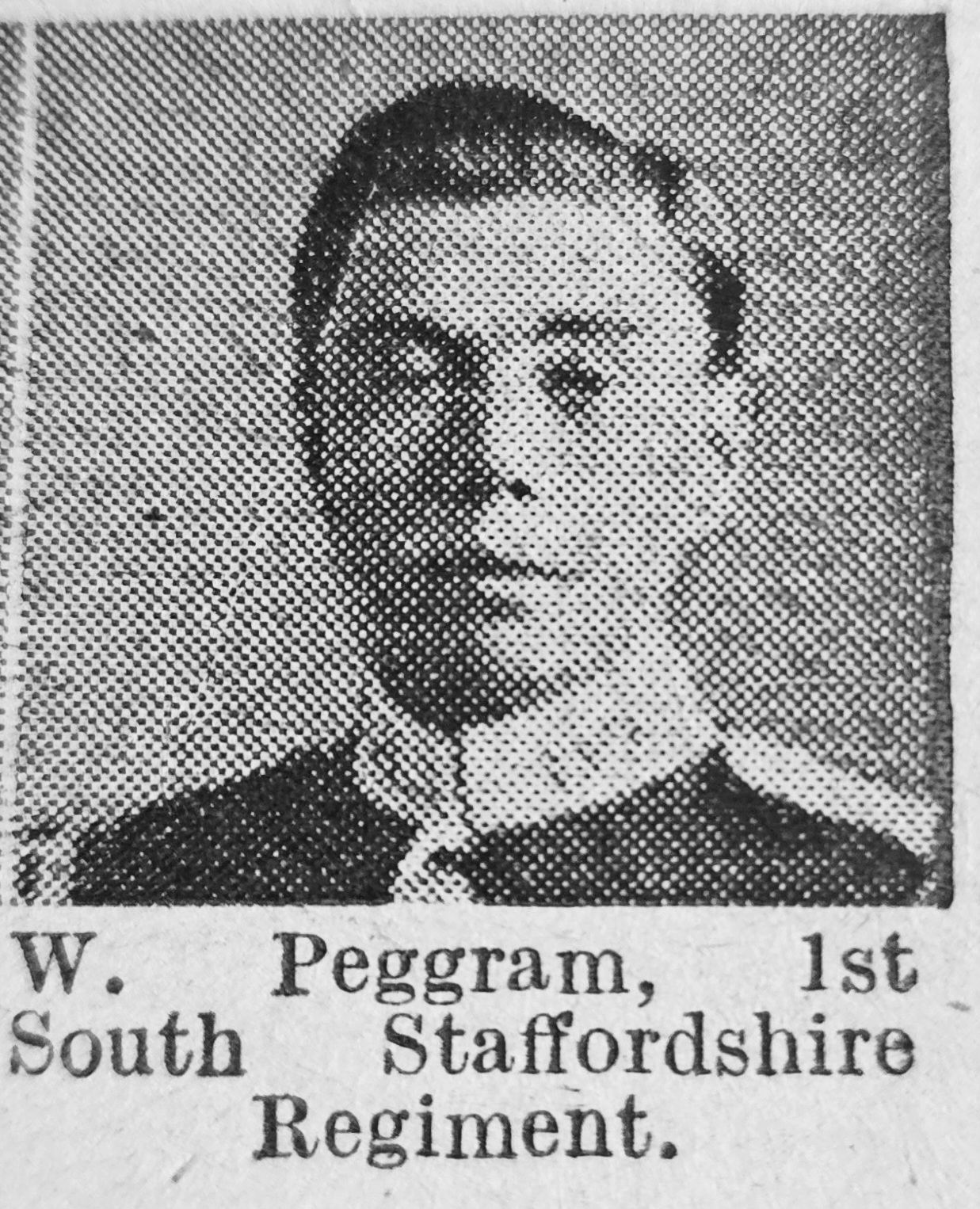
 

Thomas C H Captain 2nd South Staffs Regiment

Thomas C H Captain 2nd South Staffs Regiment

THOMAS, CHARLES HERBERT, Capt., 2nd Battn. South Staffordshire Regt., only child of Howard Thomas, of 10, Westminster Palace Gardens, S. W., by his wife, Ethel, dau. of the late William Baker, of Sneyd Park, Bristol, and grandson of the late Charles Thomas, of Stoke Bishop, Bristol, J.P., D.L.; b. Charton, Henbury, co. Gloucester, 25 April, 1880; educ. at Clifton; Abbotsholme, and Edinburgh University; gazetted 2nd Lieut. 4th Somerset L.I., 21 April, 1900, from the militia, and promoted Lieut. 16 Dec. 1901, and Capt. 8 Jan. 1909. He served in the South African War, 1899-1901, with the Somerset L.I., receiving the Queen’s medal with clasp, and in Feb. 1901, was transferred to the South Staffordshire Regt. then in India; was on leave, 1904-05; at Depôt, Lichfield, 1906-08, and in South Africa 1908-1911, where, in 1909, he was given the command of the Mounted Infantry Coy. of his Regt. then at Harrismith, and returned to Lichfield in 1911. On the outbreak of the European War he went to France with the Expeditionary Force, 11 Aug. 1914; served through the retreat from Mons and the Battles of the Marne and the Aisne; was severely wounded in action near Ypres, 27 Oct., and died at the Hotel Crystal Hospital, Boulogne, 5 Nov. 1914. He was buried in the English quarter of the cemetery there. Capt. Thomas was mentioned in Sir John (now Lord) French’s Despatch of 18 Feb. 1915, for gallant and distinguished conduct in the field, and his Col. wrote: “I had hoped that your gallant and beloved son might have been the recipient of our most coveted decoration on the strength of my recommendation.” He was an expert horseman and a keen polo player. He m. at Winsford, Exmoor, 4 June, 1912, Dorothy Catherine, only dau. of Philip Everard, of Miltons, Dulverton, co. Somerset, and had issue a son, Charles Richard, b. 15 June, 1913.

Source : De Ruvigny’s Roll Of Honour Vol 1

Stevens L B 2nd Lt 2nd South Staffs Regiment

Stevens L B 2nd Lt 3rd South Staffs Regiment

LOTHIAN BASIL STEVENS, son of Colonel G. M. Stevens, was born in 1894, came up to Balliol as a Blundell Scholar in 1913, and took a First in Mathematical Moderations in 1914. He enlisted in the Public Schools Battalion Middlesex Regiment in August 1914, but was given a commission in October in the 3rd South Staffordshire Regiment, and went to France in March 1915. There he was attached to the 2nd Battalion of the Scottish Rifles, and was killed in the action at Fromelles in May 1915. He was with his platoon, holding a German trench against an overwhelming counter-attack when he was killed.

Stevens was a mathematician of great promise, and a man of wide interests and attractive character. His achievements in his short period at College, and his tragically short career on active service, show that he would have gone far if he had lived. It is eminently fitting that his name, with that of G. M. Paddison, has been associated with the War Memorial Exhibition now attached to the Blundell Scholarship.

Source : Balliol College War Memorial Book

Stevens L B 2nd Lt 2nd South Staffs Regiment

STEVENS, LOTHIAN BASIL, 2nd Lieut., 3rd Battn. South Staffordshire Regt., attd. 2nd Battn. Scottish Rifles, yst. s. of Col. George Morton Stevens, late R.A., by his wife, Mary, dau. of Surg. -Gen. William Campbell Maclean, C.B., M.D., LL.D.; b. Southampton, 13 March, 1894; educ. Blundells School, Tiverton, and Balliol College, Oxford (Mathematical Scholar); where he took a first-class in moderations in mathematics, July, 1914; joined the Public Schools Battn. of the Middlesex Regt. in Sept. 1914, and obtained a commission in the 3rd South Staffordshires, 3 Oct. 1914; went to France in March, 1915; was attd. to the 2nd Scottish Rifles; was reported wounded and missing after the fighting at Fromelles, 9 May following, and is now assumed to have been killed in action that day; unm. The officer commanding the 2nd Scottish Rifles wrote:  “I am afraid your son must have died from his wound. It is a great distress to us all, as he was so keen and interested in his work, and such a bold and reliable leader.” His brother, Capt. R. W. M. Stevens, died of wounds, 27 Aug. 1914.

Source : De Ruvigny’s Roll Of Honour Vol 1

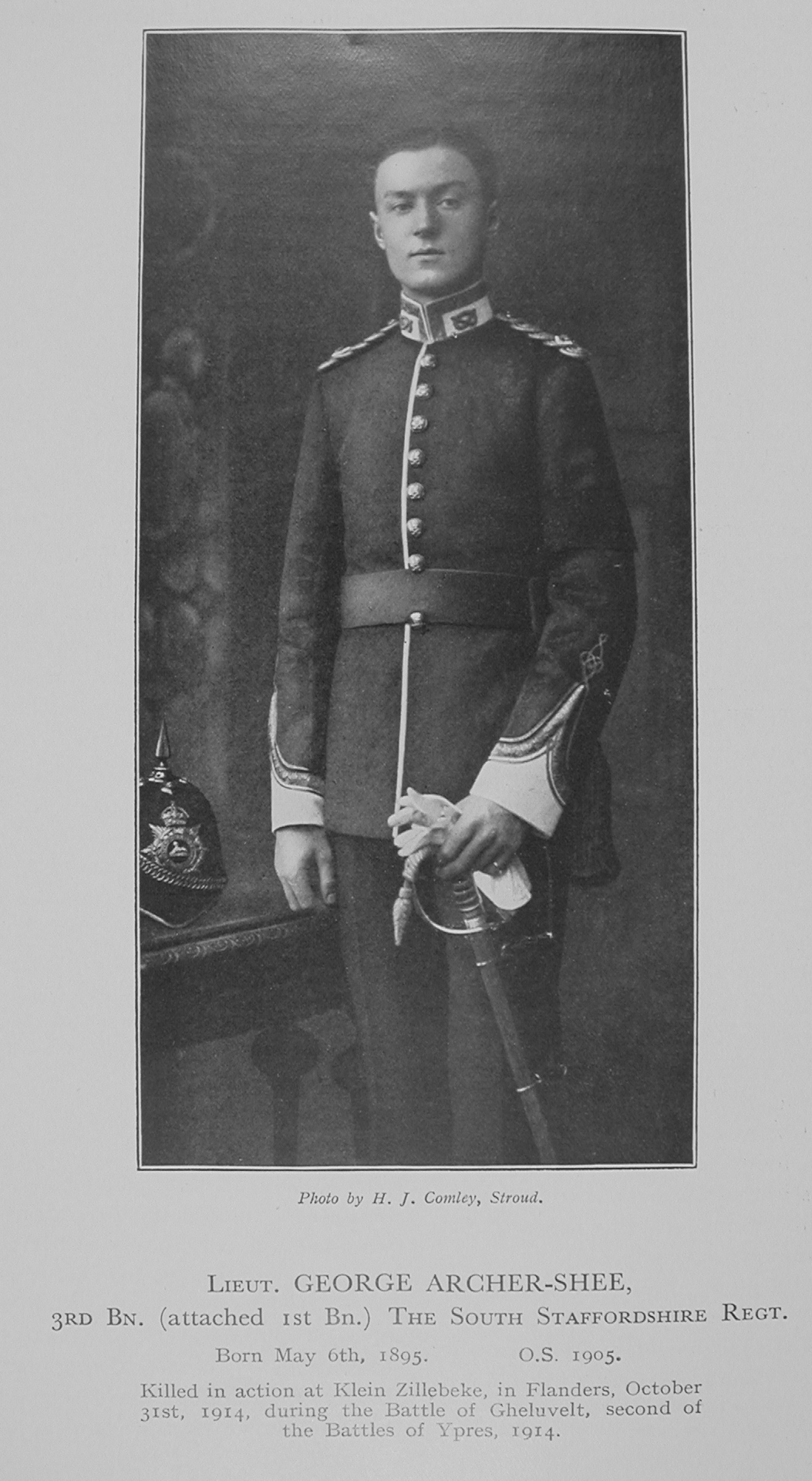
Archer-Shee G Lt 1st South Staffs Regiment

Archer-Shee G Lt 1st South Staffs Regiment


Lieut. GEORGE ARCHER-SHEE, 3rd Bn Staffordshire Regt. (attached 1st Bn.)

The death of this young officer, so well known and popular at Stonyhurst, caused deep regret to his many College friends. Our sympathy is intensified by the recollection of the very trying ordeal he had to pass through some years ago as a boy cadet at Osborne, where he was mistakenly accused and dismissed on a charge of petty theft. During the legal proceedings which followed, it will be remembered that the College authorities, who knew him well, and were convinced of his innocence, sent representatives to give evidence in court as to the high character he had always borne as a boy at Stonyhurst.

The details of the trial-the cause célèbre of the year and the subsequent debates on it in Parliament are so well known that we need not recall them here. They resulted in what every newspaper in the country described as “a complete vindication of his character.” He received an ample apology from Mr. McKenna, then First Lord of the Admiralty, and was awarded £7,000 damages.

After leaving Osborne he was welcomed back to Stonyhurst, where he remained till of age. to enter the Army. It is pleasant to recall the fact that not only did his schoolfellows at Stonyhurst believe him guiltless of the charge, but that his fellow-cadets at Osborne were unanimously in his favour.

The newspapers, in recording his death, one and all concurred in tributes of special sympathy.

The Daily Mail, under the heading “Romance of a Hero,” concluded with the words, “Driven from the Navy by injustice, Lieut. Archer-Shee has won fame and honour in the Army, and- he has served his country well.”

The following notice is from The Times :- “Lieut. George Archer-Shee, 1st Bn. The South Staffordshire Regt., who was killed near Ypres on October 31st, aged 19 years, was the younger son of the late Martin Archer-Shee and Mrs. Archer-Shee, of Woodchester,

He joined the Royal Naval College, Osborne, in 1908, but was removed. in circumstances which afterwards formed the subject of legal proceedings in the King’s Bench, the result of which was the complete vindication of his character.

Colonel Ovens, C.M.G., the officer commanding the 1st Bn. The South Staffordshire Regt., writes of him to his mother-

He was a most promising young officer, and in the short time he was in the 1st Bn. The South Staffordshire Regt. he earned the love and respect of both officers. and men, and by his bravery and example contributed largely to the success of the battalion in the actions. near Ypres.'”

Although the evidence of his death on October 31st, at Klein Zillebeke, near Ypres, was confirmed later, his relatives and friends. had been kept in suspense as to his fate from October to May, during which period his name had been officially posted as “missing.”

By all accounts received from his brother officers and the men of his regiment, he had borne himself with special gallantry throughout the fighting in which he took part.

His death at the Battle of Gheluvelt is thus described in a letter from an officer of the 1st Bn. The South Staffordshire Regt. at Ypres, to Major Archer-Shee :-

Jan. 14th, 1915.

It seems that during the retirement of the Division he was in charge of a platoon in an exposed portion of the line; other units of other corps, it seems, had received orders to retire, but the order had not reached him. Someone, it is said, pointed out to him that the units on each side of him were retiring; he replied that he did not care what they did, but no one of his men was to retire till he gave them orders to do so, and so they held on against great odds.

Later a message seems to have reached him, for he gave the order to the men to retire as best they could. He, it is said, was the last to retire, and a man, since killed, reported that he looked round and saw him lying face downwards on the ground, motionless, though killed instantly, his head towards the enemy He earned the highest opinions of his brother officer, and his loss is most keenly felt by all who knew him. He was such a charming and interesting young fellow. and had seen such a lot of the world for his years, that he was a most pleasant companion at all times and made many friends.

Source : Stonyhurst War Record