Gurney-Sheppard S Lt Col DSO Hertfordshire Yeomanry

Gurney-Sheppard S Lt Col DSO Hertfordshire Yeomanry

LIEUT.-COLONEL SAMUEL GURNEY SHEPPARD, LD.S.O., commanding the Hertfordshire Yeomanry, of Wantage, Berkshire, was the elder son of the late Samuel Gurney Sheppard, of Leggats, Potters Bar, and the Stock Exchange. Born in 1865, he was educated at Eton, where he was a member of the School Volunteer Corps. Soon after leaving Eton he became a member of the Stock Exchange in 1887, and was ultimately senior partner in the firm of Sheppards, Pelly, Price and Pott.

He went to South Africa in 1901 with the 32nd Company of the Imperial Yeomanry and saw service in the Transvaal, Orange Free State, and Cape Colony. In addition to receiving the Queen’s Medal with five clasps, he was mentioned in despatches and awarded the D.S.O. At the end of the war he became an honorary lieutenant in the Army. For some years subsequently he commanded the Enfield and Barnet troop of the Herts Yeomanry.

On the outbreak of the war he volunteered for foreign service, and in January 1915 was gazetted Lieutenant-Colonel of the Herts Yeomanry, with whom he had been in Egypt since the early days of the war.

He died of wounds received in action in the Dardanelles in August 1915.

“Our Colonel’s death,” wrote one of his brother-officers, “will be an irreparable loss to the regiment, as there was no one more beloved by his officers and men; they would all have gone through hell itself for him.”

And another wrote to his widow: “I don’t think it is possible for me, or any one else, to tell you how beloved he was by every one; ourselves and the men did more than worship him.”

Source : The Stock Exchange War Memorial 1914-1918

Evans L M Lt Army Service Corps

Evans L M Lt Army Service Corps

SECOND LIEUTENANT LESLIE MORIER EVANS, Royal Army Service Corps, the son of Thomas Stephen Evans, was born in 1879 and educated privately. He became a member of the Stock Exchange in 1904.

He served in the National Volunteers for a year, and then went to a Cadet school, till he took his commission in September 1917.

Two months later, on 12 November, he was killed by a shell.

One of his brother officers wrote: “Though he had only been with us a short time he had become the life and soul of the mess. His loss to us can never be made good. A mind so original and untrammelled is seldom met with and the world can ill spare such a man. I have lost a real friend and most charming companion. He made all our lives happier and was a most loyal and conscientious officer.”

He married the daughter of Arthur Hipwell, J.P., by whom he had one daughter.

Source : The Stock Exchange War Memorial 1914-1918

Clayton W J Sergt 2267 9th London Regiment

Clayton W J Sergt 2267 9th London Regiment

SERGEANT WALTER JOHN CLAYTON, 9th Battalion London Regiment, the youngest son of Mr. and Mrs. Charles H. Clayton of Hillside, Ditton Hill, Surrey, was born in 1885. He was a fine athlete, and at Cheltenham College, where he was educated, he represented the school at both Cricket and Football. In 1902 he entered his uncle’s firm, Clayton and Aston, and later on became a member of the Stock Exchange and of the firm of Clayton and Sons.

At the outbreak of war he joined the Inns of Court O.T.C., but, in his anxiety to get to the Front, he enlisted in the 9th Battalion London Regiment (Queen Victoria’s Rifles) and went to France in November. Soon after he was promoted to Sergeant and on several occasions was offered a commission, but said that he would prefer to stay with his men.

He served in the trenches all through that terrible first winter, and was killed at the battle of Hill 60 on 19 April, 1915.

One of his fellow sergeants wrote: “I had been with him since the start and there was no more popular man in the Regiment. He will never be forgotten by any of us.”

Sergeant Clayton had a fine voice and did splendid work in organizing concerts and sports for his men.

Source : The Stock Exchange War Memorial 1914-1918


Bartholomew C Captain MC 1st Scots Guards

Bartholomew C Captain MC 1st Scots Guards

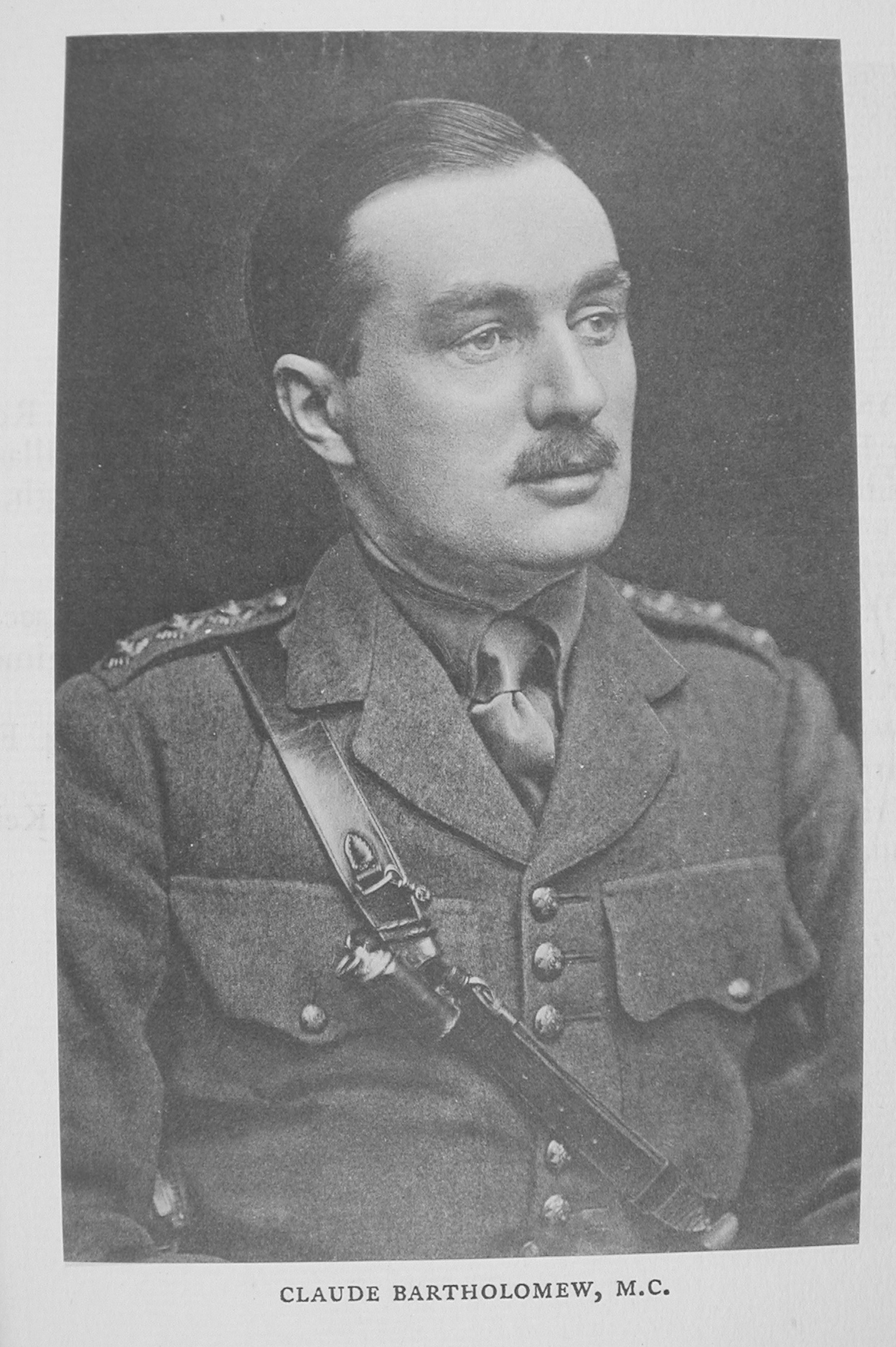
CAPTAIN CLAUDE BARTHOLOMEW, M.C., Scots Guards, was born in August 1883, the elder son of the late Henry Bartholomew. He married in 1907 the youngest daughter of G. W. Share, sister of the Lady Rothermere, and left one daughter. In 1911 he became a member of the Stock Exchange,

He joined his regiment in February 1915, and went straight to the French front in the following month.

He was killed in September 1916, while in command of the Machine Gun Company of the 2nd Guards Brigade.

Source : The Stock Exchange War Memorial 1914-1918

Stearns E G 2nd Lt 4th Royal Fusiliers

Stearns E G 2nd Lt 4th Royal Fusiliers

STEARNS, ERIC GORDON, 2nd Lieut., 4th Battn. Royal Fusiliers, yr. s. of Thomas Robert Stearns, of Lansdowne, Woodridings, Hatch End, co. Middlesex, Insurance Official, by his wife, Alice, dau. of James Grant, of Ipswich and Belize; b. Hornsey, 25 March, 1895; educ. St. John’s College, and Lower School, Harrow was a Clerk in the Sun Insurance Office; joined the Artists’ Rifles (28th London Regt.) in 1912; volunteered for foreign service on the outbreak of war; was given a commission as 2nd Lieut. 6 April, 1915, and posted to the Royal Fusiliers; went to France in Oct. 1914, and died at Abeele of wounds received in action in Belgium, while in charge of a party digging a new trench; unm. His commanding officer, Lieut.-Col. W. F. Sweny, wrote: “I have seen enough of your son to realise what a useful and cool officer he was “; Sergt. F. H. Smith: “Mr. Stearns was almost worshipped by the men under his command; they would have followed him anywhere, for they knew he was a man. He had not an atom of fear in him, and he had always a smile and a cheery word for everybody. I do not think anybody could be more liked and respected than he was and Private W. H. Leighton: “The bullet caught him just above the hip and passed upwards. We did everything we possibly could but all in vain, worse luck. He bore it extremely well, as he always did everything, being a very brave officer and one whom the men had the greatest confidence in and would have followed him anywhere.”

Source : De Ruvigny’s Roll Of Honour Vol 1


Starr T A Pte 11380 8th Welsh Regiment

STARR, THOMAS ADIN, Private, No. 11380, 8th Battn. Welsh Regt., only s. of Thomas Starr, of 2, Bolt Street, Newport, Monmouth; b. 4 Sept. 1887; served with the Mediterranean Expeditionary Force at the Dardanelles from 14 June to 8 Aug. 1915, on which date he was killed in action there; unm.

Source : De Ruvigny’s Roll Of Honour Vol 1

Alston A E Lt Col 10th Duke Of Cornwall’s Light Infantry

Alston E A B Lt Col Northants Regiment Attd Duke Of Cornwall’s Light Infantry


Alston A E Lt Col Northamptonshire Regiment Attd 10th Duke Of Cornwall’s Light Infantry

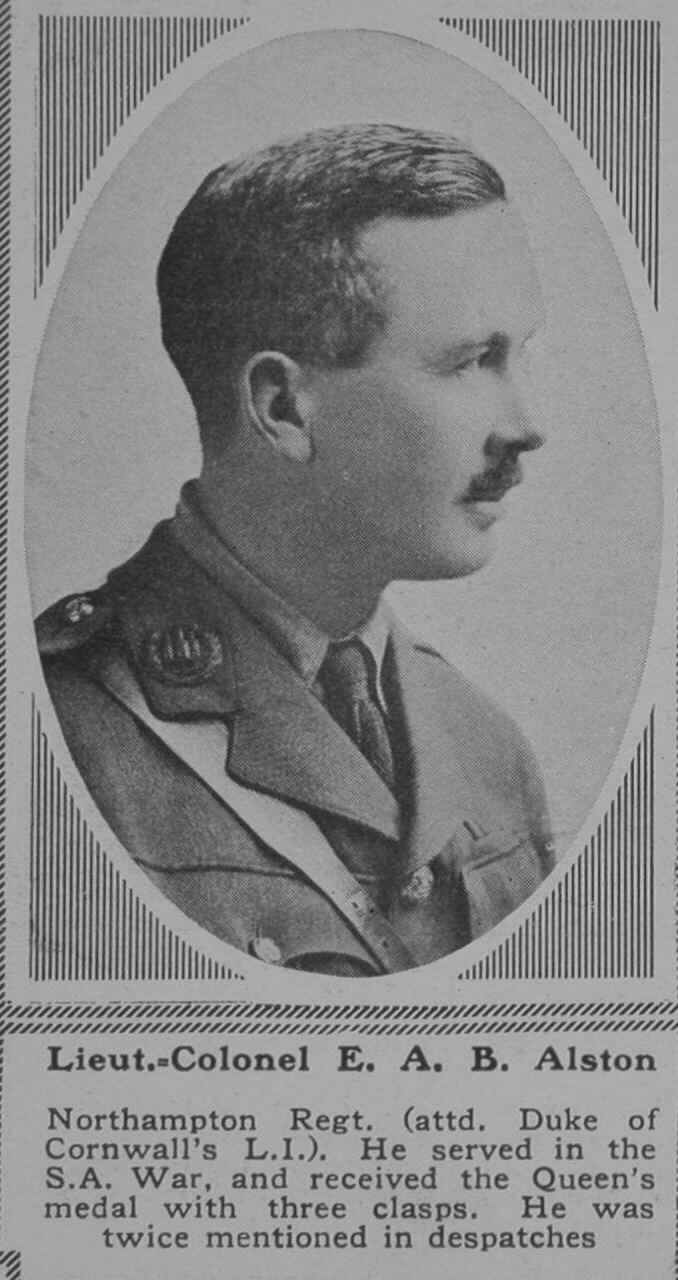
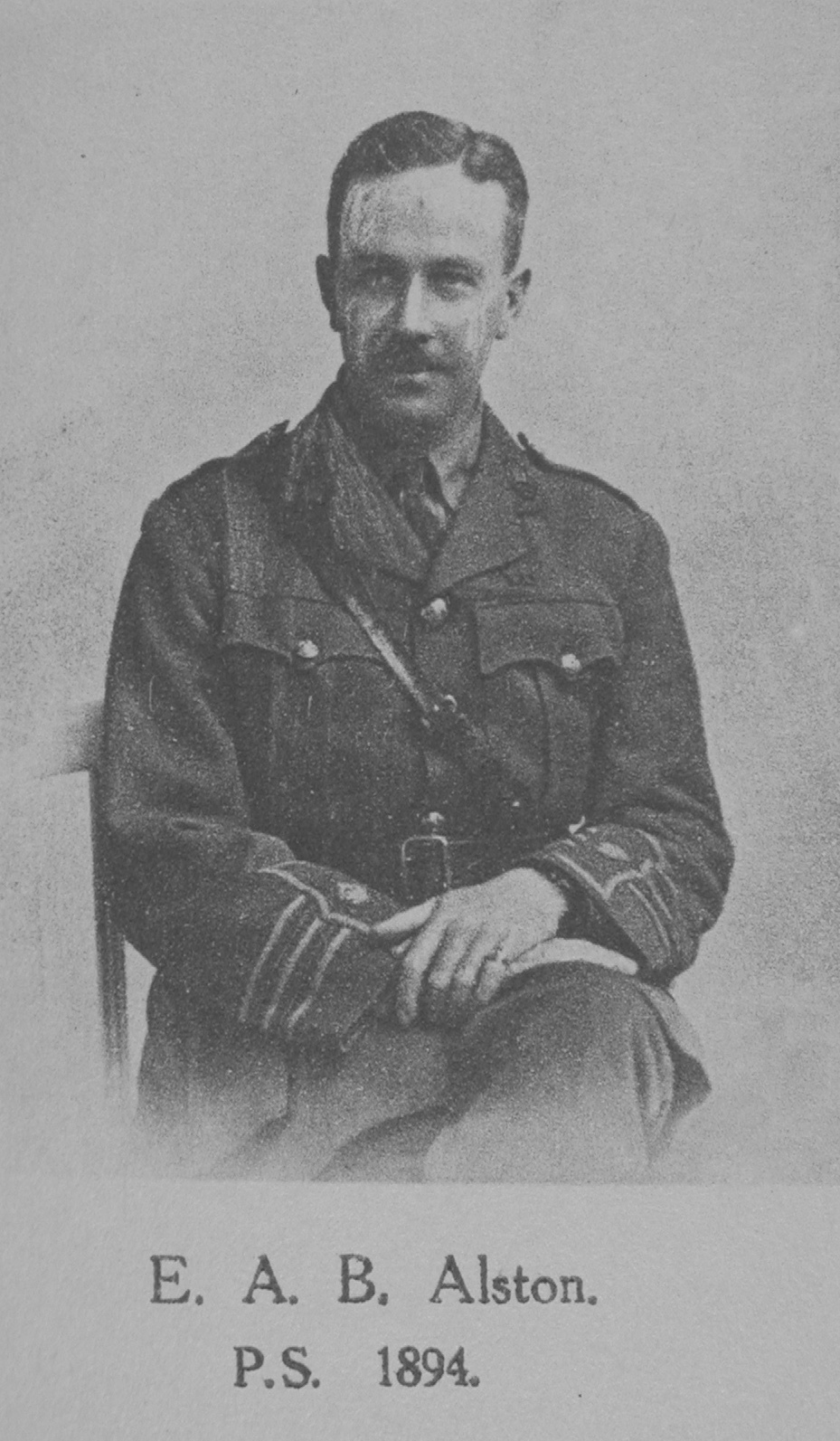
LIEUT.-COL. ERNEST ALFRED BROOKE ALSTON

MAJOR, NORTHAMPTONSHIRE REGT

O.C. 10TH BATTN. DUKE OF CORNWALL’S LIGHT INFANTRY.

KILLED IN ACTION NEAR DUNKIRK, AUGUST 11TH, 1917. AGED 39.

At the School 1893-94 (Parkside).

Lieut.-Col. E. A. B. Alston was the fourth son of the late Surg.-Major William Evelyn Alston and of Mrs. Alston, of East Cliffe House, Sandgate, Kent, and husband of Eileen Alston, formerly of 25, Iverna Court, Kensington, W., and now Mrs. Trevor Finnis, of 9, Kensington Crescent, W.

Entering the School in May, 1893, E. A. B. Alston left at the age of sixteen at Easter, 1894, and entered the Militia in the following year. At the outbreak of the South African War he was gazetted to a commission in the Northamptonshire Regiment, with which he served in South Africa, 1899-1900, being present at the Battles of Belmont, Graspan, and Modder River, and receiving the Queen’s Medal with three clasps.

He was promoted to his Captaincy in July, 1908, and soon after the outbreak of war was gazetted as Temporary Major, October 29th, 1914, to the 5th Battn. (Pioneers) of his own Regiment, and went to the Front with this Battalion in May, 1915. He was promoted to substantive rank as Major, September 1st, 1915, took part in the Actions of the Hohenzollern Redoubt in October, 1915, subsequent to the Battle of Loos, and was mentioned in Despatches for services in France in 1915.

On May 1st, 1916, he was appointed as Temporary Lieut.-Colonel to the command of the 10th (Service) Battn. of the Duke of Cornwall’s L.I. With the exception of six weeks in England after he took over this command, whilst his new Battalion were completing their training, he was on continuous active service abroad from May, 1915, till the day of his death. He commanded this Battalion in the Battles of the Somme, 1916, and in the Battles of Arras in April and May, 1917, and finally on the Belgian Coast, after being for a time in the neighbourhood of the Ypres Salient. He was again mentioned for distinguished services in Sir D. Haig’s Despatch dated November 11th, 1916, and published ou January 1st, 1917, and a third “mention ” appeared after his death, in the Despatch dated November 7th, 1917.

On August 11th, 1917, he and the Major, second in command, and the Adjutant, were asleep at the Battalion Headquarters, near Dunkirk, several miles behind the front line, when the hut was struck by two shells, and he and the Major were instantaneously killed, and the Adjutant mortally wounded. His last thought had been for the guard, whom he had ordered to take cover. He was buried in St. George’s Cemetery, Newport, Dunkirk. The Medical Officer wrote expressing the heartfelt sympathy of the whole Battalion and their great sense of loss, adding that he had been constantly with Col. Alston and had learned to know and to admire him as a true friend. Capt. H. L. Stanistreet, O.T. (P.H. 1914), who was one of his Company Commanders, after telling of their great loss, wrote:- “It is hardly necessary to add that the C.O. is a very sad loss to the Battalion as he was so popular amongst the officers and The C.O. of the 5th Northamptonshires, under whom he served for a year and a half-wrote:- “It seems incredible that one won’t see his genial, cheery face again. He was a gallant officer and nothing ever upset his natural cheerfulness. No one could possibly help liking him, and he was a general favourite with every one. When he was with us I have seen him in one or two pretty hot places, but he was always smiling and joking, and had a cheery word for every one a most gallant officer and a thorough gentleman.”

Source : Tonbridge School And The Great War Of 1914-1919