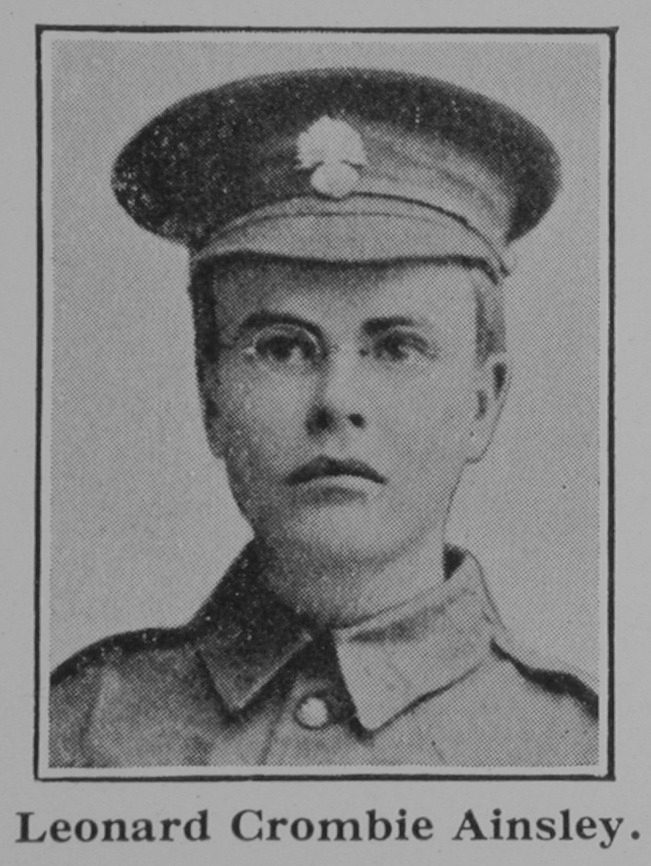
Ainsley C A Pte 3326 4th London Regiment (Royal Fusiliers)

Ainsley C A Pte 3326 4th Royal Fusiliers

AINSLEY, LEONARD CROMBIE, Private, No. 3326, D Coy., 2/4th Battn. Leonard Crombie Ainsley. (Royal Fusiliers) The London Regt. (T.F.), eldest s. of Arthur James Ainsley, of Rangoon, and New Southgate, N., Marine Engineer, by his wife, Fanny, dau. of Thomas McTurk; b. New Southgate, co. Middlesex, 9 June, 1895; educ. Garfield Road School there, and Southgate County School, Fox Lane, Palmer’s Green; was a Clerk in the employ of the Barnet and District Gas and Water Company; joined the Royal Fusiliers 6 Nov. 1914; trained in Malta; served with the Mediterranean Expeditionary Force in Gallipoli from Sept. 1915-Jan. 1916, and with the Expeditionary Force in France and Flanders from April-Sept. 1916; was for a time attached to the 13th London Regt., with whom he took part in the advance of 1 July; rejoined his old regiment in Aug. 1916; was reported wounded and missing after the attack on Cuinchy 9 Sept. 1916, and is now assumed to have been killed in action on that date; unm.

Source : De Ruvigny’s Roll Of Honour Vol 2
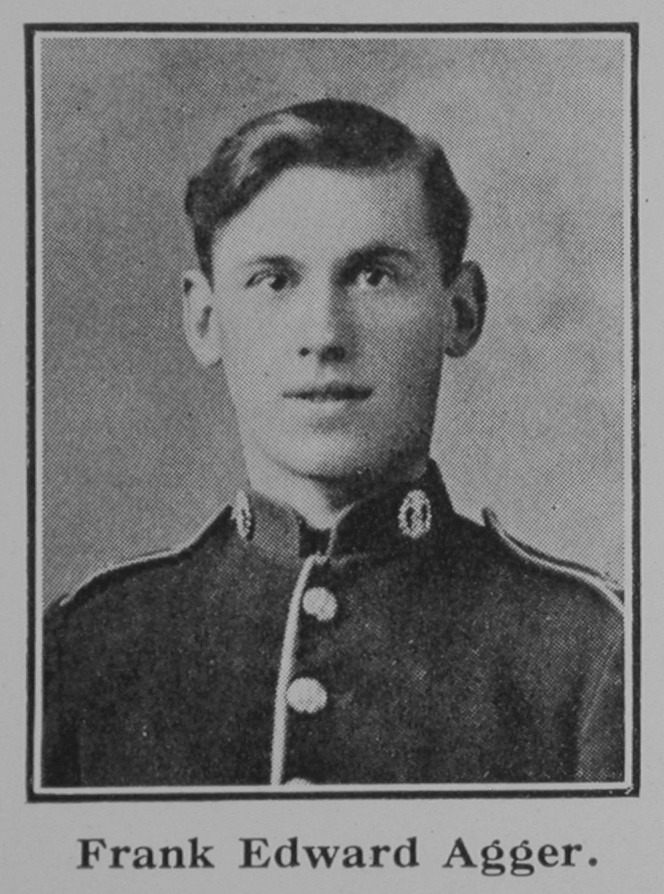
Agger F E Cpl 12880 4th Middlesex Regiment

Agger F E Cpl 12880 4th Middlesex Regiment

AGGER, FRANK EDWARD, Corpl., No. 12880, 4th Battn. The Duke of Cambridge’s Own (Middlesex Regt.), eldest s. of Harry Agger, of 4, Market Hill, Cambridge, Hairdresser and Tobacconist (d. 13 Nov. 1903), by his wife, Elizabeth Sarah (d. 16 May, 1896), dau. of Robert Holder; b. Cambridge, 14 April, 1892; educ. Farningham, and in the Higher Education Class, Aldershot (Sept. 1913-Feb. 1914); enlisted 1 Jan. 1910; formed one of the Body Guard at Hyde Park at the Coronation of King George V., 22 June, 1911; served with the Expeditionary Force in France, etc., and was killed in action during the retreat from Mons, 23 Aug. 1914. At the time of his death he was in charge of a squad of men guarding a railway bridge, at the small village of Oburg, near Mons; they were compelled to retire, and on reaching their lines, Corpl. Agger, who had been wounded, was found to be missing. Two of his comrades went out and endeavoured to bring him in, but were wounded and taken prisoners, a shell bursting as they were lifting him from the ground. He was a good athlete, played football for Middlesex, and ran in the Marathon race from Windsor to London in 1913, which race the King started himself; unm.

Source : De Ruvigny’s Roll Of Honour Vol 2
Adsetts W H 2nd Lt 1st York And Lancs Regiment

ADSETTS, WILLIAM HENRY, 2nd Lieut., 3rd, attached 1st, Battn. (65th Foot) The York and Lancaster Regt., s. of Harry Adsetts, of 12, Watery Lane, Sheffield, by his wife, Mary, dau. of William Osmon Jeffcock; b. 211, Broadfield Park Road, Heeley, 20 Sept. 1893; educ. Woodside Lane Board School and Sheffield University (Scholar), where he graduated B.Sc. 1912, and was a member of the O.T.C.; was gazetted 2nd Lieut. York and Lancaster Regt. 23 Dec. 1914; went to France 2 June, 1915, and died 1 Oct. following, from wounds received in action during the advance at Loos on 28 Sept. Buried in Choques New Cemetery; unm.

Source : De Ruvigny’s Roll Of Honour Vol 2
Adkins L Pte 5927 2nd Coldstream Guards

ADKINS, LEONARD, Private, No. 5927, 2nd Battn. Coldstream Guards; b. Stafford; served in South Africa with South Staffordshire Regt. 17 June, 1901, to 18 July, 1902 (Medal with two clasps), and with the Expeditionary Force in France from 12 Aug. 1914; killed in action at Cuinchy; m.

Source : De Ruvigny’s Roll Of Honour Vol 2

Adie D Pte 431 11th Highland Light Infantry

ADIE, DAVID, Private, No. 431, 11th Battn. The Highland Light Infantry (T.F.), elder s. of Robert Adie, of 60, Arthur Place, Cowdenbeath, Miner; b. Crossgates, Dunfermline, co. Fife, 8. Feb. 1899; educ. Crossgates (Fife) Public School; was a Miner; volunteered and enlisted 25 Aug. 1914; served with the Expeditionary Force in France from beginning of May, 1915, and was killed in action at the Battle of Loos 25 Sept. 1915, by a gunshot wound in the heart; unm.

Source : De Ruvigny’s Roll Of Honour Vol 2

Adey F J Pte 3965 8th Kings Liverpool Regiment

ADEY, FREDERICK JAMES, Private, No. 3965, 8th (Irish) Battn. The King’s (Liverpool Regt.) (T.F.), eldest s. of the late Frank Adey; and brother to Private S. Adey, also killed in action; b. West Bromwich, co. Stafford, 9 March, 1898; educ. there was a Sheet Mill Worker, enlisted 22 Feb. 1915; served with the Expeditionary Force in France and Flanders from the following April, and died 20 June following, from wounds received in action at Hooge. Buried in the local cemetery at Lillers; unm.

Source : De Ruvigny’s Roll Of Honour Vol 2

Addison A AB Clyde Z.2256 Nelson Btn Royal Naval Division

ADDISON, ALEXANDER, A.B., Clyde Z./2256, Nelson (formerly Benbon) Battn. R.N. Division, s. of Alexander Addison, of 25, Seatown, Cullen; b. Cullen, co. Banff, 29 June, 1895; educ. Cullen Higher Grade School; was a Fisherman; volunteered and joined the R.N. in Nov. 1914; served with the Mediterranean Expeditionary Force at the Dardanelles, and died on board the Hospital Ship Rewa 16 July, 1915, of wounds received in action in Gallipoli. Buried at sea between Gallipoli and Egypt. The Chaplain of the Rewa wrote to his father: “You and all your family may well be proud of your brave boy, and his supreme sacrifice for his King and country.” Unm.

Source : De Ruvigny’s Roll Of Honour Vol 2

Adcock J R Sergt 9914 2nd East Surrey Regiment

ADCOCK, JOSEPH ROBERT, Sergt., No. 9914, 1st, attached 2nd, Battn. The East Surrey Regt., s. of Joseph Adcock, of Worcester Park, formerly a soldier in the same regiment, by his wife, Margaret, dau. of James Moore; b. Wandsworth, 1 Oct. 1891; educ. Cheam Council School; enlisted 17 Jan. 1910; became L.-Corpl. 1911; Corpl. 1912, and Sergt. 27 Sept. 1914; served with the Expeditionary Force in France from 6 March, 1915, and was killed in action at the Battle of Ypres 9 May following. A comrade of Sergt. Adcock’s wrote that both of them were in an advanced trench of the line and were ordered to retire, and that he (Adcock) was seen to fall after running a short distance. He m. at Worcester Park Catholic Church, 14 Feb. 1914, Ann Elizabeth (294, Kingston Road, Raynes Park), dau. of Horace George Goulding, of Raynes Park, and had a son, Joseph William, b. 17 July, 1914.

Source : De Ruvigny’s Roll Of Honour Vol 2

Adams W Pte DCM 13208 2nd South Wales Borderers

ADAMS, W., D.C.M., Private, No. 13208, 2nd (formerly 1st) Battn. South Wales Borderers, s. of the late James Adams, by his wife, Harriet (Newland Almshouses, Gloucestershire); b. at Redbrook, co. Glos.; enlisted 1901; served with the Expeditionary Force in France and Flanders, and afterwards at the Dardanelles, and was killed in action there, July, 1915. He was awarded the D.C.M. [London Gazette, 30 June, 1915] “for conspicuous gallantry from the 21st to 23rd December, 1914, near Festubert. Difficulties arose in getting necessary supplies to the men in the forward trenches, and the only known communication trench being impassable, he, with another man, carried the rations over a fire-swept zone of 1,000 yards after the ration party had been dispersed by heavy fire. He subsequently returned and took up ammunition to the same trenches.”

Source : De Ruvigny’s Roll Of Honour Vol 2

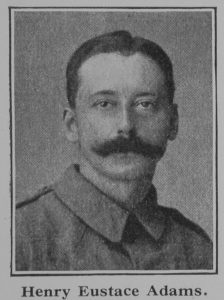
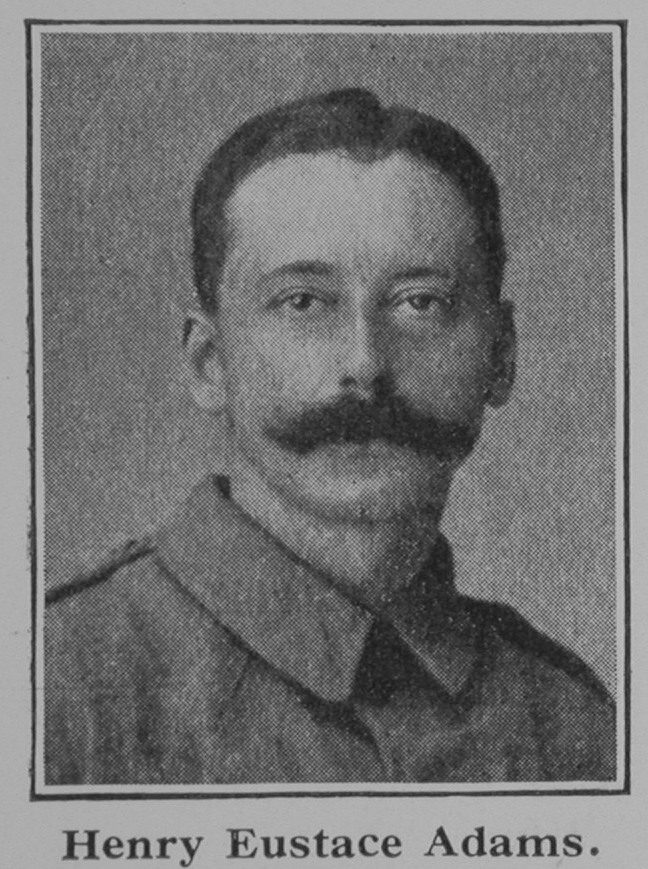
Adams H E Rfn 2950 13th Rifle Brigade And Royal Engineers

Adams H E Rfn 2950 13th Rifle Brigade And Royal Engineers

ADAMS, HENRY EUSTACE, Rifleman, No. 2950, 13th (Service) Battn. The Rifle Brigade (The Prince Consort’s Own), and R.E., yst. s. of the late Robert Adams, of Victor Lodge, Brixton Road, London, S.W., Engineer, by his wife, Ann, dau. of the late Richard Lee, of Cobham; b. London, 19 Oct. 1878; educ. West Cliff School, Ramsgate, and City of London School, matriculating at the University of London in 1900; subsequently entered the architectural profession, serving his articles with the late Mr. H. H. Collins, F.R.I.B.A., and Mr. M. E. Collins, F.R.I.B.A.; passed the Intermediate Examination of the R.I.B.A. in June, 1904; but was afterwards invited to join his father’s business, and on the death of his father became a partner in the firm. On the outbreak of war he endeavoured to enrol in the R.E. or R.A., but, on being informed that their ranks were at that time filled, he joined the Rifle Brigade 9 Sept. 1914; served with the Expeditionary Force in France and Flanders from 29 July, 1915; took part in operations along the British front from Armentières to Albert; was selected for special duties with the R.E. in the winter of 1915-16, and attached to the 147th Army Troop Coy., when he was entrusted with the We survey of important works connected with the 7th Corps line, which included those in front of the villages of Souastre and St. Amand, and prepared the plans which were submitted to Headquarters, and for these services ices he was highly commended; took part in the Battle of the Somme, and died in No. 14 Stationary Hospital, Wimereux, 25 Oct. 1916, from complications supervening on long exposure on the field, after being wounded in action between Contalmaison and Pozieres on 10 July. Buried in Wimereux Communal Cemetery [Grave No. 1170]. A comrade wrote: “We have just learnt of the death of your brother and our late comrade, and I am writing on behalf of the few remaining members of his platoon to let you know how deeply moved we were to hear the news, and also to express our sympathy with you in your great loss. It can honestly be said that he sacrificed his own life with a thought of saving others. had been carrying bombs, etc., up to the front line, a small party of about eight, and we succeeded in getting through a terrible barrage to our destination safely. We were told to take shelter in the front line for a time. It was then he got hit by a piece of shrapnel. As things did not get better, we were told to make our way back, and, of course, take Mr. Adams with us; but he absolutely refused to let us do so, saying he did not want to jeopardize our young lives in attempting to save his. We were all so sorry to leave him, for he was highly respected by us all, and he was always looked upon as our adviser owing to his superior knowledge on almost everything possible to think of. We all appreciated him very much in coming up to fight for the great cause; also he was always most anxious to do anything in his power for our comfort. He was formally transferred to the R.E. by instructions from Headquarters in France, but was still serving with his battalion when he was wounded; unm.

Source : De Ruvigny’s Roll Of Honour Vol 2