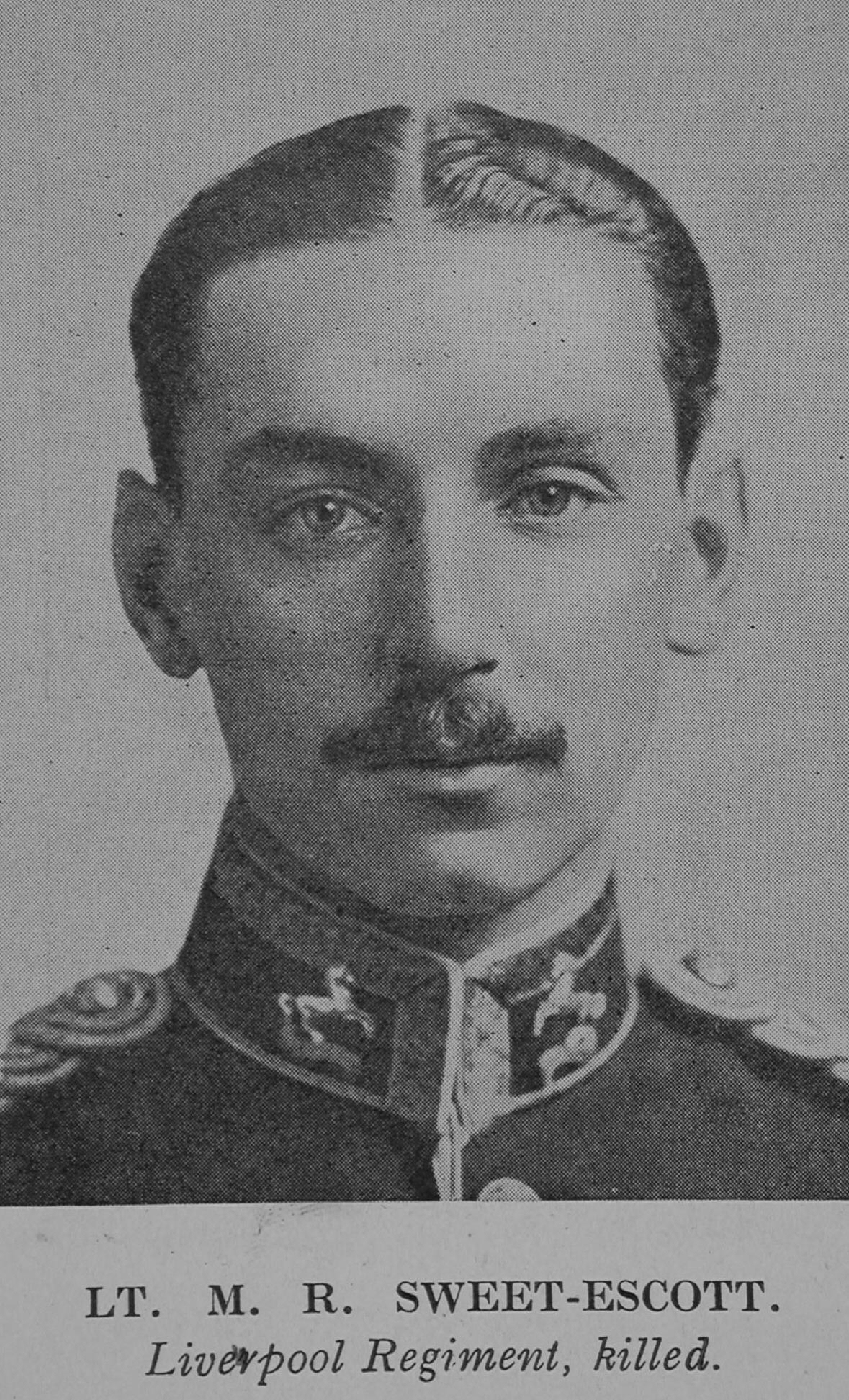
Sweet-Escott M R Lt 3rd Attd 1st The King’s (Liverpool Regiment)
Source : The Navy And Army Illustrated
LIEUTENANT MURRAY ROBERTSON SWEET-ESCOTT (1900-2). 3rd Battalion The King’s Liverpool Regiment.
Born 14th December, 1887. He was gazetted 2nd Lieutenant to the Special Reserve of The King’s Liverpool Regiment in December, 1909, and after a year’s training with the Irish Fusiliers was promoted Lieutenant. In January, 1912, he was appointed A.D.C. to Sir E. B. Sweet- Escott, K.C.M.G., Governor of the Leeward Islands, and in the same year followed him in the same position to Fiji. He returned in the autumn of 1913, and at outbreak of war was attached to the 1st Battalion of his regiment, proceeding to France with it in August, 1914. He was killed in action near Missy, on the Aisne, on 20th September, 1914. He was the younger son of the Rev. E. H. Sweet-Escott, late assistant master of Dulwich College.
Source : Dulwich College War Record 1914-1919
SWEET-ESCOTT, MURRAY ROBERTSON, Lieut., 1st Battn. King’s Liverpool Regt., yr. s. of the Rev. Edward Herbert Sweet-Escott, of Hartrow Manor, Taunton, a Master of Dulwich College, S.E., by his wife, Anna Frances, dau. of Henry Robertson, of Over Stowey; b. Over Stowey, Bridgewater 14 Dec. 1887; educ. Dulwich College, and Marlborough ; gazetted 2nd Lieut. 3rd Battn. King’s Liverpool Regt. (Special Reserve), in Dec. 1909, and, after a year’s training with the Irish Fusiliers, was promoted Lieut. 24 Feb. 1911. Three years later he was seconded for service as A.D.C. to Sir E. B. Sweet-Escott, K.C.M.G., the Governor of the Leeward Islands, and in the same year followed him in the same position to Fiji He returned in the autumn of 1913, and on the outbreak of war at once volunteered for foreign service, being transferred to the 1st Battn. 5 Aug. 1914. He went with his battn. to the Front, and was killed in action on the Aisne, close to Missy and near the town of Brayne, 20 Sept. 1914, and was buried where he fell; unm.
His commanding officer wrote: “Your son was killed while leading his platoon to repel a very heavy attack made on my battn. by six German battns.; and it was in great part due to the gallant behaviour of his company that we were eventually able to repel the attack. I cannot speak too highly of your son’s behaviour, and, although he had been with us so short a time, he had endeared himself to both officers and men.
Source : De Ruvigny’s Roll Of Honour Vol 1