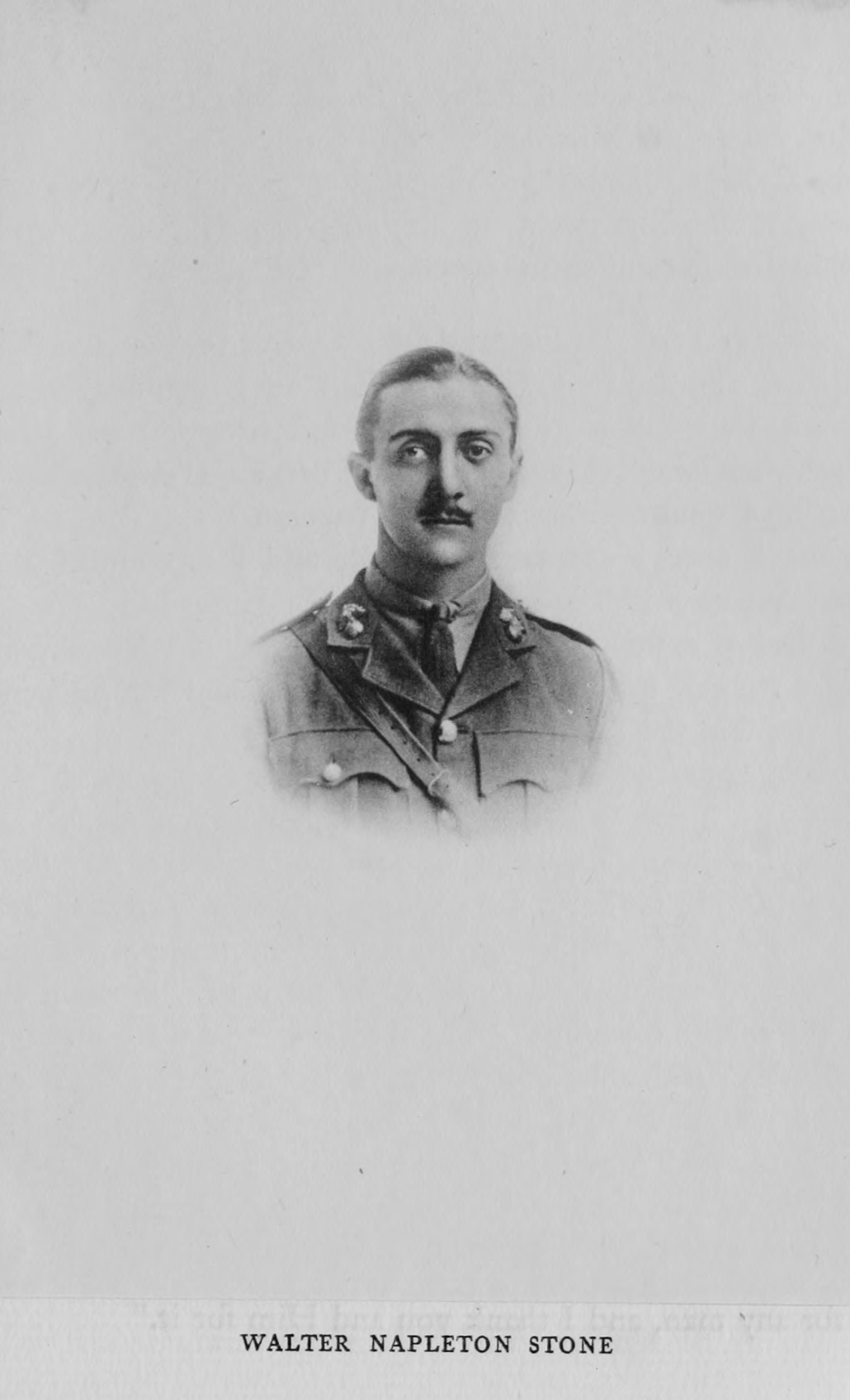
Stone W N Captain VC 3rd Attd 17th Royal Fusiliers
CAPTAIN W. N. STONE, V.C.
Royal Fusiliers
Aged 25
November 30th, 1917
Fifth and youngest son of Edward Stone, Solicitor, and of his wife, Emily Frances Stone, née Miéville.
Pembroke College, Cambridge, 1910.
On leaving Cambridge went to Regina, Canada, and afterwards to Toronto, where he studied land surveying.
Captain Stone returned to England from Canada on the outbreak of the War and joined the Inns of Court O.T.C. in November, 1914. The following month he went to the R.M.C., Sandhurst, and was gazetted to the 3rd Royal Fusiliers in May, 1915. He became Lieutenant in March, 1916, and Acting Captain in the following November.
He left for France in September, 1915, and four months afterwards was appointed Acting Staff Captain to the 5th Brigade H.Q.
He was killed in action between Bourlon Wood and Mœuvres, during the Battle of Cambrai, on November 30th, 1917, and for his conduct on that day was awarded the Victoria Cross.
The following appeared in the “London Gazette Supplement,” February 13th, 1918-
“The King has been pleased to approve of the award of the Victoria Cross to the following Officer: Lt. (A/Capt.) Walter Napleton Stone, late R. Fusiliers. For most conspicuous bravery when in command of a Company in an isolated position, 1000 yards in front of the main line, and overlooking the enemy’s position. He observed the enemy massing for an attack and afforded invaluable information to Battalion Headquarters. He was ordered to withdraw his Company, leaving a rearguard to cover the withdrawal. The attack developing with unexpected speed, Captain Stone sent three Platoons back and remained with the rearguard himself. He stood on the parapet with the telephone under a tremendous bombardment, observing the enemy, and continued to send back valuable information until the wire was cut by his orders. The rearguard was eventually surrounded and cut to pieces, and Captain Stone was seen fighting to the last, till he was shot through the head. The extraordinary coolness of this heroic Officer and the accuracy of his information enabled dispositions to be made just in time to save the line and avert disaster.”
Source : Harrow Memorials Of The Great War Vol 5 1914-1918