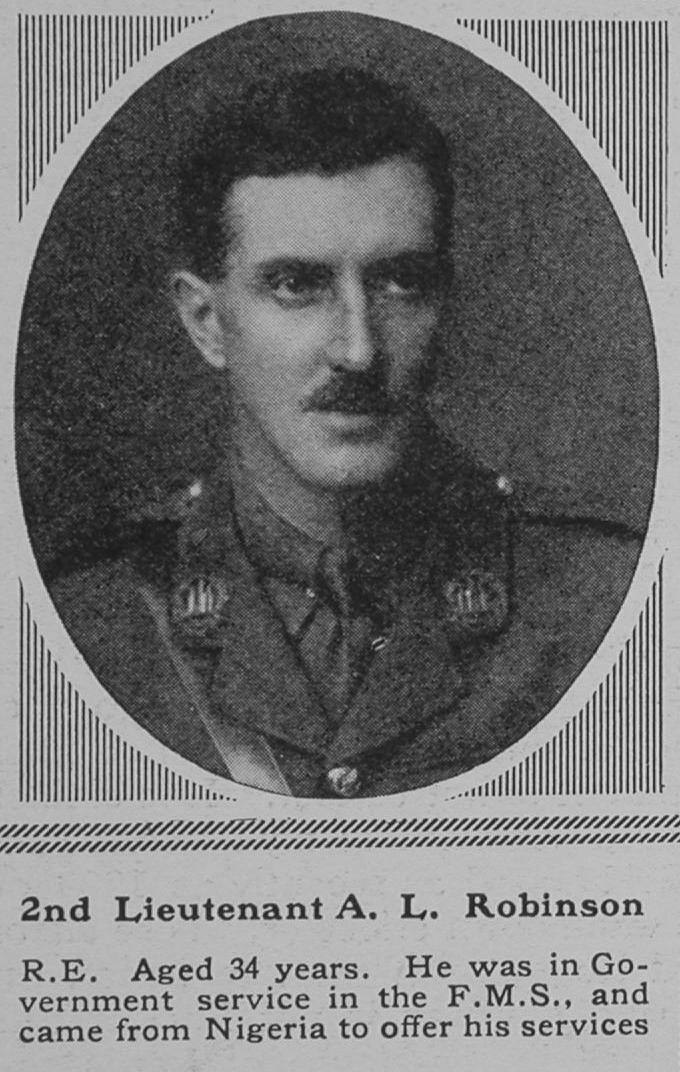
Robinson A L 2nd Lt Royal Engineers
2nd Lieutenant A. L. Robinson R.E. Aged 34 years. He was in Government service in the F.M.S., and came from Nigeria to offer his services
Source : Source : The Sphere 13th May 1916
Service Background
- Colonial Engineering Service: Engineers serving in British colonial administrations—specifically the Federated Malay States (F.M.S.) (often in Railways, Public Works, or Survey departments) and Nigeria (such as the Nigerian Railways or Public Works Department)—frequently traveled back to the United Kingdom at the outbreak of WWI to volunteer.
- Royal Engineers Commission: Because of their civilian technical and surveying expertise, colonial government engineers were routinely granted direct temporary commissions as 2nd Lieutenants in the Royal Engineers (such as Field Companies, Railway Operating Division, or Tunnelling/Signal companies) rather than enlisting in the ranks.
Military Service Details
- Rank & Regiments: Second Lieutenant, 8th (Reserve) Battalion, Northamptonshire Regiment, serving on attachment to the 173rd Tunnelling Company, Royal Engineers (Tunnelling Section).
- Transfer to Tunnelling: Having initially been commissioned as a 2nd Lieutenant in the Northamptonshire Regiment, his background as a professional mining engineer led to his transfer/attachment to the Royal Engineers’ Tunnelling Section less than two months before his death.
- Date of Death: 25 February 1916 (Western Front, France).
- Burial & Commemoration: Buried on 26 February 1916 at Lapugnoy Military Cemetery (Pas-de-Calais, France), where a firing party from the 173rd Tunnelling Company attended his funeral. He is also commemorated on the Royal School of Mines WW1 War Memorial and the Roll of Honour in Ipoh, Malaysia.
Personal & Pre-War Background
- Birth & Family: Born in Mercara, Coorg, India, he was the son of the late Major Mark Robinson (Indian Medical Service) and Elizabeth Robinson, and the husband of the late Grace Leefe Robinson.
- Education & Career: He trained as a mining engineer and became an Associate of the Royal School of Mines (ARSM). Prior to volunteering in WWI, he worked in colonial government service in the Federated Malay States (F.M.S.) and Nigeria.
Key War Diary Events Around 25 February 1916
-
- 17 February 1916: A German camouflet/mine exploded against Hart’s Crater (often transcribed as Hant’s Crater in summaries), killing one Royal Engineers officer (2nd Lt. Wallace Campbell Paterson) and six sappers.
- 25 February 1916 (Day of Robinson’s Death): At 7:00 p.m., the 173rd Tunnelling Company detonated two British mines beneath Hart’s Crater, supported by a full divisional artillery barrage. Second Lieutenant Robinson was killed in action on this date.
- 26 February 1916: The company provided a firing party for Robinson’s burial at Lapugnoy Military Cemetery.