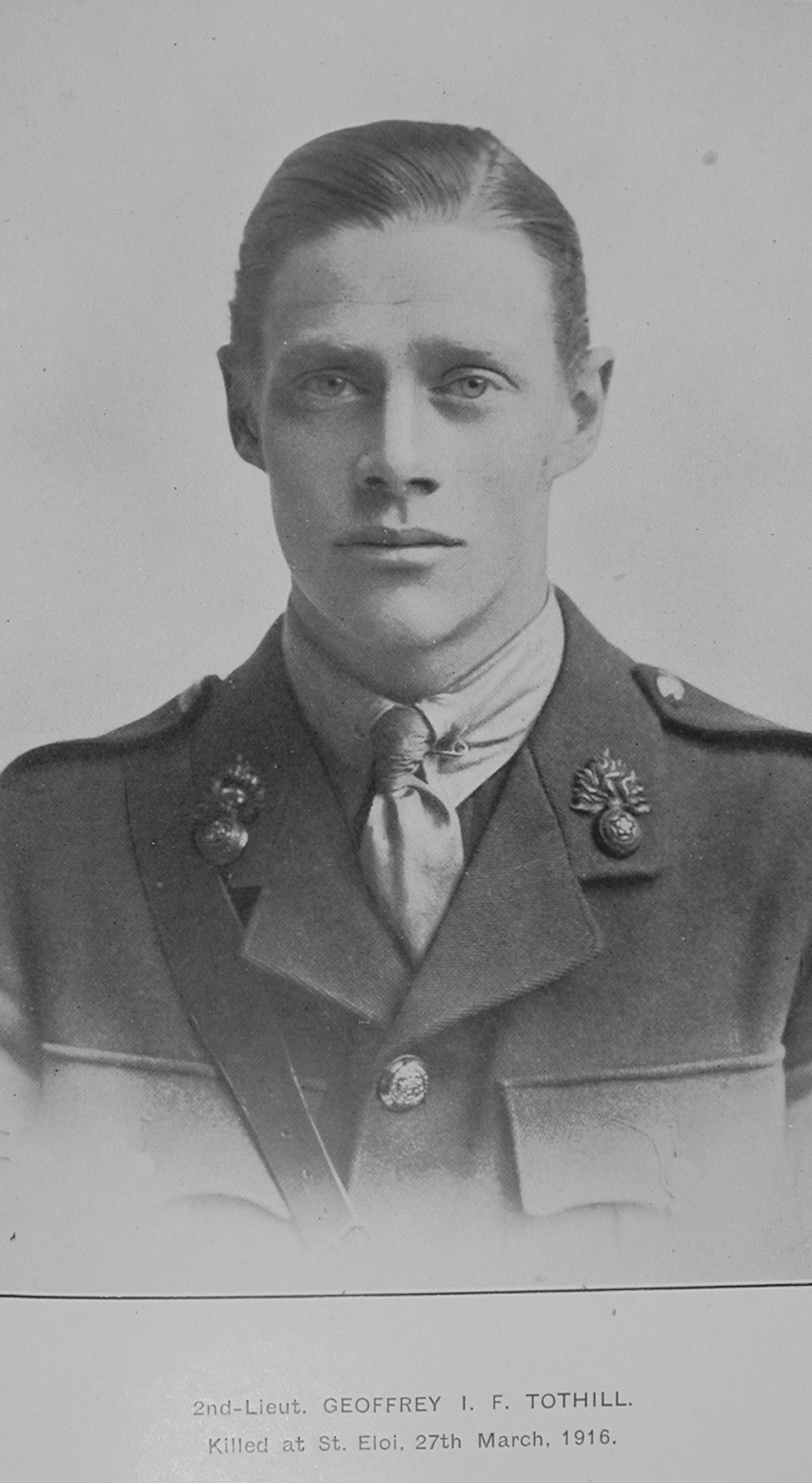
Tothill G I F 2nd Lt 4th London Regiment
Source : Lloyd’s War Memorial 1914-1918
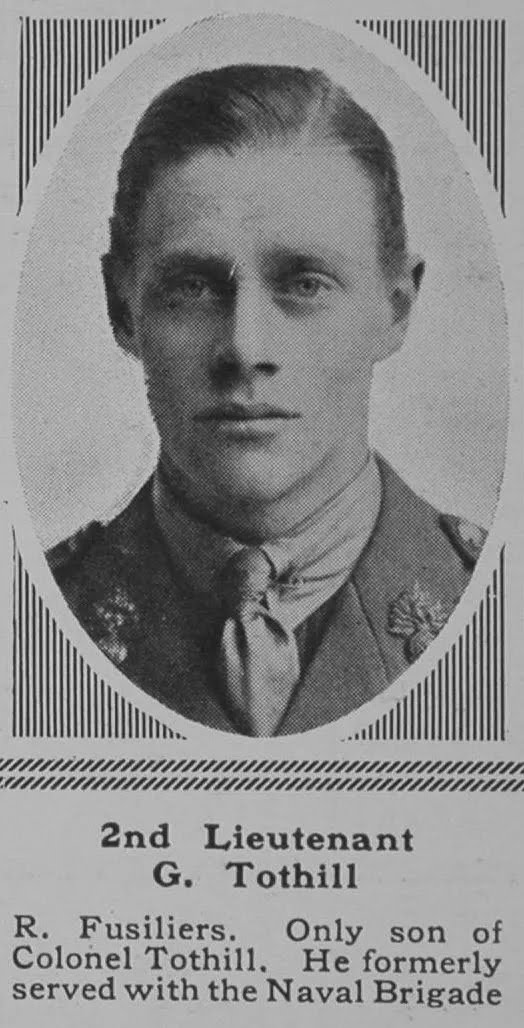
Tothill G 2nd Lt 4th Royal Fusiliers
2nd Lieutenant G. Tothill R. Fusiliers. Only son of Colonel Tothill. He formerly served with the Naval Brigade
Source : The Sphere 20th May 1916
Second Lieutenant Geoffrey Ivan Francis Tothill (1894–1916), who served with the 4th Battalion, Royal Fusiliers, and previously served in the Royal Naval Division / Naval Brigade during World War I. He was the only son of Colonel Francis William Galbraith Tothill (Royal Artillery) and was killed in action on 27 March 1916, aged 22.
Early Life & Family
- Birth. He was born on 21 March 1894 in St. Helier, Jersey.
- Parents. He was the only son of Colonel Francis William Galbraith Tothill (1860–1938), a Royal Artillery officer who served in the Second Boer War and commanded the Royal Artillery at Dover Castle during WWI, and Winifred Arnold Tothill (née Pittis). The family later resided at “Rosenealte” in Fareham, Hampshire.
Military Service
- Royal Naval Division (Naval Brigade). Early in the war, Tothill served as a Sub-Lieutenant in the Royal Naval Volunteer Reserve (RNVR) with the Howe Battalion, Royal Naval Division, seeing action at Gallipoli.
- Royal Fusiliers. He later transferred to the British Army, receiving a commission as a Second Lieutenant in the 4th Battalion, Royal Fusiliers (part of the 3rd Division).
Death & Commemoration
- Action at St. Eloi. He was killed in action on 27 March 1916, just six days after his 22nd birthday, during the fighting at St. Eloi on the Western Front in Belgium. On that day, his battalion suffered heavy casualties—losing 10 officers (including Tothill) and 255 other ranks—under intense German artillery fire.
- Memorial. Because he has no known grave, he is commemorated on Panel 8 of the Ypres (Menin Gate) Memorial in Belgium.
Summary of Events: 27 March 1916 (St. Eloi)
- 04:15 hrs — Zero Hour & Mine Detonation. Without a preliminary artillery barrage (to preserve the element of surprise), British engineers detonated six deep mines beneath the German front line at “The Mound” near St. Eloi. The explosion was massive—reportedly heard as far away as Folkestone in Kent—and obliterated the old landmarks, leaving a chaotic landscape of huge craters and collapsed trenches.
- The Assault. Immediately following the blast, the 9th Infantry Brigade (3rd Division) attacked. While the 1st Battalion, Northumberland Fusiliers advanced on the right, the 4th Battalion, Royal Fusiliers attacked on the left toward Craters 5 and 6.
- Heavy Resistance & Confusion. Unlike the right flank, the 4th Royal Fusiliers met fierce small-arms fire and became disoriented in the waterlogged, cratered terrain. Within a minute of zero hour, German artillery opened a heavy retaliatory barrage on No Man’s Land and the British trenches, inflicting severe casualties on the advancing waves.
- Artillery Duel & Relief. Unable to reach their final objectives near Crater 5, the surviving Fusiliers dug in under relentless German shellfire. An intense artillery duel continued for the rest of the day, making it impossible to relieve the battalion until after midnight; small parties of the 2nd Royal Scots began filtering through in the dark, finally completing the relief at 06:00 on 28 March.
- Casualties. The battalion lost 10 officers and 255 other ranks during the action. Five officers—Captain Moxon and Second Lieutenants Tothill, Howard, Boddy, and Perrier—were killed outright, while Lieutenant Hardman died of wounds three days later. Because the ground was heavily shelled and fought over for weeks afterward, Tothill’s body was never recovered.
-