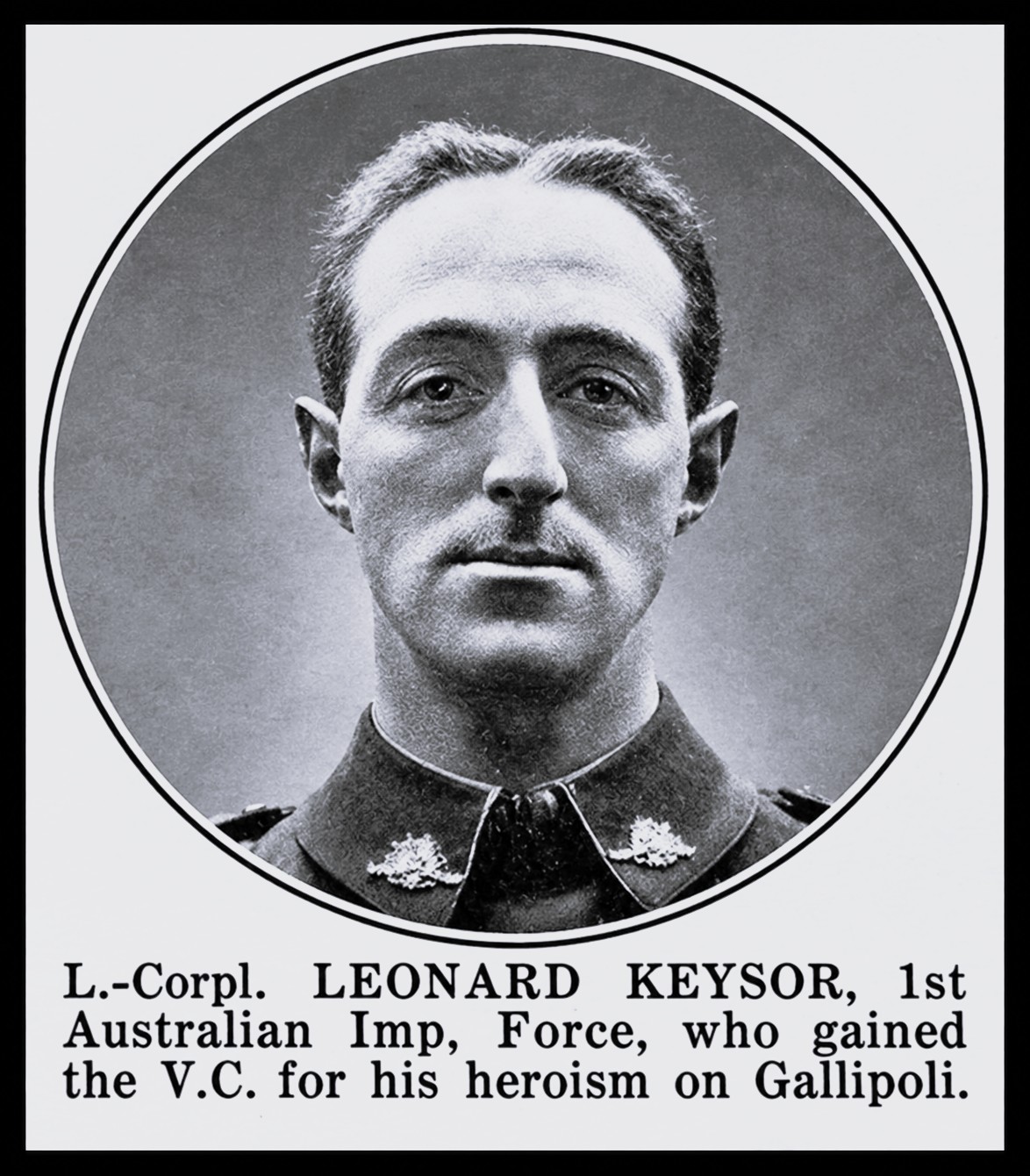
Keysor L LCpl VC 1st Australian Imperial Force
Source : The War Illustrated Vol 5
Gallipoli Action & Victoria Cross
- Battle of Lone Pine (7–8 August 1915): Keysor served as a bomb thrower in the trenches. He picked up and threw back live enemy bombs, smothered blasts with sandbags or clothing, and helped clear enemy troops from a contested trench section.
- Wounds & Endurance: Despite being wounded twice and marked for hospital evacuation, he continued fighting and throwing bombs for roughly 50 hours.
- Medal Display: His Victoria Cross is held at the Australian War Memorial in Canberra.
VC Citation
Awarded to No. 958 Private Leonard Keysor, 1st Battalion, Australian Imperial Force, for conspicuous bravery at the Lone Pine Trenches on the Gallipoli Peninsula. On 7 and 8 August 1915, despite sustaining wounds, he repeatedly caught and returned live enemy bombs, cleared an entrenched enemy position, and refused evacuation to volunteer as a bomb-thrower for another hard-pressed company until the situation was saved.
Later Service & Life
- Born in Maida Vale, London, Keysor moved to Australia in 1914 before enlisting in the Australian Imperial Force.
- After Gallipoli, he later served on the Western Front in France and rose to the rank of lieutenant before medical discharge in December 1918.
Family & Business Life
- Return & Marriage: After briefly working as a clerk in Sydney, Keysor moved back to London. On 8 July 1920, he married Gladys Benjamin, and the couple had one daughter, Joan, in 1921.
- Clock Importing: He settled back in Maida Vale and joined his father’s business importing clocks. A shy man who avoided the spotlight, he famously described himself in a 1940s interview as “a common-or-garden clock importer” and remarked that “the war was the only adventure I ever had”.
- A Courteous Burglar: Shortly after returning to London in 1920, Keysor’s Maida Vale flat was burgled and his Victoria Cross was stolen. Upon realising whom the medal belonged to, the burglar mailed it back to him.
The 1927 Film Accident (For Valour)
- On-Set Explosion: In 1927, director G.B. Samuelson persuaded Keysor to play himself and re-enact his Lone Pine bomb-throwing exploits for the silent film For Valour (released in 1928).
- Severe Injuries: Unbeknownst to Keysor, the director was dissatisfied with the weak explosions of the dummy bombs and instructed an electrician to wire up much larger explosive charges. When Keysor picked up a sandbag to smother a “bomb,” it detonated centimetres from his face.
- Aftermath & Lawsuit: The blast fractured his jaw, required the removal of eight teeth, and peppered his left arm and leg with shot. Keysor successfully sued Samuelson for damages and was awarded £675.
World War II & Final Years
- Home Front Efforts: When World War II broke out in 1939, Keysor—who remained on the Australian Military Forces inactive reserve list—tried to re-enlist for active duty. He was rejected on medical grounds due to the lasting effects of being gassed on the Western Front in 1918. Instead, he and Gladys opened their London home to Jewish refugees and assisted families during the Blitz.
- Community & Memorials: Living in Britain meant Keysor was the only Australian WWI Victoria Cross recipient able to attend the first two Victoria Cross Reunions in London in 1920 and 1929. He was active in the Anzac Club and Jewish ex-servicemen’s parades, though he suffered from deafness in his later years.
- Death & Legacy: Keysor died of cancer in Paddington, London, on 12 October 1951 at age 65, and was cremated at Golders Green Crematorium following a service at the Liberal Jewish Synagogue in St John’s Wood. His life in the city is commemorated by a paving stone in Victoria Embankment Gardens and a plaque at Rodney Court in Maida Vale, where he lived in the 1940s and 1950s. Further biographical details are recorded on the Australian Dictionary of Biography and the Anzac Portal.