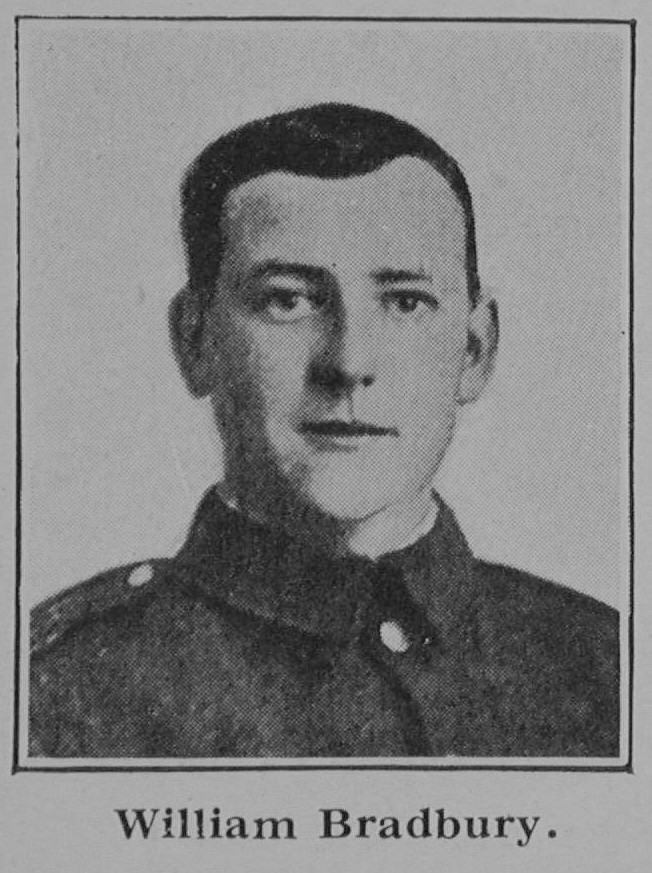
Boyd W N L Lt 2nd Seaforth Highlanders
BOYD, WILLIAM NOEL LAWSON, Lieut., 2nd Battn. (78th Foot) Seaforth Highlanders (Rossshire Buffs, The Duke of Albany’s), only surv. child of William Boyd, of 26, Inverleith Place, Edinburgh, Writer to the Signet, Member of the King’s Body Guard for Scotland (R.C.A.), by his wife, Laura, dau, of the late John Crerar, of Halifax, Nova Scotia; and gdson. of the late Sir John Boyd, of Maxpoffle, co. Roxburgh, by his wife, Isabella, 2nd dau. of John Lawson, 14th Laird of Cairnmuir, co. Peebles; and brother to 2nd Lieut. Nigel John Lawson Boyd, who died from wounds received in action at the Battle of the Aisne 14 Sept. 1914 (see Vol. I, page 46); b. Edinburgh, 26 Dec. 1892; educ. Cargilfield, Midlothian: Clifton College, and Exeter College, Oxford, being a member of the O.T.C., both at Clifton and Oxford. When war broke out he was in Norway, visiting friends there, and at once telegraphed that he was returning to take up a commission; after considerable difficulties he arrived in Scotland 14 Aug. 1914; immediately reported himself to the Headquarters of the O.T.C. at Oxford; was gazetted 2nd Lieut. 7th (Service) Battn. Seaforth Highlanders at the beginning of the following month, and, after a period of training at Churn Camp, he joined his battalion at Aldershot in Oct. subsequently applied to be transferred to the 3rd (Special Reserve) Battn. Seaforth Highlanders, which battalion he joined early in Jan. 1915. When training with the 3rd Seaforths, he definitely decided to adopt the Army as a profession, and, on a recommendation from the University of Oxford, obtained a commission in the Regular Army, being posted to the 2nd Battn. of his regiment served with the Expeditionary Force in France and Flanders from March, 1915, when he joined his battalion, with which he was in the trenches near Messines, and took part in other operations in which it was concerned, including the Second Battle of Ypres. He was reported wounded and missing on 25 April, 1915, and from the evidence which was afterwards obtained. it has been concluded that he was killed in action on that day.
It appears that on 25 April his company was the leading company of the battalion in an attack upon the German trenches, north-east of Ypres, near St. Julien, and came under very severe fire. He was reported to have been seen leading his platoon with fine gallantry throughout the attack, and got to within about 20 yards of the enemy’s lines when he was observed to be wounded. He was believed to be hit again, and, as stated, it has been decided, from the testimony received, that he must have been killed in action on that day. From the battalions of the regiment with which he had been connected came expressions of the estimation in which he had been held, and special appreciation of the fearless devotion to duty displayed on the day he fell. Warm-hearted and generous, he had many friends among whom he was a great favourite. He was a keen sportsman, being specially devoted to shooting and fishing, and he rowed for his college in 1913 and 1914; unm.
Source : De Ruvigny’s Roll Of Honour Vol 5