King R N Captain 1st Lincolnshire Regiment

King R N Captain 1st Lincolnshire Regiment

CAPTAIN R. N. KING

IST BATTALION THE LINCOLNSHIRE REGIMENT

ROBERT NEAL KING was the only son of Robert King, of Moulton, Lincolnshire.

He entered the School in 1890. He obtained his first Commission in the 2nd Battalion in 1896 and was promoted Captain in 1904.

He served in the Nile Expedition of 1898, was present at the Battle of Atbara, and received the British Medal and the Egyptian Medal with Clasp. He served with the Mounted Infantry in the South African War in 1902, and took part in the operations in the Transvaal, Cape Colony and the Orange River Colony, and received the Queen’s Medal with four Clasps.

He retired in 1911 and joined the Reserve of Officers, but was called up on Mobilisation, in August, 1914, went to France in September, and was reported killed in action at Wytschaete, near Ypres, on November Ist, 1914. Age 38.

He married, in 1910, Klara, second daughter of Robert Shand Kynoch-Shand, of Hillside, Kincardineshire, and of the Linn, Keith, Banffshire, and had two sons.

Source : Memorials Of Rugbeians Who Fell In The Great War Vol 1

KING, ROBERT NEAL, Capt., 1st Battn. Lincolnshire Regt., only s. of the late Robert King, M.D., F.R.C.P., London, by his wife, Esther, dau, of Thomas Case; b. in London, 14 Sept. 1874; edue. Rugby; gazetted 2nd Lieut., 1st Lincolns, from Militia, 6 June, 1896; promoted Lieut. 31 July, 1899, and Capt. 19 Nov. 1904; served in the Nile Expedition, 1898, and was present at the Battle of the Atbara (medal; Egyptian medal with ciasp); in the South African War, 1902, where he was employed with Mounted Infantry in operations in the Transvaal and Cape Colony, April and May, 1902, and in the Orange River Colony, Jan. to March, 1902 (Queen’s medal with four clasps); and from 24 Dec. to 31 Dec. 1901, was on special service. He retired 21 June, 1911, and was placed in the Reserve of Officers, but re-joined his regt. on the outbreak of war; left for France, Sept. 1914, and was reported killed in action at. Wystchaete, 1 Nov. following. Capt. King m. at St. George’s, Hanover Square, London, 19 Dec. 1910, Klara Alice Fanny, 2nd dau. of Robert Shand Kynoch Shand, of Hillside, co. Kincardine, and the Linn Keith, co. Banff, and had two sons: Robert McKerrell, b. 24 Nov. 1911, died 3 Nov. 1914; and Philip Marshall, b. 23 March, 1914.

Source : De Ruvigny’s Roll Of Honour Vol 1

Kelly H H Captain Royal Engineers

Kelly H H Captain Royal Engineers

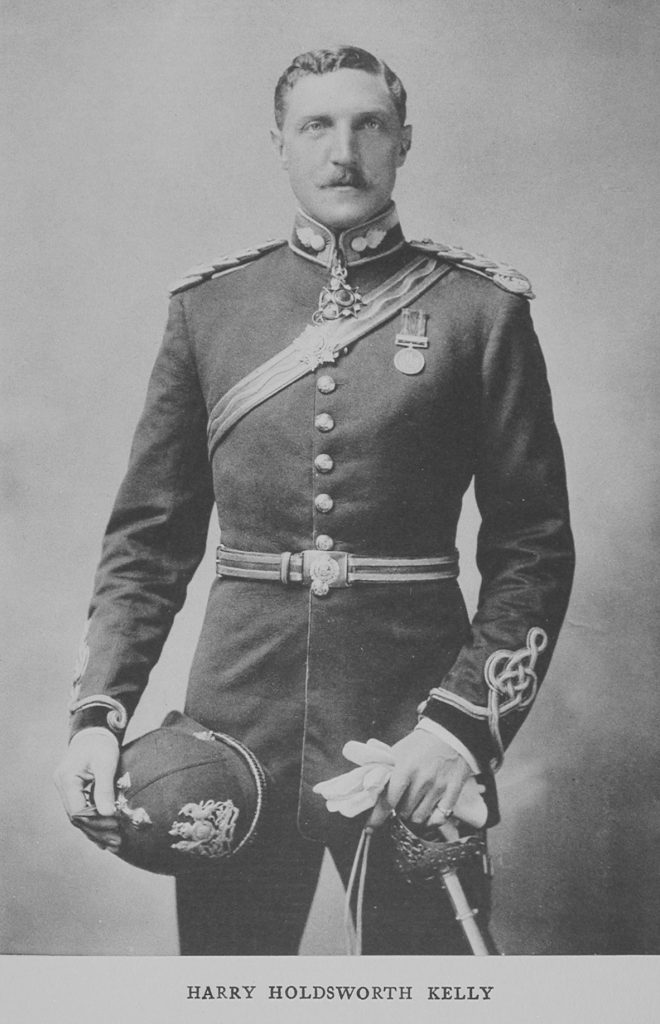
CAPTAIN H. H. KELLY

ROYAL ENGINEERS

HARRY HOLDSWORTH KELLY was the fourth and youngest son of Lieutenant-Colonel Henry Holdsworth Kelly, Royal Marine Artillery, of Montrose House, Southsea, and of Elizabeth Eleanor, daughter of John Collum, of Bellune, County Fermanagh, Ireland.

He entered the School with a Modern Language Scholarship in 1894, was Head of his House in his last Term and passed sixth into the R.M.A., Woolwich, in 1896. At Woolwich he was Under-Officer, was in the first XV, and won the Boxing Medal in 1898. He received his Commission in 1899 and was promoted Captain in 1908.

He played in the Hampshire County Football Team in 1899 and won the Army and Navy Heavy-weight Boxing Championship, at Aldershot, in 1901.

From 1903 to 1913 he served with the Egyptian Army. He was Resident Engineer for the construction of the town and harbour of Port Sudan, and received the 4th Class Osmanieh, for services in connection with this. He was Inspector of Roads and Communications for the Sudan, 1908-13. He served as a member of the Lado Enclave Commission in 1911. He was appointed by the Sudan Government as Commissioner for the Sudan-Uganda Boundary Commission in 1913 and was responsible for the Reconnaissance to the Borna Plateau in the same year.

He took part in the operations in the Atwot Region, Sudan, in 1910, receiving the Sudan Medal, and in the operations against the Beir and Anuak tribes in South Eastern Sudan as Intelligence Officer in 1912, adding a Clasp to the Sudan Medal and receiving the 3rd Class Medjidieh.

He was awarded the 3rd Class Osmanich in 1913, for which he was qualified, at so early an age, only by his local rank of Lieutenant-Colonel.

He carried out explorations in Abyssinia in 1907, 1911, and in 1913, and was a Fellow of the Royal Geographical Society.

He went to the Front at the beginning of the War, with the 38th Field Company R.E., and while engaged in superintending the erection of wire entanglements between ours and the enemy’s trenches, he was shot by a sniper on the night of October 24th, 1914. Age 34.

The Sirdar of Egypt, and his brother Officers testified to the gallantry of this distinguished soldier:—

“It was not only total absence of fear, but absolutely sound judgment and capacity for carrying a thing through, and readiness to take responsibility, which made him a marked man.”

“He was so big and cheery, never depressed however tired and hard-worked he might be, and did his duty gallantly. Although exposed daily and nightly to possibly greater risks than others, he was always willing and helpful and a pattern to all.”

“He was greatly loved and admired by his comrades. Had he lived he would have gone far-very far indeed.”

A brother Officer, who was wounded, wrote in the following terms:-

“It was a great blow to me to read of Kelly having been killed in action, just after I had written a letter thanking him for being so kind to me after I was hit. He came down some miles to see me in the trenches, under heavy fire, saw me into the dressing station, and did not leave me until just before I left in the ambulance wagon. The dressing station was under fire and was struck by a shell just before I was got away. He was a fine man, 6 ft. 6 in. in his socks, beautifully built, popular and known everywhere, and I was very proud of his friendship.”

Source : Memorials Of Rugbeians Who Fell In The Great War Vol 1

KELLY, HARRY HOLDSWORTH, Capt., R.E., yst. s. of Lieut. Col. Henry Holdsworth Kelly, R.M.A. (ret.), of Montrose House, South-sea, by his wife, Elizabeth Eleanor, dau. of John Collum, of Bellevere, co. Fermanagh; b. Staff Officers’ House, Eastney Barracks, Portsmouth, 24 Aug. 1880; educ. Rugby and R.M.A., Woolwich (Feb. 1897-99); gazetted 2nd Lieut. R.E. 8 March, 1899; promoted Lieut. 25 July, 1901, and Capt. 8 March, 1908; served with the Egyptian Army, 1903-13; was Resident Engineer for the construction of the lown and Harbour of Port Sudan, 1904-08, and received the 4th Class Osmanich for services in connection with this, 28 June, 1908; was Inspector of Roads and Communications for the Sudan, 18 Nov., 1908, serving as a member of the Lado Enclave Commission in 1911: Commissioner for the Sudan Government in the Sudan-Uganda Boundary Commission, 1913, and was responsible for the Reconnaissance to the Boma Plateau, carried out in the same year; took part in the operations in the Atwot Region, Sudan, in 1910 (Sudan medal), was Intelligence Officer in the operations against the Beir and Anuak tribes in South Eastern Sudan (clasp to Sudan medal and 3rd Class Mediidieh) 1912; decorated with the 3rd Class Osmanich, 1913; re-absorbed into the British Establishment, Nov. 1913.

He served with the 38th Field Coy. R.E. in France, and was killed in action at Bois Grenier, near Armentières, 24 Oct. 1914, while superintending wire ontanglement work between the British and German trenches; buried at Bois Grenier; uam. His Commanding Officer, Major F. M. Browne, wrote: “Не was killed early this morning while on duty in the trenches. He was struck by two bullets, one in the head and one in the back, and I feel sure that death was instantaneous and painless. We were enabled to recover his body, which was to-day buried simply by the chaplain in the presence of all the Coy. His grave lies by the roadside near a pretty country town and we are at present crecting a cross and railings to enclose it. I need hardly tell you what a great loss your son’s death is to me, both as a friend and an officer. He was invaluable to me in every way and the country has lost in him a most valuable officer”; and writing home from a Colchester Hospital, Lieut. Arthur Evans, Royal Engineers (of Carnarvon), paid a tribute to the bravery and kindness shown by Capt. Kelly. who commanded his coy., in attending to him when he was wounded, four days before Capt. Kelly himself was killed. The letter states: “It was a great blow to me to read of Kelly having been killed in action just after I had written him a letter thanking him for being so decent to me after I was hit. He came down to me some miles from Coy, headquarters to the trenches, which must have been under heavy fire, saw me into the dressing station, and did not leave me until just before I left in the ambulance wagon. The dressing station was under fire, and was struck by a shell just before I got away. He was a fine man, 6 ft. 6 in. In his socks, beautifully built, popular and known everywhere, and I was very proud of his friendship.” Capt. Kelly won the Army and Navy Heavyweight Boxing Championship in 1901. He carried out explorations in Abyssinia in 1907, 1911 and 1913.

Source : De Ruvigny’s Roll Of Honour Vol 1

Johnston E J F Captain 1st Royal Scots

Johnston E J F Captain 1st Royal Scots

CAPTAIN E. J. F. JOHNSTON

IST BATTALION THE ROYAL SCOTS (LOTHIAN REGIMENT)

EDWARD JOHN FARQUHARSON JOHNSTON was the elder son of E. F. Johnston, Ship Owner, London, and Mary his wife.

He entered the School in 1896, and left in 1899. He joined the Royal Scots from the Militia, in 1901, and was Adjutant of the 1st Battalion, 1906 to 1909, and of the 3rd Battalion, 1911 to 1914. He was promoted Captain in 1909. He served in the South African War and received the two Medals with five Clasps. He was killed in action in Flanders on April 12th, 1915. Age 32.

He was mentioned in Despatches of May 31st, 1915.

Lt. Col. David Callender, C.M.G., Commanding his Battalion, wrote:-“He was so dependable, so lovable, so absolutely certain always to do the right thing. He never spared himself at his work in the trenches or out. He seemed to have no fear, and would walk about from one trench to another all night long. He was far and away the best, and best loved Officer I have met.”

A brother Officer and the Chaplain of the 81st Infantry Brigade wrote:-

“An example of what an Officer should be, loved and respected by every man in the Regiment, and we know that, had he been spared, he was destined to rise to great heights in his profession.”

“His life has not been lived and given in vain, for the qualities and virtues that made him the man he was, will live and bear rich fruit in the lives and characters of those who knew and loved him. Could you have stood with us to-day, as we laid him to rest, and heard the sobbing of his men and brother Officers, it would have told you how much of all that is best and noblest in man your husband stood for.”

A Corporal and a Sergeant wrote:-

“His loss is felt in every sense of the word, as the men put complete trust and confidence in him. At night, instead of sleeping, he would crawl along to the men at the listening posts between the German lines to see how they were getting on. He used to pray with his men every night in the trenches, and give them all the comfort he could.”

“The bravest man I ever knew was my Captain, Captain Johnston. The men worshipped him, and would have followed him anywhere. Always after being in action they would ask if the Captain was safe, and they said that God took care of him. He was so brave, they had come to believe that nothing could happen to him.”

He married in October, 1907, Vivien Hope Mignon Bayley.

Source : Memorials Of Rugbeians Who Fell In The Great War Vol 1

Royal Scots Officers 1st Battalion

Source : The Royal Scots 1914-1918 By E Wing

Higginbotham C E Major 2nd Northamptonshire Regiment

Higginbotham C E Major 2nd Northamptonshire Regiment

MAJOR C. E. HIGGINBOTHAM

2ND BATTALION THE NORTHAMPTONSHIRE REGIMENT

CHARLES ERNEST HIGGINBOTHAM was the second son of Charles Titus and Agnes Higginbotham, of Craigmaddie, Milngavic, N.Β.

He entered the School in 1880, and left in 1884, in which year he was in the XI.

He proceeded through Sandhurst to the Army, obtaining his Commission in the Northamptonshire Regiment in February, 1887, his Company in 1899, and his Majority in 1907. He had a Staff appointment at Devonport during the Boer War, but served subsequently in South Africa with his Regiment, 1903-07. From 1909-13 he was on the Staff at Aldershot as Inspector of Gymnasia, and did a great deal to encourage all sport in the Army among Officers and men. He captained the Aldershot Officers’ Cricket X1 for several years, taking it over in 1911.

He was killed at Neuve Chapelle, on March 10th, 1915, but no details were received as all those who were with him were also killed. Age 48.

His Commanding Officer wrote from France:-

“Had he alone survived I should be content for the future of the Regiment. He was everything to me during this War, as a soldier.”

Another Officer at Aldershot said:-

“He was a sportsman in the highest sense of the word, always cheerful, kindly and considerate, beloved by his brother Officers and by all the men who came under him. He was an ideal type of British Officer.”

He married in January, 1891, Florence H. Hopkins, who died in January, 1907. In 1909 he married Lucy Frances Gray Round, who died March 5th, 1915, five days before he was killed.

Source : Memorials Of Rugbeians Who Fell In The Great War Vol 1

Heywood G G Pte 1218 1st Honourable Artillery Company

Heywood G G Pte 1st Honourable Artillery Company

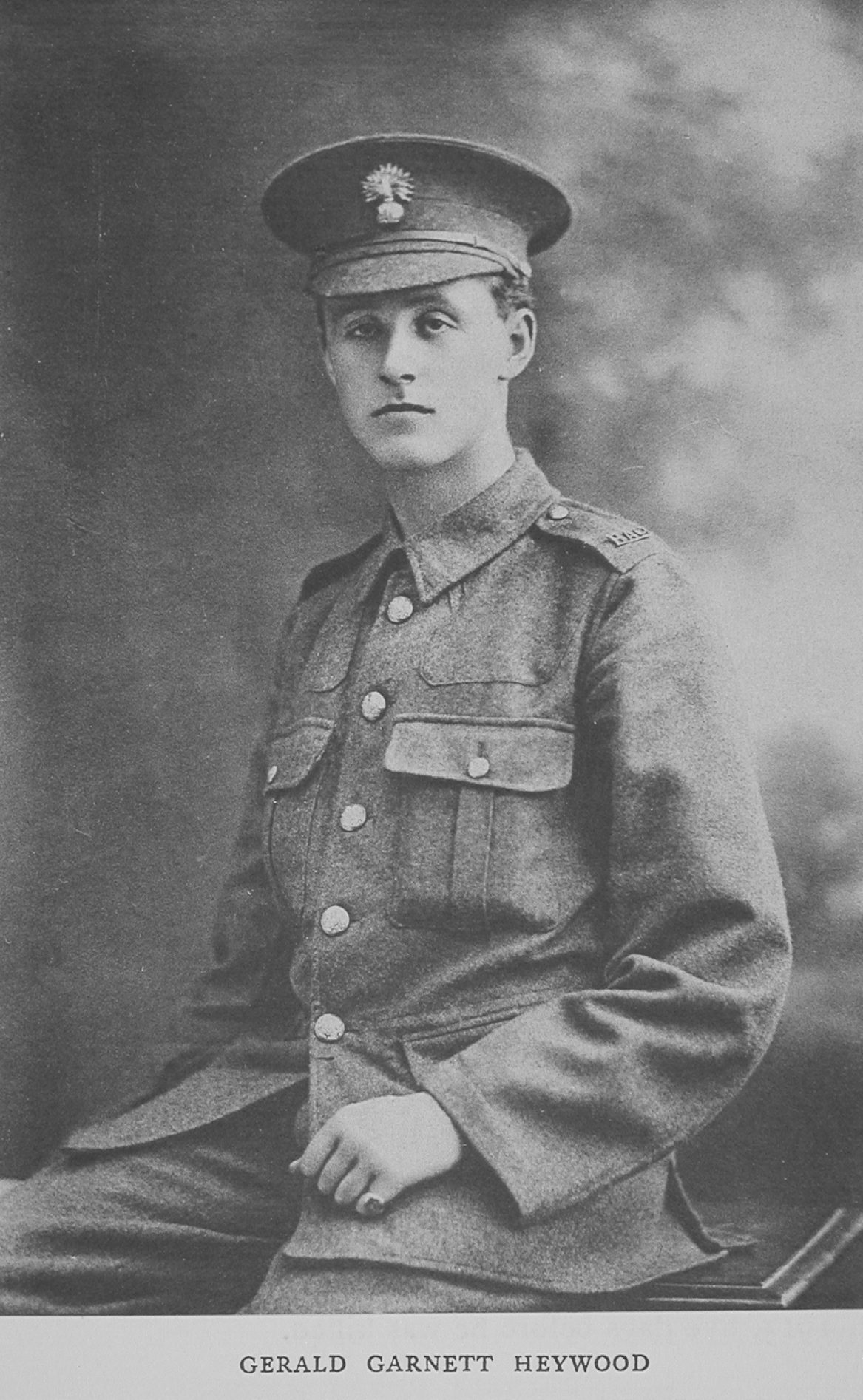
PRIVATE G. G. HEYWOOD

1ST BATTALION HONOURABLE ARTILLERY COMPANY

GERALD GARNETT HEYWOOD was the second son of James Garnett and Alice M. de Quincey Heywood, of Chislehurst. He entered the School in 1906, and left in 1910 for Hertford College,

Oxford, taking a Second Class in the Modern History School, in June, 1914. He joined the H.A.C. on August 8th, 1914, and was sent to the Front in September.

While in the front trenches near Ypres he was wounded by shrapnel in the head, on February 15th, 1915. He was sent back to England on March 5th, and died in Derby Infirmary, on March 12th. Age 23.

His Lieutenant wrote of him:-

“Gerald has been perfect over here. Always cheerful and willing to do anything, he has borne the hardships as well as the toughest. He has never missed going up to the firing line, and has been the heart and soul of the section under most trying conditions.”

The Chaplain of the Hospital at Bailleul wrote:-

“We all feel his loss keenly, because we were filled with admiration for one who showed us a glorious example of the patience and courage of a British soldier and gentleman.”

Source : Memorials Of Rugbeians Who Fell In The Great War Vol 1

Herbert-Stepney H A Major Irish Guards

Herbert-Stepney H A Major Irish Guards

MAJOR H. A. HERBERT-STEPΝΕΥ

IRISH GUARDS

HERBERT ARTHUR HERBERT-STEPNEY was the eldest son of George Herbert-Stepney, of Alberta House, Templeogue, County Dublin.

He entered the School in 1893, and passed on to the R.M.C., Sandhurst, in 1897. He was gazetted to the Coldstream Guards in 1898, and served in the South African War, 1900-01, when he was slightly wounded. For his services he received the Queen’s Medal with Three Clasps and the King’s Medal. He was recalled and transferred to the Irish Guards in 1901, of which he was Adjutant in 1902. He was promoted Major in 1912.

He went to France in August, 1914, with the First Expeditionary Force, and was in command of the Regiment during the Retreat from Mons, in the Battles of the Marne and of the Aisne, and afterwards at Ypres.

He was killed in action at Klein Zillebeke, near Ypres, in Flanders, on November 7th, 1914. Age 35.

He was mentioned in Despatches of January 14th, 1915.

Source : Memorials Of Rugbeians Who Fell In The Great War Vol 1


Herbert-Stepney H A Major Irish Guards

Source : The Illustrated London News 26th Dec 1914

Herbert M C N Lt 1st Gloucestershire Regiment

Herbert M C N Lt 1st Gloucestershire Regiment

LIEUTENANT M. C. N. HERBERT

IST BATTALION THE GLOUCESTERSHIRE REGIMENT

MALCOM CAVAGNARI NORTON HERBERT was the only son of Brigadier-General Lionel Norton Herbert and Ida Louisa his wife, of Hove, Sussex,

He entered the School in 1909 and left in 1910.

He passed into the R.M.C., Sandhurst, in February, 1914, and was gazetted to the 1st Battalion Gloucestershire Regiment in the following August. He was promoted Lieutenant and went to the Front in November, 1914.

He was mortally wounded in the advance trenches at Festubert whilst in command of a platoon, on December 22nd, and died in No. 4 Clearing Hospital, Lilliers, France, on January 2nd, 1915. Age 20.

The Officer Commanding the Regiment wrote:-

“He always was so keen and energetic, so promising, and much liked by his men.”

And a friend wrote:-

“He was very keen to do something for the honour of his old School, and his dying message home was, ‘Tell my people that I tried to do my duty.”

Source : Memorials Of Rugbeians Who Fell In The Great War Vol 1

Henderson N W A Lt 1st Royal Scots Fusiliers

Henderson N W A Lt 1st Royal Sots Fusiliers

LIEUTENANT N. W. A. HENDERSON

IST BATTALION THE ROYAL SCOTS FUSILIERS

NORMAN WILLIAM ARTHUR HENDERSON was the eldest son of Arthur Henderson and Gareth his wife, eldest daughter of James O’Shaughnessy, of County Limerick, Ireland.

He entered the School in 1906. He left in 1907, went to the R.M.C., Sandhurst, in January, 1911, and served with his Regiment in South Africa from 1912 to February, 1914, when they returned to England.

He went to the Front in August of the same year and was present at the Retreat from Mons and in the Battles of the Marne and the Aisne.

In the first Battle at Ypres, during the attack by the Prussian Guards, some of our trenches were taken, and in the counter attack to retake these Lieutenant Henderson was killed, in the wood round Heventhage Château, four miles east of Ypres, on November 10th, 1914. Age 23. He was buried near the Château with nine other officers of the Regiment. The few who survived bore testimony to his splendid, soldierly qualities.

Source : Memorials Of Rugbeians Who Fell In The Great War Vol 1

Henderson N W A Lt Royal Scots Fusiliers

Source : The Illustrated London News 26th Dec 1918

Hancock R E Lt DSO 1st Devonshire Regiment

Hancock R E Lt DSO 1st Devonshire Regiment

LIEUTENANT R. E. HANCOCK, D.S.O.

1ST BATTALION THE DEVONSHIRE REGIMENT

RALPH ESCOTT HANCOCK was the only son of Frank Hancock, of Ford, Wiveliscombe, Somerset.

He came to the School in 1902, and won his Cap in 1905, and was in the XI in 1905 and 1906. He passed into the R.M.C., Sandhurst, in 1906, and was gazetted to

the 2nd Battalion of his Regiment in 1908. He was promoted Lieutenant in 1911, and served with the 2nd Devons in Crete, Malta, and Alexandria from 1909 to 1912. He was a well-known sportsman, playing in both the Cricket and Football teams of the County of Somerset. At Malta he played in the Polo team that won the Regimental Cup, and captained the Army Polo team v. the Navy. He was a well-known follower of the West Somerset and East Devon Foxhounds, and in 1913 won the Heavy-weight Point-to-Point Race of the East Devon Hunt. He won several prizes for rifle shooting. In August, 1914, he was sent to France with reinforcements to the Ist Battalion of the Devons, and was killed in action at Festubert on October 29th, 1914. Age 26.

He was mentioned in Despatches of January 14th, 1915, and awarded the D.S.O. The Official record for this is as follows:-

Lieut. Ralph Escott Hancock, 1st Bn. Devonshire Regt. “On October 23rd displayed conspicuous gallantry in leaving his trench under very heavy fire, and going back some 60 yards over absolutely bare ground to pick up Corporal Warwick, who had fallen whilst coming up with a party of reinforcements.

“Lieut. Hancock conveyed this Non-Commissioned Officer to the cover of a haystack, and then returned to his trench. (Since killed in action.)”

In 1913 he married Mary Hamilton, the younger daughter of the Rev. P. P. Broadmead, Olands, Milverton, and left one son.

Source : Memorials Of Rugbeians Who Fell In The Great War Vol 1


Hancock R E Lt Devonshire Regiment

Source : The Sphere 5th Dec 1914


Hancock R E Lt DSO 1st Devonshire Regiment

HANCOCK, RALPH ESCOTT, D.S.O., Lieut., 1st Battn. Devonshire Regt., only s. of Francis Escott. Hancock, of Ford, Wiveliscombe, Somerset, by his wife, Guita, dau. of Patrick Vans Agnew Reid; b. Llandaff, co. Glamorgan, 20 Dec. 1887; educ. Rugby; gazetted 2nd Lieut. 2nd Battn. Devonshire Regt. 29 Jan. 1908, and promoted Lieut. 1 Feb. 1911; served with his regt. at Crete, Malta, and Alexandria, returning to the depôt at Exeter in 1912; went to France, 30 Aug. 1914, and was killed in action at Festubert, 29 Oct. 1914, whilst endeavouring to reinforce another company who were in difficulties. He was mentioned in F.M. Sir John (now Lord) French’s Despatch of 14 Jan. 1915, and was awarded the D.S.O., having “on 23 Oct. displayed conspicuous gallantry, in leaving his trench under very heavy fire, and going back some 60 yards over absolutely bare ground to pick up Corpl. Warwick, who had fallen whilst coming up with a party of reinforcements. Lieut. Hancock carried this non-commissioned officer to the corner of a haystack, and then returned to his trench.”

At Rugby he played for two seasons in the first XI, and at Malta played in the polo team that won the Regimental Cup, and also captained the Army Polo Team v. the Navy at Malta. He won several prizes for rifle shooting, and played cricket and football for the County of Somerset. He was a well-known follower of the West Somerset and East Devon Foxhounds, and won the East Devon Heavyweight Point-to-Point in 1913 and 1914, on horses taught and trained by himself. He m. at Milverton, 17 Sept. 1913, Mary Hamilton, dau. of the Rev. Philip Palfrey Broadmead, of Olands, Milverton, Somerset, and left a son, Patrick Frank, b. 20 June, 1914.

Source : De Ruvigny’s Roll Of Honour Vol 1


Grundy G S Pte 1362 1st Honourable Artillery Company

Grundy G S Pte 1362 1st Honourable Artillery Company

PRIVATE G. S. GRUNDY

1ST BATTALION HONOURABLE ARTILLERY COMPANY

GEOFFREY STEWART GRUNDY was the only son of Gordon Graham Stewart Grundy, of Headingley, Leeds.

He entered the School in 1900. After leaving School he served his Articles as a Solicitor in Leeds, and eventually joined the firm of Messrs. Spyer and Sons, Austin Friars House, London.

He joined the H.A.C. on August 6th, 1914, and sailed for France in September, landing at St. Nazaire. After being employed in guarding lines of communication, and important stations, and on a short spell of military police duty in Paris, he was moved up to the Front in November, and was killed in action near St. Eloi, on the night of April 14th, 1915. He was buried in the grounds of Château Elzenwalle by Voormezeele. Age 28.

A comrade wrote:

“On the night of the action in which he was killed he was engaged in watching the German trenches, which necessitated the exposure of the head from time to time over the parapet of the trench. Owing to the accuracy of the German shooting this is one of the most dangerous duties involved in trench work.”

Another wrote:-

“He was a great favourite in the Regiment there was no crouching below the parapet when on guard: he stood up square and kept his watch conscientiously, in spite of the bullets.”

Source : Memorials Of Rugbeians Who Fell In The Great War Vol 1

GRUNDY, GEOFFREY STEWART, Private, No. 1362, No. 1 Coy. Honourable Artillery Coy., onlys. of George Graham Stewart Grundy, of Whernside, Headingley, Leeds, Iron and Steel Merchant, by his wife, Joanna, only dau. of George Taylor, of Leeds and Ripon, and grandson of the late Edmund Grundy, of Bridge Hall, Bury; b. Leeds, co. York, 1 Dec. 1886; educ. Rugby, and on leaving there was articled to Messrs. Barr, Nelson & Co., Solicitors, of Leeds. He was admitted a Solicitor in Jan. 1911, and at the time war broke out was with Messrs. Spyer & Sons, Austin Friars, E.C. Ηe immediately volunteered and joined the H.A.C., 6 Aug. 1914; went to France, 19 Sept. 1914, and was killed in action near Ypres, 14 April, 1915; unm.

He was buried in the grounds of the Château Elzenwalle, Voormezeele. His Platoon Commander, Capt. M. M. Schiff, wrote: “He was a great favourite, as he was always so cheerful and bright, under the worst conditions. He was on guard at the time, in the trench, that is, standing with his head above the parapet, keeping a look-out against the Germans. Unfortunately, a shot caught him, and his death was practically instantaneous. He suffered no pain at all. He was taken down by the stretcher bearers, and was buried next evening in the grounds of a chateau, some distance behind the line”; and a comrade (Private M. Phillips, who was killed exactly one month later, 14 May): “We had a most terrible time on the above-mentioned night, the Huns mined a trench on our left, and that started it, rifles, machine guns, artillery, trench mortars and a few other atrocities, and for about three-quarters of an hour we were very lively. It died down after a bit ; but, unfortunately, during that time poor old Grundy went under (my special chum, of whom I was very fond, and I have mentioned him many times to you in my letters); he was on the ‘look-out’ and took a bullet straight through the head, dying instantaneously; it was perfectly awful, as he was next to me in the trench, and was joking and laughing up to the very minute. He was such a topping good fellow.”

Source : De Ruvigny’s Roll Of Honour Vol 1