Goold-Adams J Captain 1st Leinster Regiment

Goold-Adams J Captain 1st Leinster Regiment

CAPTAIN J. GOOLD ADAMS

IST BATTALION THE PRINCE OF WALES’S LEINSTER REGIMENT (ROYAL CANADIANS)

JOHN GOOLD ADAMS was the only son of the Venerable John Michael Goold Adams, M.A., Archdeacon of Derry, and of Emma his wife.

He came to the School in 1898 and left in 1900. He entered the R.M.C., Sandhurst, in 1901, was gazetted to the Leinster Regiment in 1903, and was promoted Captain in 1912. He served in the West African Frontier Force, North Nigeria Regiment Mounted Infantry, from 1908 to 1913, and, with it, took part in a punitive expedition.

He went to France with his Regiment in December, 1914, and was wounded in the following February. He rejoined and took part in the Battle of Hill 60, near Ypres, and, while leaning over the trenches in order to fire at the enemy, was killed by a shell, on May 4th, 1915. Age 31.

He married in August, 1913, Ierne Grace, eldest daughter of Assheton Biddulph, M.F.H., of Moneyguymeen, King’s Co.

Source : Memorials Of Rugbeians Who Fell In The Great War Vol 1


Goold-Adams J Captain 1st Leinster Regiment

ADAMS, JOHN GOOLD, Capt., 1st Battn. Prince of Wales’ Leinster Regt. (Royal Canadians), s. of the Ven. John Michael Goold Adams, Rector of Clonleigh, co. Donegal, and Archdeacon of Derry, by his wife, Emma, dau. of Robert McClintock, of Dunmore, co. Donegal, D.L.; b. Rossdowney Vicarage, Londonderry, 10 Oct. 1883; educ. Bilton Grange Preparatory School, Rugby, and Sandhurst; gazetted 2nd Lieut. Leinster Regt. 22 April, 1903, becoming Lieut. 15 Dec. 1904, and Capt. 21 Sept. 1912; served at Pretoria, 1903-4, with the Mounted Infantry at Harrysmith, 1904-5, and in the Mauritius, 1905-6, and was employed with the West African Frontier Force in Northern Nigeria, 1908 to Nov. 1913.

After the outbreak of war in Aug. 1914, he accompanied his regiment to France (Dec. 23), was wounded in Feb. 1915, and was killed in action at Hill 60, near Ypres, 4 May following. He m. at Moneyguine, Birr, King’s County, 5 Aug. 1913, Ierne Grace, dau. of Assheton Biddulph, M.F.H., of Moneyguyneen aforesaid; s.p.

Source : De Ruvigny’s Roll Of Honour Vol 1
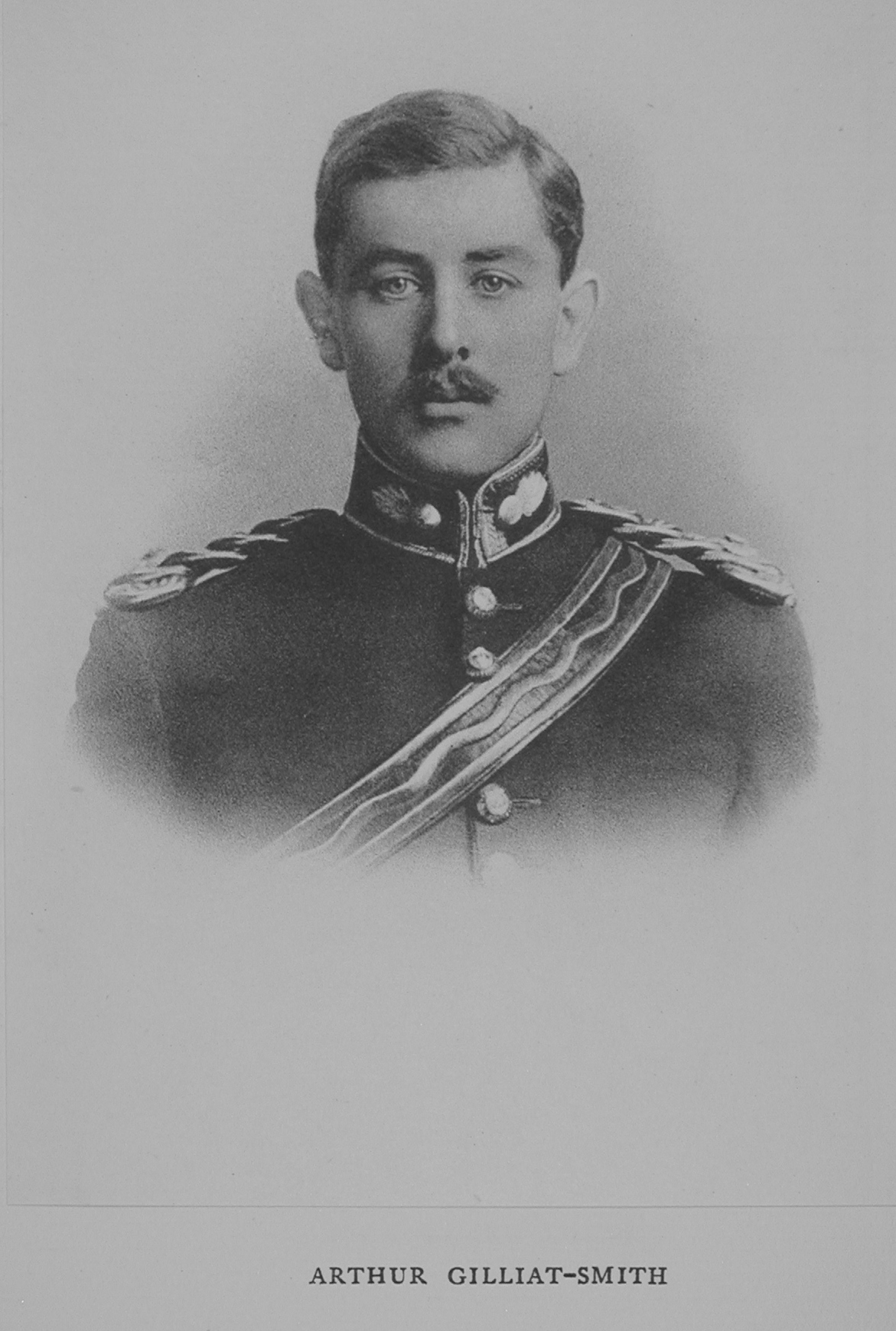
Gilliat-Smith A Lt Royal Engineers

Gilliat-Smith A Lt Royal Engineers

LIEUTENANT A. GILLIAT-SMITH

26TH FIELD COMPANY ROYAL ENGINEERS

ARTHUR GILLIAT-SMITH was the only surviving son of Harold and Sybil Gilliat-Smith.

He entered the School in 1902, and left in 1906. He passed into the R.M.A., Woolwich, and was gazetted to the 26th Field Company R.E., which formed part of the 1st Division of the Expeditionary Force in France.

He was killed near Ypres, on November 1st, 1914. The 26th Company was in reserve, and received orders to reinforce. On arriving at the spot indicated it was found that the attack had been beaten back and the trenches were full. The 26th Company was exposed to a cross fire, and Lieutenant Gilliat-Smith, in endeavouring to get his men under cover, was shot just as it was reached. Age 26.

His Commanding Officer writes:-

“A most keen and efficient Officer, who died gallantly leading his section.”

Source : Memorials Of Rugbeians Who Fell In The Great War Vol 1


Gilkison J D R Lt 1st Argyll And Sutherland Highlanders

Gilkison J D R Lt 1st Argyll And Sutherland Highlanders

LIEUTENANT J. D. R. GILKISON

1ST BATTALION PRINCESS LOUISII’s (ARGYLL AND SUTHERLAND HIGHLANDERS)

JAMES DAVID RALSTON GILKISON was the younger son of Dugald Stewart Gilkison, East India Merchant, of Wimbledon and Dalquharran, Ayrshire, and of Margaret his wife.

He entered the School in 1898, went to Trinity College, Oxford, 1903, was called to the Bar, Inner Temple, the same year, and obtained his Commission in the Argyll and Sutherland Highlanders in December, 1907.

He entered the and Battalion and served with it in South Africa and, on its return home, exchanged into the 1st Battalion at Malta, in order to go with it to India, where he served over a year.

He was home on leave when the War broke out, joined the 2nd Battalion at Fort George in time to go to France on August 12th, 1914, and took part in the fighting there till August 26th, when he was killed at the Battle of Le Cateau. He was shot down while leading his men towards one of the enemy’s machine guns. Age 30.

A soldier in his Company wrote of him:-

“He was a fine Officer, and was a man loved by all the men in his Company. I served under him in Africa and in India. I was under him at Harrismith, in the Mounted Infantry, and afterwards with him in India, where he was in charge of the machine-gun section. We knew him as a first-class soldier, and we all looked up to him and respected him in the Regiment. A finer Officer we could not be under.”

Source : Memorials Of Rugbeians Who Fell In The Great War Vol 1

Gilkison D S Captain 2nd Cameronians

Gilkison D S Captain 2nd Cameronians

CAPTAIN D. S. GILKISON

2ND BATTALION THE CAMERONIANS (SCOTTISH RIFLES)

DUGALD STEWART GILKISON was the elder son of Dugald Stewart Gilkison, East India Merchant, of Wimbledon and Dalquharran, Ayrshire, and of Margaret his wife.

He entered the School in 1894, passed direct into the R.M.C., Sandhurst, in February, 1898, and passed out with honours in the following December.

He was gazetted to the Scottish Rifles in February, 1899, served under Sir Redvers Buller in the Ladysmith Relief Force, was present at the Battles of Colenso, Vaal Kranz, the Tugela Heights and Pieter’s Hill, was Intelligence Officer at Greylingstad, October, 1900, to August, 1901, and afterwards served in the Mounted Infantry till the end of the South African War, when he received the Queen’s Medal with five Clasps, and the King’s with two.

He rejoined his Regiment in Glasgow in 1904, was promoted Captain the same year, became Commandant of the School of Instruction in Glasgow, was Adjutant of his Regiment 1905 to 1908, Staff College 1908 to 1910, Staff Officer Northern Command 1911, Brigade Major 5th Infantry Brigade 1912, till the time of his death, September 20th, 1914. He was killed by a bullet while superintending operations of the 5th Brigade, near the village of Verneuil, on the Aisne. Age 34.

He was mentioned in Despatches of October 8th, 1914.

The General Commanding First Division wrote as follows :-

“His work during the Campaign has been simply splendid, and I honestly think he was one of the very best soldiers in the Army. He was always ready to cope with the most difficult extremity, and by his extraordinary gallantry he continually set the very best possible example to every one. I tried on all occasions to keep him away from the worst of the shoot-ing, because he was constantly desirous of being in every post of danger, and I am afraid that, when I left, he took risks which were not absolutely necessary.”

Colonel Davies, the Oxfordshire and Buckinghamshire Light Infantry, wrote:-

“During the very trying time of the retirement, when we were all dropping with fatigue and want of sleep, he was always absolutely clear-headed and confident. The anxiety for one in his position was no doubt great, but he always set an excellent example of cheerfulness and confidence. When things went better, and we were advancing, he was equally good.”

Colonel Westmacott, the Worcestershire Regiment, who commanded the Brigade after General Haking was wounded, wrote:-

“He was the most fearless man I ever met, and a great loss to us and to the Service.”

He married in February, 1905, Janet Kate, daughter of the Rev. A. Н. Harcourt-Vernon, of Keble, Clocolan, Orange River Colony, South Africa, and left four children.

Source : Memorials Of Rugbeians Who Fell In The Great War Vol 1

Geddes J Captain 16th Canadian Infantry

Geddes J Captain 16th Canadian Infantry

CAPTAIN J. GEDDES

79TH CAMERON HIGHLANDERS, 16TH BATTALION CANADIAN CONTINGENT

JOHN GEDDES was the elder son of Alexander and Frances R. Geddes, of Blairmore, Aberdeenshire, and nephew of Sir William Geddes, Principal of Aberdeen University.

He entered the School in 1893. He was in the XV in 1895-96. On leaving School he went to America, followed a mercantile career, and was in business, first in Chicago, and later in Winnipeg, where he served for seven years in the 79th Cameron Highlanders, a Regiment allied with the Queen’s Own Cameron Highlanders.

A friend in Canada said that, on the outbreak of War, “he was one of the very first Officers of the 79th to volunteer. If they have any use for me, I am ready, he said; and for the rest of his life he was a soldier.” He came over to England with the First Canadian Contingent.

He fell, under machine-gun fire, at Langemarke, in Flanders, on April 23rd, 1915, leading his men in the famous Canadian charge, made necessary by the retirement of the French, when the Germans first used asphyxiating gas. Age 37.

A School-fellow wrote:-

“He was an absolutely fearless man. At School he never knew what fear was, and his one idea was to do things in a way to bring credit to his House. I have talked to several men who were at School with him, and we always remarked on his pluck, because it had stuck in our memories.”

A friend in Canada said:-

“John Geddes was one of the excellent of this earth a good citizen, a brave soldier, and a loyal friend.”

An Officer of his Company wrote:-

“Even after he was hit, and while dying, he kept crawling onwards, calling, ‘Go on, boys, you’ll win, you’ll win!’ He was a true born Highland gentleman; every single man in the Regiment felt that, and his death is indeed a heavy blow.”

He married, in 1907, Helen, daughter of Marshall Tillie, D.L., of Duncreggan, Londonderry, and left two sons and one daughter.

His only brother, Second Lieutenant A. F. Geddes (O.R.), was killed in action on June 16th, 1915.

Source : Memorials Of Rugbeians Who Fell In The Great War Vol 1

Gatacre J K Major Indian Army

Gatacre J K Major Indian Army


11TH KING EDWARD’S OWN LANCERS (PROBYN’S HORSE)

JOHN KIRWAN GATACRE was the younger son of Major-General Sir William Forbes Gatacre, K.C.B., D.S.O., and grandson of Edward Lloyd Gatacre (O.R., 1818), of Gatacre, Shropshire.

He entered the School in 1898 and passed into the R.M.C., Sandhurst, in 1901. He was gazetted to his Regiment, then called the Prince of Wales’ Own Bengal Lancers, in 1902, and was promoted Captain in 1911. Не served various periods as Squadron Officer, Quartermaster, and Adjutant in his Regiment, and in 1912 was appointed for Special Duty in attendance on His Majesty King George, at the Delhi Durbar. In 1913 he qualified for the Staff College at Camberley.

He won many Cups for tent pegging and swordsmanship, and in 1913, the Kaidir Cup for pig-sticking, the Blue Ribbon of India. In the same year he was one of the four representatives of England in the Fencing Tournament in Paris, in which the English team gained the third prize.

On the outbreak of War he was attached to the 4th Hussars, crossed over to France on August 14th, 1914, and took part in the Retreat from Mons and the Battles of the Marne and of the Aisne. On September 20th he was promoted Major “for distinguished service in the field.” While reconnoitring a position, held in great strength by the enemy at the Monastery of Mont des Cats, near Godewaersvelde, a few miles from Hazebrouck, he was killed, on October 12th, 1914. Age 31.

He was mentioned in Despatches of October 8th, 1914, and was awarded the Cross of the Legion of Honour (Croix de Chevalier).

The following are extracts from a notice in the “Indiaman,” of October 31st, 1914:

“All those who knew Captain Gatacre will mourn one of the bravest spirits in the British Expeditionary Force fighting for their country’s honour. He was a born soldier. Fighting seemed to him, as he said in one of his most recent letters, the most natural thing in the world. He was absolutely fearless and was possessed of one of those iron constitutions which seem to be immune from fatigue. He was a fine rider and sportsman. He had won the Kaidir Cup and, as an experienced swordsman, he was very near winning the prize for the best Man-at-Arms in the Army at the Delhi Durbar. He had a sword made from his own design just before the War, and took it with him to the Front. How well he wielded it is known by his gallant exploits. It is said that on one occasion he engaged three Uhlans single-handed and killed them all.

“Whatever John Gatacre did, he did well. He possessed considerable talent as an artist in Water Colour, and the vivid actuality of his sketches at the Simla Fine Art Exhibition, where he was a Prize Winner, will be remembered by all Simla residents of the time. His pictures were, like himself, full of individuality, and distinctive by reason of their rugged and rare simplicity; but there is no doubt that his métier lay in War. It was there that his splendid, soldierly qualities found their fit expression, and now that he is dead death has scarcely ever seemed so nearly an empty name.”

Source : Memorials Of Rugbeians Who Fell In The Great War Vol 1


Gatacre J K Major Indian Army

Source : The Sphere 31st Oct 1914

Garrett S Captain 4th Suffolk Regiment

Garrett S Captain 4th Suffolk Regiment

4TH BATTALION THE SUFFOLK REGIMENT, T.F.

STEPHEN GARRETT was the third son of Frank Garrett, J.P. (O.R., 1860), M. INST. C.E., and of Mary Anne his wife, of Aldringham House, Saxmundham, Suffolk.

He entered the School in 1892, was in the XV in 1896, and left in 1897.

He was at Trinity College, Cambridge, 1897-99, and studied at Düsseldorf, 1899-1900. In 1900 he went into the family business, Richard Garrett and Sons, Ltd., at Leiston, Suffolk, and became a valued Director in that Company. He joined the Territorial Force and rose to be Captain in the 4th Battalion of the Suffolk Regiment.

He was killed on March 12th, 1915, at the Battle of Neuve Chapelle, and was buried in the cemetery at Estaires, France. Age 36.

The Officer in command of his Regiment at the time, Major Cruddas, 41st Dogras, wrote:-

“He met his end like a true and gallant gentleman, at the head of his men. A life lost like this is a life gained in a cause such as we are fighting for.”

He married in 1905, and left a widow and four children.

Source : Memorials Of Rugbeians Who Fell In The Great War Vol 1

Fraser J H Lt 2nd Gordon Highlanders

Fraser J H Lt 2nd Gordon Highlanders

LIEUTENANT J. H. FRASER

2ND BATTALION THE GORDON HIGHLANDERS

JAMES HOWIE FRASER was the only son of Edward Cleather Fraser, C.M.G., Member of the Legislative Council of Mauritius, and of Mary Josephine his wife.

He entered the School in 1901, and went on to the Woolwich branch of the R.M.C., Sandhurst, in 1906, passing out with Prizes for Tactics and Military Engineering. He served with his Regiment in India and Cairo, and was promoted Lieutenant in 1909.

He went to the Front early in October, 1914. He was sent forward with some of his men to see if a farmhouse was held by the enemy, and in so doing was shot on October 30th, 1914, at Klein Zillebeke Farm, near Ypres. Age 26.

He was mentioned in Despatches of January 14th, 1915.

His Colonel wrote:-

“He was one of the very finest Officers I have ever met, absolutely fearless, a splendid leader, always cool, and every soul in the Battalion admired him for his splendid soldierly qualities, and loved him for his character, which was an ideal one. I cannot tell you what his loss is to me personally, and from a military point of view the Army has lost one of its very best Officers.”

And one of his men said:-

“He was a grand gentleman. All the men loved him, and he was one of our best Officers.”

Source : Memorials Of Rugbeians Who Fell In The Great War Vol 1


Fraser J H Lt 2nd Gordon Highlanders

FRASER, JAMES HOWIE, Lieut., 2nd Battn. Gordon Highlanders, only s. of Edward Cleather Fraser, C.M.G., Member of the Council of Government, Mauritius, and a Partner in the firm of Ireland, Fraser & Co., of Port Louis, by his wife, Mary Josephine, dau. of the late Thomas Howie, and gdson. of the late James Fraser, of Newfield, Blackheath Park; b. Blackheath, London, 4 April, 1888; educ. Summerfields, near Oxford, Rugby and the Royal Military Academy, Woolwich, out of which he passed first in Summer Term 1907, with prizes for Tactics and Military Engineer-ing; gazetted 2nd Lieut. to the Gordon High-landers, 9 Oct. 1907, and promoted Lieut. 20 March, 1909; joined the 2nd Battn. in India, and served with it there and in Egypt, and with the Expeditionary Force in France and Flanders, and was killed in action 30 Oct. 1914, in the attack on Zillebeke Farm House. He was unm., and was buried at Klein Zillebeke. Lieut. Fraser was mentioned in F.M. Sir John (now Lord) French’s Despatch of 14 Jan. [London Gazette, 17 Feb.] 1915, for gallant and distinguished service in the field.

Source : De Ruvigny’s Roll Of Honour Vol 1


Francis B H 2nd Lt 3rd Royal Scots

Francis B H 2nd Lt 3rd Royal Scots

SECOND LIEUTENANT B. H. FRANCIS

BATTALION THE ROYAL SCOTS (LOTHIAN REGIMENT)

BASIL HUGH FRANCIS was the only surviving son of Captain Harold Hugh Francis, The Royal Scots, of Manor House, Long Stratton, Norfolk.

He entered the School in 1909, was admitted to University College, Oxford, in March, 1914, and received his Commission in the 3rd Battalion The Royal Scuts in August of the same year.

He was shot, in the trenches, near La Bassée, on February 4th, 1915, and was buried in the grounds of the Château of Gorre, near Béthune. Age 19.

His Colonel and other Officers wrote in the warmest terms of the impression he had made during his short time with the Regiment, and the following extract from a letter, written by one of his Company, without the least idea that it would ever be seen by his relatives or friends, shows the feelings of his men:”We lost,” it says, “our Company Lieutenant last week by a German sniper. He was called Francis, and he was an awful nice man. He was a true Tommy Atkins’ friend. He was too good to live, and too brave to lose. All my platoon are sorry to lose such a good Officer.”

Source : Memorials Of Rugbeians Who Fell In The Great War Vol 1