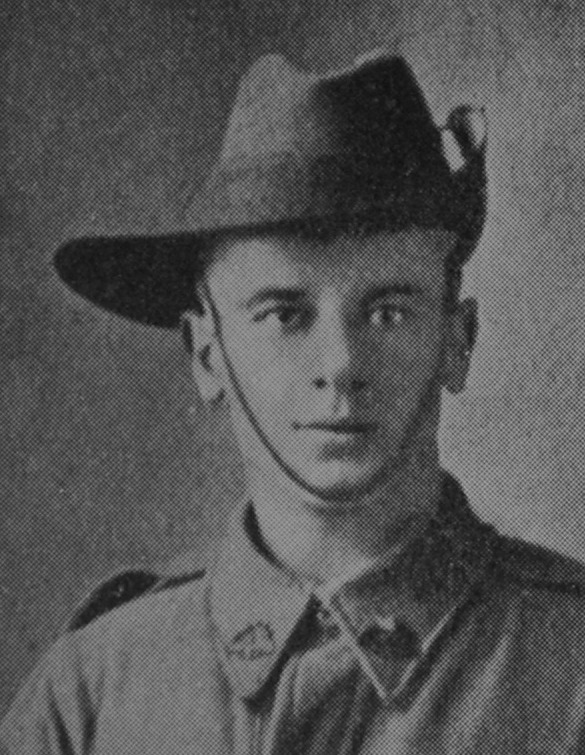
Tetley A N L/Cpl 304 8th Australian Light Horse
TETLEY, ARTHUR NORMAN, L.-Corpl., No. 304, B Squadron, 8th Australian Light Horse, 3rd Brigade, Australian Expeditionary Force, 3rd s. of William Tetley, of Berwick, Gippsland, Victoria, Squatter, by his wife, Kate, dau. of Arthur Noyes; b. in Victoria, 19 Feb. 1889; educ. C. E. Grammar School, Melbourne; volunteered on the outbreak of war, being the first to do so in his district; left for Egypt with the main force; went to the Dardanelles 15 May; was wounded in action at Walker’s Ridge, Gallipoli, 7 Aug., and died at sea on board the hospital ship Delta, 8 Aug. 1915; unm.
Sergt. C. H. Lyon wrote: “I saw a good deal of him over at Gallipoli, and he did splendidly from beginning to end. I know men in his troop thought a lot of him, and it was only owing to lack of vacancies that he didn’t get rapid promotion. On June 23 Norman got shaken up pretty badly. The Turks were shelling us pretty heavily with French 75’s and high explosives. Where Norman was stationed they got it very badly; he wasn’t actually hit, but the shells bursting near him peppered his face with gravel. He got over it, however, without going away, but when the attack came on 7 Aug. he was very run down. From that I heard the doctor had advised him not to go out, but like many others he was keen on being with his troop and couldn’t stand the idea of being left behind. For three days we were expecting the attack, and on the evening of 6 Aug. we were taken out into the left hand sap on Walker’s Ridge. All night we sat there not knowing what moment we would be called on, and towards daylight the men-of-war and cruisers bombarded the Turkish trenches right in front of us. The 8th were divided into the 1st and 2nd lines of attack. A squadron and two troops out of B formed the 1st line (including Norman), and C Squadron with the other half of B formed into 2nd line. The 10th Regt. formed the 3rd and 4th. The Turkish trenches were about 25 yards from us, and the whole front not more than 150 yards long. At 4.30 a.m. the bombarding stopped and the attack commenced. Owing to a misunderstanding, my troop was late in moving up, and just as we got into the front sap, our officer was shot through the hand and retired. I was left in charge, and being unable to jam past the men, jumped up and ran round to the front of the sap, calling on them to follow, but just as we got out, the 1st line fell back, nearly all wounded, with orders to retire. As we dropped back into the sap, I saw Norman lying just out in front, and with the assistance of others, got him in and laid him on the bottom of the trench. His leg was in a fearful state, a machine-gun had got on to him, but he stood it wonderfully and a 10th man applied first aid. The stretcher bearers were fearfully busy, and we were in an out of the way place and he had to lie there over two hours before it was possible to get him away. The loss of blood must have been very great. Of 318 of our men that went out that morning, 154 were killed, and 80 odd wounded. The Turks had 34 machine-guns playing on the narrow strip between the trenches, and only one of our men, a sergt. in A Squadron, ever reached their trenches. All but two of our officers that went out were killed, including Col. White, Major Retford, and our Adjutant.”
Source : De Ruvigny’s Roll Of Honour Vol 1