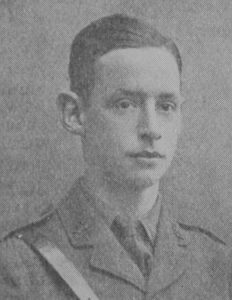
Stewart W V 2nd Lt 1st Monmouthshire Regiment
STEWART, WILLIAM VICTOR, 2nd Lieut. 1st Battn. Monmouthshire Regt. (T.F.), only s. of William Stewart, of Brodawel, Caerleon, co. Monmouth, Mining Engineer, President of the South Wales Institute of Engineers, and late Chairman of the South Wales Coal Owners’ Association, by his wife, Margaret, dau. of Hopkin John. of Tonypandy, Glamorgan; b. Abertillery, co. Monmouth, 10 Jan. 1897; educ. Blundell’s School, Tiverton; enlisted, 28 Aug. 1914, and was killed in action at Festubert, near Ypres, 8 May, 1915; unm.
On the previous evening the 1st Monmouths had been moved up into the trenches, in which it was found there was little shelter. The battn. was thereupon engaged throughout the whole of the night in improving the trenches. At daybreak the enemy commenced fiercely bombarding the 1st Monmouths, and continued doing so all the morning until about midday, when they broke through our lines to the right of Mons, and it was then that Lieut. Stewart was killed by a bullet wound in the forehead. An incident which occurred on the day of the charge at Neuve Chapelle (12 March, 1915) is thus related in a letter which appeared in the “South Wales Argus” of 13 April, 1915: “Our time at the redoubt was 24 hours, and our next 24 hours was spent at a farm about half a mile from the line. It was at this point that I essayed my most dangerous exploit. Our Capt. asked for volunteers to carry ammunition to the trenches as their stock was getting exhausted. No sooner had the words been spoken than the volunteers were ready and I am pleased to say I was one of them. First we had to get back to headquarters to obtain the ammunition. Well, our party, under the direction of Lieut. Stewart, safely fulfilled this part of our duty. Then our task began in earnest, and slowly we approached the danger area along the road. On arriving at a certain point our officer, Lieut. Stewart, ordered us to open the boxes and carry 10 bandoliers each. Truly this was far more favourable for moving about, and at this juncture we crept on to the side of the road and then right into the ditch. What with the heavy going, the excitement of being spotted, I can tell you it was far from pleasant. Step by step we advanced until we got to the communication trench, which was also knee deep in water. Still keeping up heart and receiving encouragement from our officer, we plodded on. With our goal in sight we were spotted, and didn’t the lead fly! Still, there were no hits and we arrived safely, every man completely exhausted. After a brief spell we soon revived, only to stop with damp pants for some eight or nine hours, until darkness set in, when we marched back to our billets.”
Source : De Ruvigny’s Roll Of Honour Vol 1

