
Agnew G Captain Northumberland Fusiliers
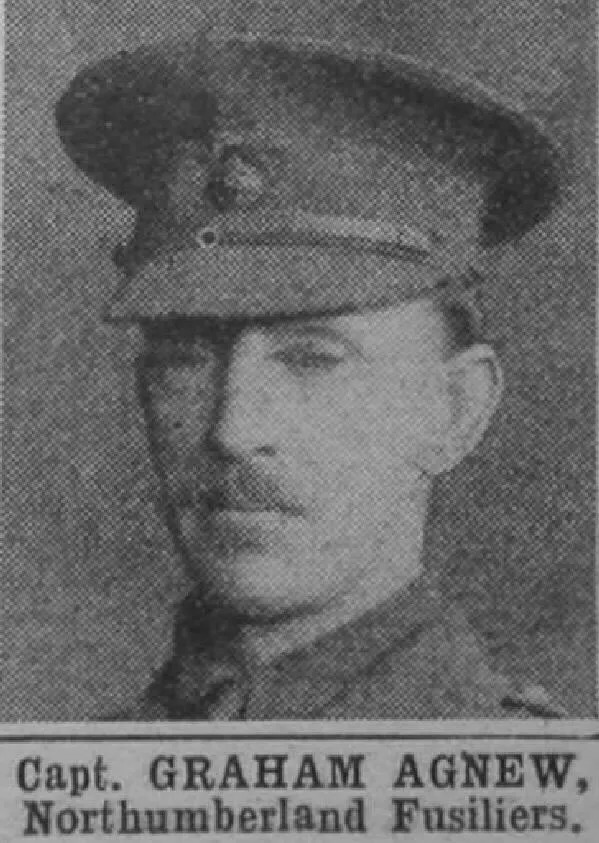
Agnew G Captain Northumberland Fusiliers Original Photo
Source : The War Illustrated 23rd Oct 1915
First World War Soldiers Photos
World War One Soldier's Photos, Obituaries And Short Service Records
Agnew G Captain Northumberland Fusiliers
Agnew G Captain Northumberland Fusiliers Original Photo
Source : The War Illustrated 23rd Oct 1915

Bunker C J Pte 31773 11th Northumberland Fusiliers
BUNKER, CHARLES JOHN, Private. No. 31773, 11th (Service) Battn. The Northumberland Fusiliers, s. of John Thomas Bunker, of 20, Burford Road, Catford, S.E., by his wife, Ada Amelia, dau. of an. of Charles Brigden; b. Catford, London, S.E., 27 June, 1893; educ. Kilmore Road Forest County Council School; enlisted in the Northumberland Fusiliers 7 April, 1916; served with the Expeditionary Force in France from June, 1916: subsequently proceeded to Italy, and died there 28 Oct. 1918, of wounds received in action on the Italian front. Buried there. He m. at Lewisham, in 1914, Ellen Georgina, dau. of John Gedge, and had two children: Charles John, b. 5 April, 1915, and Agnes Ada, b. 12 June, 1918.
Source : De Ruvigny’s Roll Of Honour Vol 5
BAXTER, ALEXANDER WALLS, Private, No. 59185, 25th (Service) Battn. The Northumberland Fusiliers, s. of Alexander Baxter, of 353, Holburn Street, Aberdeen, Tailor, by his wife, Margaret, dau. of John Davidson, of Strichen; b. Aberdeen, 8 Feb. 1885 educ. Robert Gordon’s College there was a Туреwriter Mechanic; enlisted in the Seaforth Highlanders 27 June, 1916; served with the Expeditionary Force in France and Flanders from 1 Aug. following; was transferred to the Northumberland Fusiliers in Sept. 1917; saw much fighting being employed in the Lewis Gun Section, and died a prisoner of war at Berlin 12 May, 1918, of wounds received in action near Lens 21 March previously. Buried in the Military Churchyard, Hasenheide; unm.
Source : De Ruvigny’s Roll Of Honour Vol 5
BANKS, FREDERICK EDWIN, Sergt., No. 9544, 1st Battn. (5th Foot) The Northumberland Fusiliers, s. of Frederick Banks, of 154, Thorney Hedge Road. Chiswick, W., Commercial Traveller; b. Knightsbridge, London, S.W., 24 April. 1879; served in the South African War, 1899-1902 (King’s and Queen’s Medals): on the conclusion of the war joined the Reserve; rejoined his old regiment 5 Oct. 1914; trained at Scott’s Camp, Newcastle; served with the Expeditionary Force in France and Flanders from 26 May, 1917, and was killed in action 24 Sept. following. He m. at Hammersmith, London, W., Ada Alice (7. Dean’s Road, Hanwell), dau. of Henry Edward Bacon, and had a son, Frederick, b. 15 Sept. 1910.
Source : De Ruvigny’s Roll Of Honour Vol 5
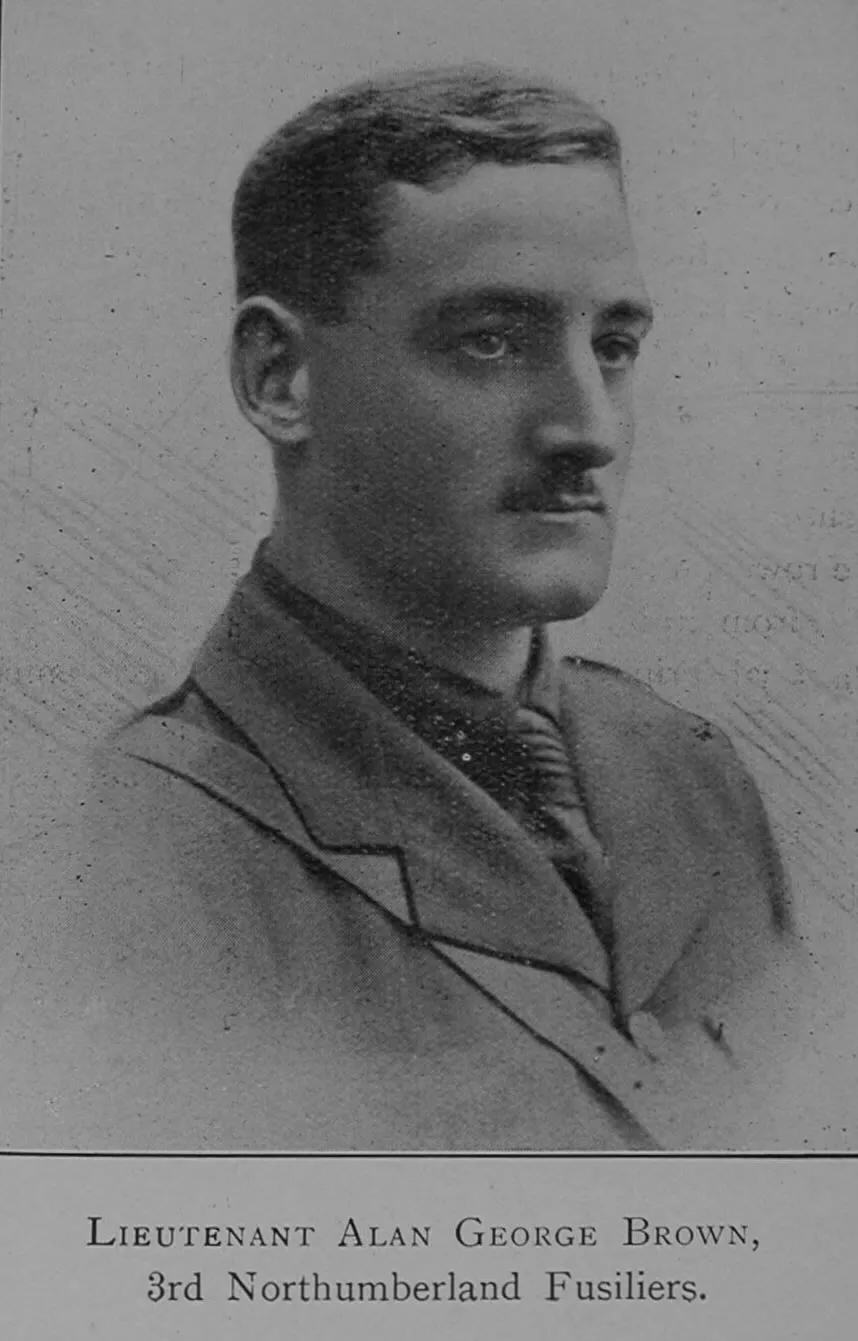
Brown A G Lt 3rd Attd 10th Northumberland Fusiliers
Lieutenant ALAN GEORGE BROWN,
3rd Northumberland Fusiliers, was the son of Mrs. G. Brown, Stockton-on-Tees, and was born in 1894. He entered the School House in September, 1906, and was in the XI. from 1908 to 1911. He played in the XV. of 1911, and was a Monitor. He left in December, 1911, and was employed with Messrs. Feetham and Grieveson, Newcastle, until the war broke out. In September, 1914, he enlisted in the 21st (Public Schools’ Battalion) Royal Fusiliers, and served in France and Flanders from the Autumn, 1915, till April, 1916, when he came home to qualify for a commission. He was gazetted Second Lieutenant, 3rd Northumberland Fusiliers, in August, 1916, and joined the 10th Battalion of that Regiment in France in February, 1917, where he served until the Battalion was moved to Italy in Noveniber, 1917. He served in Italy from that date until the 27th October, 1918, when he was killed while crossing the River Piave during an attack. He was mentioned in despatches.
During his time at the School A. G. Brown was prom-inent as a slow, left hand bowler, and took many wickets in the four seasons in which he was a member of the XI. In 1911 he took 60 wickets at a cost of 14-3 runs each-an excellent average for a slow bowler.
Source : The War Record Of Old Dunelmians 1914-1919
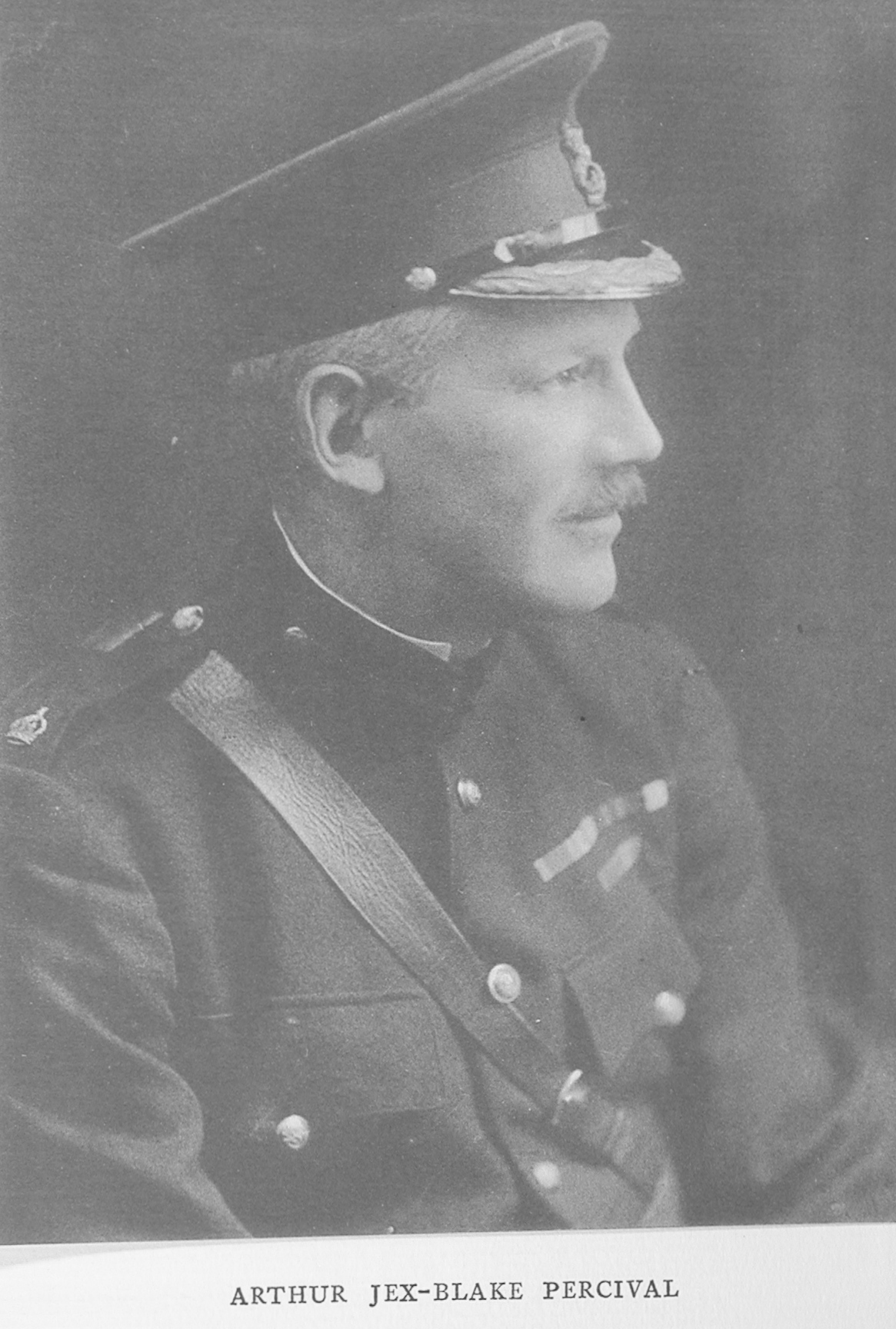
Percival A J-B Major DSO Northumberland Fusiliers
MAJOR (TEMPORARY LIEUT.-COL.) A. J.-B. PERCIVAL, D.S.O.
THE NORTHUMBERLAND FUSILIERS
ARTHUR JEX-BLAKE PERCIVAL, D.S.O., was the youngest surviving son of the Right Reverend John Percival, D.D., Bishop of Hereford.
He entered Marlborough College in 1885, but came on to Rugby in 1887, when his father was appointed Headmaster of the School. He was in the XV in 1889. He was gazetted to the Northumberland Fusiliers in 1892, and promoted Lieutenant in 1894. He served in the Nile Expedition of 1898, taking part in the Battle of Khartum and receiving the Egyptian Medal with Clasp.
In the South African War, 1899-1902, he was in the actions of Belmont and Modder River, and was afterwards on the Staff, being three times men-tioned in Despatches, and receiving the D.S.O., 1900, and the two Medals with six Clasps. He was promoted Captain in 1900. He saw active service in the Egyptian Army under Lord Kitchener from 1903 to 1908, was in command of the Camel Corps, and served in operations against the Nyam-Nyam tribes, and in southern Kordofan, adding two Clasps to the Egyptian Medal and receiving the 4th Class of the Medjidich.
He was promoted Major in 1908, and later was employed on the Staff at the War Office and at the Staff College.
He went to the Front at the beginning of the War, as General Staff Officer to Major-General Munro, Commander of the 2nd Division of the First Army Corps, and during the first eleven weeks of the War was twice mentioned in Despatches, and was one of the first English officers to receive the Cross of the Legion of Honour (Croix d’Officier). A week before his death it was decided that he was to be given a Brigade immediately. He was told of this, but did not live long enough to be gazetted.
He was killed by shell, with four other officers of the Staff of the First and Second Divisions, who had met for a conference in the Château of La Hooge. General Lomax (O.R.), who was present at this conference, was wounded, and subsequently died of his wounds. He fell on October 31st, 1914, in his 44th year.
Officers of all ranks testified to the gallantry of this eminent soldier, and the loss which his death caused to the Nation and the Army.
Field-Marshal Lord Methuen, G.c.n., G.C.V.O., C.M.G., wrote:-
“I had no officer serving under me in the South African War whose service as a Regimental Officer I valued more highly. He was a born leader of men, of splendid courage, and possessing a character which inspired all with whom he came in contact.”
General Gorringe, cCB., C.M.G., D.S.O., said:-
“He was the best Staff Officer I have ever had. I don’t say this only now. I have said so for some time, and had he been given, as he deserved, a Command during the War, he would have won still higher honours.”
A brother Officer wrote:-
“He and I were in the Egyptian Army together, and I learnt out there to admire his wonderful energy and great strength of character. I shall never forget the day he rode quietly into Wau, in the Bahr el Ghazal, on the date he said he would arrive, after the most extraordinary journey, in which his great qualities had had full play. His Arabs simply worshipped him. By his death we have lost one of the best officers in the Army, and at a time when men of his type are priceless.”
Others spoke in these terms:
“A very gallant soldier, loyal, straight, and the best of friends, with never an unkind word.”
“He was one of the few men I have ever met who apparently did not know fear.”
“The whole Army knew his splendid qualities. I always used to talk of him as the bravest man I have ever known. He simply knew no fear.”
He married, in 1907, Cecil, daughter of Charles Henry Henland, but left no children.
Source : Memorials Of Rugbeians Who Fell In The Great War Vol 1
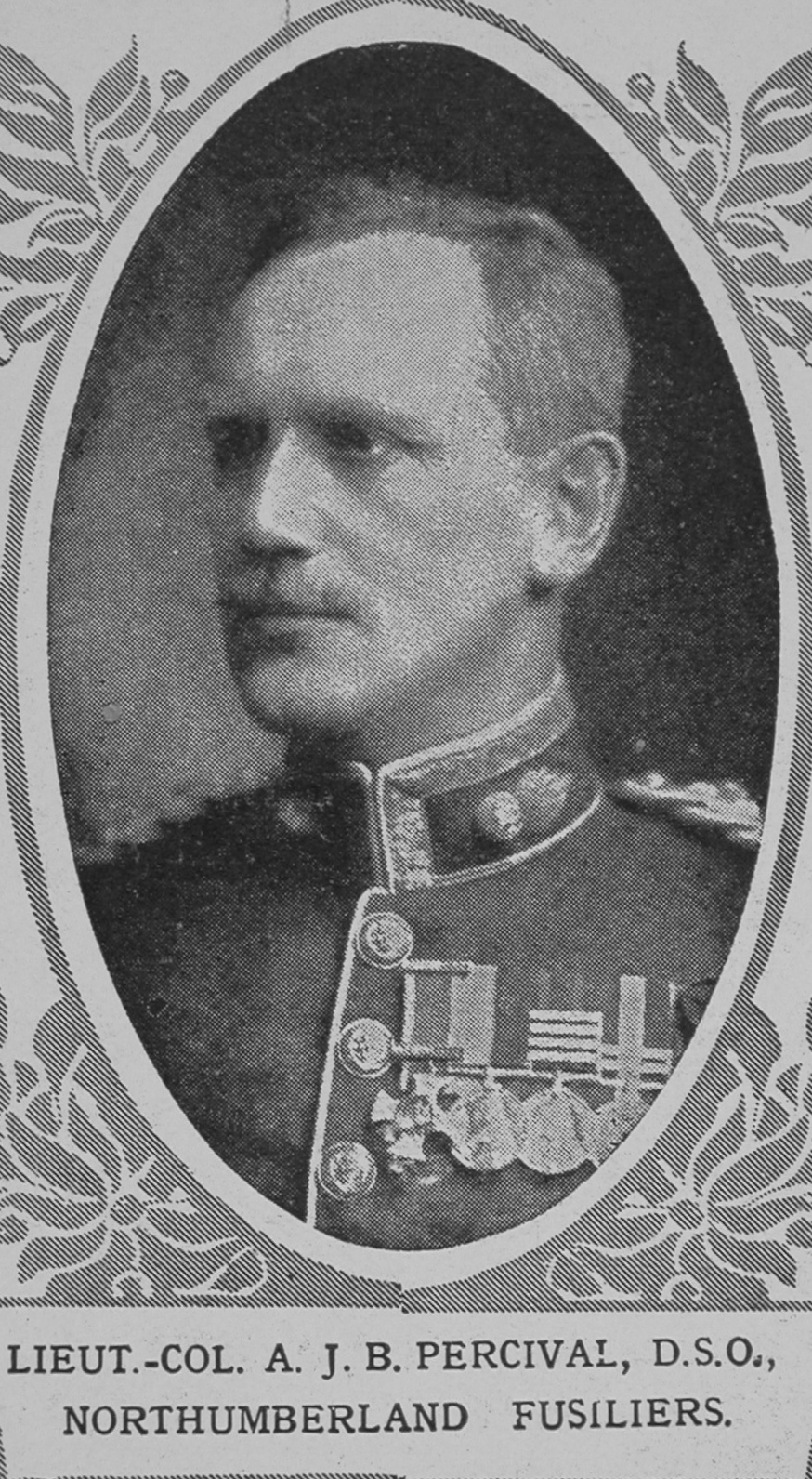
Percival A J B Lt Col DSO Northumberland Fusiliers
Source : The Illustrated London News 21st Nov 1914
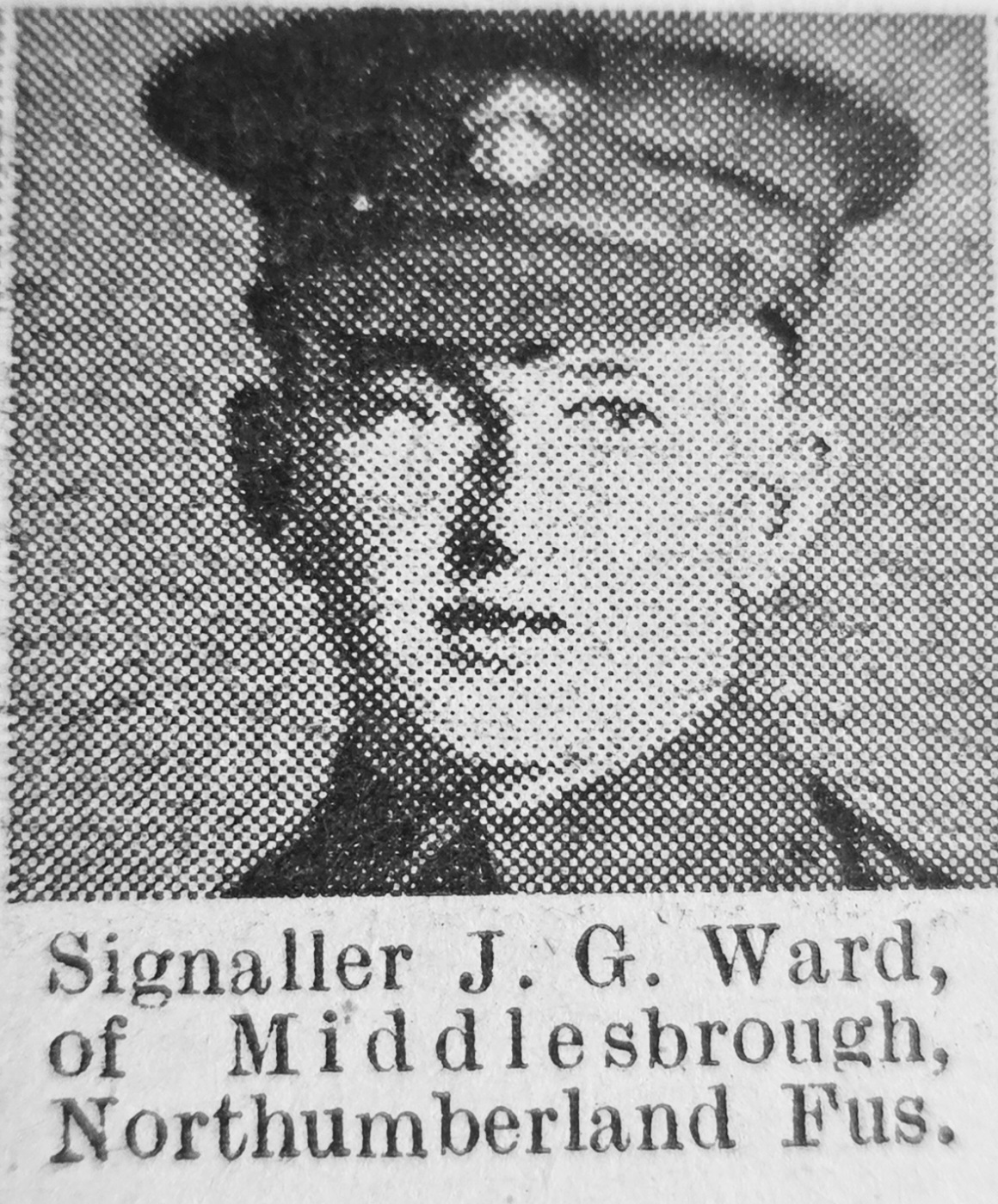
Ward J G Signaller Northumberland Fusiliers
Source : The Vivid 1st May 1915
From Middlesbrough

Vachell R T Captain Northumberland Fusiliers Attd Royal Flying Corps
CAPTAIN R. T. VACHELL Northumberland Fusiliers
Aged 25 September 1st, 1915
ONLY Son of Horace Annesley Vachell (O.H.), Novelist and Dramatist, of Beechwood House, Bartley, Southampton, and of Mrs. Vachell, née Phillips, of San Luis Obispo, California.
Football XI, 1907. Rugby XV, 1906-7.
He had considerable literary gifts, especially for the Short Story and the Drama, and contributed several articles to the St. George’s Gazette. At one time he intended to go on the stage, but, on leaving Harrow, finally made up his mind to adopt the Army as a profession and went to Sandhurst.
Captain Vachell was gazetted to the Northumberland Fusiliers in 1910, and joined the Ist Battalion, at Gharial in the Murree Hills, the same year. Except for a short period in 1912, when he acted as A.D.C. to Lord Sydenham, the then Governor of Bombay, he served continuously with the 1st Battalion till the outbreak of the War. He left for France with his Regiment in August, 1914. He was all through the Retreat from Mons, but was wounded on October 20th, 1914, and invalided home. For his services at that time he was mentioned in Despatches. He was then seconded for service with the Flying Corps as Observation Officer, and took many remarkable photographs of the enemy’s lines. Later he qualified as a Pilot and again went to France in July, 1915. On the 31st of August, as he was returning from a reconnaissance, he broke his propeller on landing; by some mischance the machine caught fire, and he and his Observer fell to earth from a height of about ten feet. They both extricated themselves without difficulty, but Vachell was badly burnt, and died next day from shock.
From the St. George’s Gazette:-
“All who knew Dick Vachell will realize the loss the Regiment has suffered by his death. A sportsman through and through, keen as mustard, and the cheeriest of comrades, he made friends wherever he went. His peculiar power of making friends was never more apparent than among the French and Belgian Officers, with whom he mixed freely, when he was with the Flying Corps in Belgium.”
Source : Harrow Memorials Of The Great War 1914-1918 Vol 2

Vachell R T Captain 1st Northumberland Fusiliers Attd Royal Flying Corps
VACHELL, RICHARD TANFIELD, Capt., 1st Battn. Northumberland Fusiliers and Royal Flying Corps, only s. of Horace Annesley Vachell, of Beechwood, Bartley, Southampton, Author and Dramatist, by his wife, Lydia, dau, of Chauncy Hatch Phillips, of San Luis Obispo, California; b. San Luis aforesaid, 29 June, 1890; educ. Harrow and Royal Military College, Sandhurst; gazetted 2nd Lieut. in the 1st Battn. Northumberland Fusiliers, 13 June, 1910; promoted Lieut. 27 Nov. 1913, and Capt. in July, 1915; joined the 1st Battn. at Gharial in the Murree Hills in 1910, and served with it continuously, except for a short period in 1912, when he acted as A.D.C. to Lord Sydenham, the then Governor of Bombay, until the outbreak of war in Aug. 1914, when he proceeded with it to France. He took part in the retreat from Mons, but was wounded in Oct. and invalided home. Shortly after returning to the Front he joined the Flying Corps as an observer, again returning to England in April to train for his pilot’s certificate, which he obtained in June, 1915. He returned to France at the end of July, and died at Choques, 1 Aug. 1915, of wounds received on 31 July, being buried in the military cemetery there; unm.
Capt. Vachell was a good all-round sportsman. While at Harrow he was a member of the football eleven and fifteen; was an ardent Skihari, and represented the regt. at polo in the Jubbulpore Tournament in 1912. He contributed several articles to the St. George’s Gazette under the nom de plume of “The Sprouter,” notably “With the American Section at the Delhi Durbar,” which exhibited his strong sense of humour. He was mentioned in F.M. Sir John (now Lord) French’s Despatch of 14 Jan. [London Gazette, 17 Feb.] 1915.
Source : De Ruvigny’s Roll Of Honour Vol

Turner M A F L/Cpl 3532 2nd Northumberland Fusiliers
TURNER, MONTAGUE ALWEYNE FISHER, L.-Corpl., No. 3532, 2nd Battn. Northumberland Fusiliers, 5th s. of Alweyne Turner, of Kobe, Catherine Road, Surbiton, late Government Advocate, of Lahore, India, by his wife, Violet Frances, dau. of Deputy Surgeon-Gen. Thorp; b. in Gulmery, Kashmir, 3 July, 1893; educ. Lancing College; enlisted 14 April, 1913; went to France in Jan. 1915, and was killed in action 25 April, 1915, being shot through the head in the trenches at Cross Roads, east of Zonnebeke, by a sniper. Buried at the Zonnebeke Dressing Station; unm.
A writer in the regimental journal said: “It is only necessary to record two or three instances of gallantry displayed by our comrades to show what our men are, when it comes to the crucial point, and these are only a few of many. The first to be mentioned is the gallantry of our bomb-throwers under L.-Corp. M. Turner during the attack on Hill 60 on the 21-22 April. They went to work like one man, and soon had the enemy on the move. The coolness and bravery of Turner was one outstanding feature and we believe he was highly commended for the excellent work performed by his bomb-throwing party.”
Source : De Ruvigny’s Roll Of Honour Vol 1

Ashdown J Pte 1st Northumberland Fusiliers
Ashdown John Pte 3788 1st Northumberland Fusiliers.
Source : The Vivid 10th Apr 1915
To France 16th Mar 1915.
Listed as “Wounded” on the Casualty List issued by the War Office from the 26th June 1915.
This man was entitled to wear a “Wound Stripe” as authorised under the Army Order 204 of 6th July 1916. The terms of this award being met by their naming in this list.
Died 27th Oct 1918 at Murthly War Hospital of Exhaustion from epilepsy.
Between January 1917 and March 1919 Murthly hospital was used as a Military Psychiatric Hospital.
Buried at Hither Green Cemetery, London.