Baldwin W F Lt DCM MC Royal Engineers

Baldwin W F Lt DCM MC Royal Engineers

BALDWIN, WILLIAM FREDERICK, D.C.M., M.C., Temp. Lieut. (Acting Major), Royal Engineers, third s. of the late Harry Baldwin, of Colvestone Crescent, Dalston, London, N., and eldest s. of Ada Mary Baldwin, of Wharfedale, Albert Terrace, Margate: b. 3 Jan. 1895; was educ. at Margate College. He enlisted as a Sapper in the Royal Engineers 2 Sept. 1914, and served in France and Flanders with the Expeditionary Force from the following July, and was wounded in the Battle of Loos. He was gazetted 2nd Lieut., 7th Field Coy., Royal Engineers, in Dec. 1915; promoted Lieut. in Oct. 1917, Capt. in March, 1918, and made Acting Major 18 April, and was killed in action at the Battle of the Aisne on 27 May following. His Colonel wrote: “His loss is deeply regretted by his company, in which he served a considerable time in the field and with which he did most brilliant work.” He was awarded the Croix de Guerre by the French Government for distinguished service in the Battle of Loos [London Gazette, 25 Feb. 1916], and also received the Distinguished Conduct Medal [London Gazette, 14 Jan. 1916]. Major Baldwin was also awarded the Military Cross [London Gazette, 21 Sept. 1918], “For conspicuous gallantry and devotion to duty in handling his company at short notice, and with limited means at his disposal, he successfully completed a long line of posts during the night and held them until fully manned by other troops. His coolness and gallant conduct in action was most marked. Though often working with tired troops he invariably got a great deal of work done, and was always ready to deal efficiently with changing situations.”

Source : De Ruvigny’s Roll Of Honour Vol 5

Bailey A W Sapper 224162 Royal Engineers

BAILEY, ARTHUR WILLIAM, Sapper, No. 224162, Royal Engineers, s. of Cousins Arthur John Bailey, by his wife, Lizzie, dan. of Thomas Bailey, of Amersham, co. Buckingham: b. Islington, London, N., 7 May, 1884; edue. Tollington Park, London, N.: was a Carpenter; enlisted 29 Dec. 1916; served with the Expeditionary Force in France and Flanders from 17 Sept. 1917, and died at Bethune 17 April, 1918, from wounds received in action at Lille the same day. Buried at Guardbacque, south-west of Bethune. An officer wrote: “I should like to tell you that he died doing his duty like the brave man he was. His loss is felt very much in the company, as he was liked and respected by all.” and another: “Since he was in my section, while with the 476th Coy. Royal Engineers, he proved himself a very good Sapper indeed, not only when working at his trade, but at all the other jobs that we get: always ready and willing for a job of work, and very popular with the rest of my men, who. I am sure, join with me in expressing our appreciation of his good comradeship and regret at his loss.” He m. at St. Saviour’s Church, Islington, N., 17 June. 1917. Florence Emily (46 Sparsholt Road, Crouch Hill, London, N.), dau. of Arthur Bannister; s.p.

Source : De Ruvigny’s Roll Of Honour Vol 5

Munby E J 2nd Lt Royal Engineers

Munby E J 2nd Lt Royal Engineers

SECOND LIEUTENANT E. J. MUNBY

EAST ANGLIAN FIELD COMPANY, ROYAL ENGINEERS, T.F.

ERNEST JOHN MUNBY was the second son of the Rev. G. F. W. Munby (O.R., 1846), Rector of Turvey, Bedfordshire.

He entered the School in 1888, and after leaving went to America, where he took his degree as a Mechanical Engineer. He worked as a Mining Engineer in Colorado and Borneo, and on the tunnels under the Hudson River at New York.

He obtained a Commission in the Royal Engineers, in October, 1914, went to the Front at Christmas, was killed on January 31st, near Bethune, and was buried in the cemetery of Le Touret. His section was working at night. They had finished work, and had gone into an old farm building, when a bullet crashed through the wall and caused his instantaneous death. Age 40.

One who knew him in civilian life wrote:- “The thing that struck me most was the fact that whenever there was work involving much danger, he always took the dangerous place, rather than allow the men to take it, and this seems to have been the keynote of his life, self-sacrifice for the good of others.”

Another wrote “He always had the truest spirit of self-sacrifice, and his death seemed a fitting end to a life that was always full of courage and enthusiasm.”

He married in 1905 Emily Louisa Ann, widow of Captain Herbert Turner Turner-Emery, R.A., of Baddow Park, Essex, only daughter of Charles Henry Coxhead.

Source : Memorials Of Rugbeians Who Fell In The Great War Vol 1


Munby E J 2nd Lt Royal Engineers

Source : The Illustrated London News 13th Feb 1915

MUNBY, ERNEST JOHN, 2nd Lieut., 1st East Anglian Field Coy., R.E. (T.F.), 2nd s. of the late Rev. George Frederick Woodhouse Munby, Rector of Turvey, Bedford (1869-1905), by his wife, Harriet Louisa, dau, of the Rev. Canon Linton; b. Turvey Rectory, 19 May, 1875; educ. Rugby and Stevens Institute, Hoboken, New Jersey, U.S.A., where he took his degree as Mechanical Engineer, and became M.Am. S.M.E. and A.I.M. and M. As a Mining Engineer, he worked in Colorado and Borneo, and was subsequently engaged with Lord Cowdray (then Sir Weetman Pearson) in constructing the tunnel under the Hudson River to New York. He was afterwards employed by the Gardner Electric Drill and Hammer Company, and had latterly been engaged at the St. John’s Mine, Montezuma, Colorado. On the outbreak of war he returned to England and applied for a commission. He was gazetted 2nd Lieut. to the 1st East Anglian Coy., R.E., 14 Sept. 1914; went to France at the end of Dec., and was killed in action near Bethune, 31 Jan. 1915, being buried at Le Touret. He m. at Croydon, 7 Nov. 1905, Emily Louisa Ann, widow of Capt. Herbert Turner Turner Emery, of Baddow Park, Essex, and dau. of Charles Henry Coxhead; s.p.

Source : De Ruvigny’s Roll Of Honour Vol 1

Miller G L 2nd Lt Royal Engineers

Miller G L 2nd Lt Royal Engineers

SECOND LIEUTENANT G. L. MILLER

ROYAL ENGINEERS

GODFREY LYALL MILLER, born at Cawnpore, was the eldest surviving son of Sir John O. Miller, K C.S.I., of the Indian Civil Service, at one time Chief Commissioner of the Central Provinces, and Member of the Governor-General’s Council, and of Mary Evelina, daughter of the Right Honble. Sir

Alfred Lyall, C.C.I.E., K.C.B. He entered the School in 1906, became a Cadet Officer of the School O.T.C., and left for the R.M.A., Woolwich, in 1911, passing in 12th.

In December, 1912, he passed 1st out of Woolwich and entered the Royal Engineers. At Woolwich he gained the King’s and Pollock Gold Medals, besides other prizes, and later, at Chatham, a Haynes Memorial Medal for Field Engineering.

At the outbreak of War, August 4th, 1914, he was appointed to the 11th Field Co. R.E., forming part of the 2nd Division.

He was killed on September 14th, 1914, at Pont Arcy, on the Aisne, 14 miles east of Soissons. Age 21. On this day he was in charge of a damaged bridge over a canal, in rear of the pontoon bridge at Pont Arcy. The 2nd Division had crossed the canal and river bridges on the evening of the 13th and morning of the 14th. In the afternoon of the latter day an ammunition train returning from the north of the river attracted the German fire to the bridge, where Lieut. Miller and one Sapper were killed, and ten others severely wounded, some of them succumbing later. His Commanding Officer wrote:-

“He was held in high esteem by the Officers, Non-Commissioned Officers and men of the Company, and we all liked him. From the moment he joined me on mobilisation at Aldershot, he showed signs that he would make a good Officer, and the more I knew him the better I liked and put confidence in him. I now miss him very much, and am extremely grieved that such a promising young life has been cut short.”

Several men of his Company spoke warmly of his thoughtfulness and kindness, and their regret at losing “a fine and brave Officer, and a thorough gentleman,”

Source : Memorials Of Rugbeians Who Fell In The Great War Vol 1

MILLER, GODFREY LYALL, 2nd Lieut., Royal Engineers, elder s. of Sir John Ontario Miller, of Rowley Lodge, Arkley, Herts, K.C.S.I., late Indian Civil Service, by his wife, Mary Evelina, dau. of the late Sir Alfred Lyall; b. Cawnpore, India, 14 Feb. 1893; educ. Warden House School, Deal, Rugby, and Woolwich, where he gained the King’s Gold Medal; was gazetted 2nd Lieut., R.E., 20 Dec. 1912; visited Germany twice during leave to study the language was appointed on mobilisation to the 11th Field Coy. R.E. attd. to the 2nd Division, with which he left for France on 15 Aug. 1914, and was killed in action while in charge of a bridge over a canal at Pont Arcy, 14 Sept. 1914, during the crossing of the Aisne: unm. Buried where he fell.

Source : De Ruvigny’s Roll Of Honour Vol 1

Atkinson A F C Lt Royal Engineers

ATKINSON, ARNOLD FRANCIS CROSSLEY, Lieut., Royal Engineers, eldest s. of the Rev. F. Atkinson, of Blackwater House, The College, Eastbourne, by his wife, Edith Blanche, dau. of the late John Crossley, J.P.; b. Musselburgh, co. Midlothian, 12 March, 1898; educ. Tyttenhanger Lodge, St. Albans; Eton (King’s Scholar), and the Royal Military Academy, Woolwich; gazetted 2nd Lieut., Royal Engineers, 26 Aug. 1916; promoted Lieut. 26 Feb. 1918; served with the Expeditionary Force in France and Flanders from July, 1917; proceeded to Italy in the following Dec., returning to France in April, 1918; was sent to India, being appointed to the 75th Coy., 3rd Sappers and Miners, in Nov. of the same year, and was accidentally killed at Kirgi, North-West Frontier Province, 22 Jan. 1919. Buried at Tank, North-West Frontier Province, India.. A brother officer wrote: “We all loved him in the company, a boy of extraordinary energy and courage. I remember him volunteering to blow up a bridge in No Man’s Land under heavy German fire, and doing the work most successfully,” and another: “A most promising young officer, of great capacity.” While at Eton he was head of the Army Class, gaining the Head Master’s Prize and the Hamilton Army Class Divinity Prize; unm.

Source : De Ruvigny’s Roll Of Honour Vol 5

Atkins S J Pte 100279 Royal Engineers

ATKINS, SIDNEY JAMES, Private, No. 100279. Royal Engineers, s. of the late George Atkins, of Tottenham, N.; b. Hastings, co. Sussex; educ. there joined the Royal Engineers in June, 1915; served with the Expeditionary Force in France and Flanders, and died at Edmonton in 1918, from influenza contracted while on service. Buried in Tottenham Cemetery; unm.

Source : De Ruvigny’s Roll Of Honour Vol 5

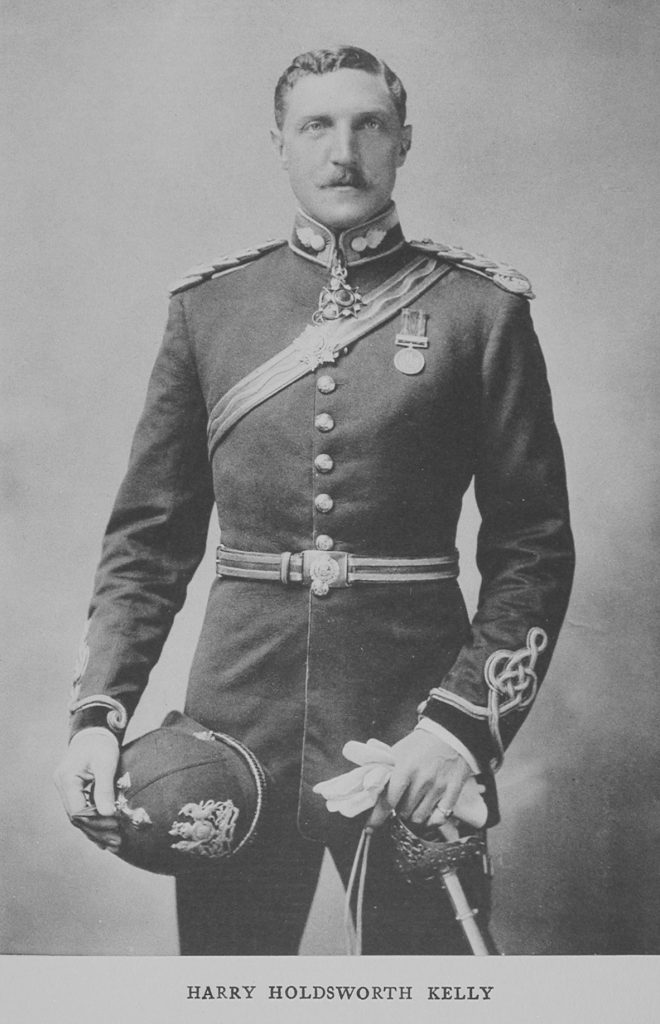
Kelly H H Captain Royal Engineers

Kelly H H Captain Royal Engineers

CAPTAIN H. H. KELLY

ROYAL ENGINEERS

HARRY HOLDSWORTH KELLY was the fourth and youngest son of Lieutenant-Colonel Henry Holdsworth Kelly, Royal Marine Artillery, of Montrose House, Southsea, and of Elizabeth Eleanor, daughter of John Collum, of Bellune, County Fermanagh, Ireland.

He entered the School with a Modern Language Scholarship in 1894, was Head of his House in his last Term and passed sixth into the R.M.A., Woolwich, in 1896. At Woolwich he was Under-Officer, was in the first XV, and won the Boxing Medal in 1898. He received his Commission in 1899 and was promoted Captain in 1908.

He played in the Hampshire County Football Team in 1899 and won the Army and Navy Heavy-weight Boxing Championship, at Aldershot, in 1901.

From 1903 to 1913 he served with the Egyptian Army. He was Resident Engineer for the construction of the town and harbour of Port Sudan, and received the 4th Class Osmanieh, for services in connection with this. He was Inspector of Roads and Communications for the Sudan, 1908-13. He served as a member of the Lado Enclave Commission in 1911. He was appointed by the Sudan Government as Commissioner for the Sudan-Uganda Boundary Commission in 1913 and was responsible for the Reconnaissance to the Borna Plateau in the same year.

He took part in the operations in the Atwot Region, Sudan, in 1910, receiving the Sudan Medal, and in the operations against the Beir and Anuak tribes in South Eastern Sudan as Intelligence Officer in 1912, adding a Clasp to the Sudan Medal and receiving the 3rd Class Medjidieh.

He was awarded the 3rd Class Osmanich in 1913, for which he was qualified, at so early an age, only by his local rank of Lieutenant-Colonel.

He carried out explorations in Abyssinia in 1907, 1911, and in 1913, and was a Fellow of the Royal Geographical Society.

He went to the Front at the beginning of the War, with the 38th Field Company R.E., and while engaged in superintending the erection of wire entanglements between ours and the enemy’s trenches, he was shot by a sniper on the night of October 24th, 1914. Age 34.

The Sirdar of Egypt, and his brother Officers testified to the gallantry of this distinguished soldier:—

“It was not only total absence of fear, but absolutely sound judgment and capacity for carrying a thing through, and readiness to take responsibility, which made him a marked man.”

“He was so big and cheery, never depressed however tired and hard-worked he might be, and did his duty gallantly. Although exposed daily and nightly to possibly greater risks than others, he was always willing and helpful and a pattern to all.”

“He was greatly loved and admired by his comrades. Had he lived he would have gone far-very far indeed.”

A brother Officer, who was wounded, wrote in the following terms:-

“It was a great blow to me to read of Kelly having been killed in action, just after I had written a letter thanking him for being so kind to me after I was hit. He came down some miles to see me in the trenches, under heavy fire, saw me into the dressing station, and did not leave me until just before I left in the ambulance wagon. The dressing station was under fire and was struck by a shell just before I was got away. He was a fine man, 6 ft. 6 in. in his socks, beautifully built, popular and known everywhere, and I was very proud of his friendship.”

Source : Memorials Of Rugbeians Who Fell In The Great War Vol 1

KELLY, HARRY HOLDSWORTH, Capt., R.E., yst. s. of Lieut. Col. Henry Holdsworth Kelly, R.M.A. (ret.), of Montrose House, South-sea, by his wife, Elizabeth Eleanor, dau. of John Collum, of Bellevere, co. Fermanagh; b. Staff Officers’ House, Eastney Barracks, Portsmouth, 24 Aug. 1880; educ. Rugby and R.M.A., Woolwich (Feb. 1897-99); gazetted 2nd Lieut. R.E. 8 March, 1899; promoted Lieut. 25 July, 1901, and Capt. 8 March, 1908; served with the Egyptian Army, 1903-13; was Resident Engineer for the construction of the lown and Harbour of Port Sudan, 1904-08, and received the 4th Class Osmanich for services in connection with this, 28 June, 1908; was Inspector of Roads and Communications for the Sudan, 18 Nov., 1908, serving as a member of the Lado Enclave Commission in 1911: Commissioner for the Sudan Government in the Sudan-Uganda Boundary Commission, 1913, and was responsible for the Reconnaissance to the Boma Plateau, carried out in the same year; took part in the operations in the Atwot Region, Sudan, in 1910 (Sudan medal), was Intelligence Officer in the operations against the Beir and Anuak tribes in South Eastern Sudan (clasp to Sudan medal and 3rd Class Mediidieh) 1912; decorated with the 3rd Class Osmanich, 1913; re-absorbed into the British Establishment, Nov. 1913.

He served with the 38th Field Coy. R.E. in France, and was killed in action at Bois Grenier, near Armentières, 24 Oct. 1914, while superintending wire ontanglement work between the British and German trenches; buried at Bois Grenier; uam. His Commanding Officer, Major F. M. Browne, wrote: “Не was killed early this morning while on duty in the trenches. He was struck by two bullets, one in the head and one in the back, and I feel sure that death was instantaneous and painless. We were enabled to recover his body, which was to-day buried simply by the chaplain in the presence of all the Coy. His grave lies by the roadside near a pretty country town and we are at present crecting a cross and railings to enclose it. I need hardly tell you what a great loss your son’s death is to me, both as a friend and an officer. He was invaluable to me in every way and the country has lost in him a most valuable officer”; and writing home from a Colchester Hospital, Lieut. Arthur Evans, Royal Engineers (of Carnarvon), paid a tribute to the bravery and kindness shown by Capt. Kelly. who commanded his coy., in attending to him when he was wounded, four days before Capt. Kelly himself was killed. The letter states: “It was a great blow to me to read of Kelly having been killed in action just after I had written him a letter thanking him for being so decent to me after I was hit. He came down to me some miles from Coy, headquarters to the trenches, which must have been under heavy fire, saw me into the dressing station, and did not leave me until just before I left in the ambulance wagon. The dressing station was under fire, and was struck by a shell just before I got away. He was a fine man, 6 ft. 6 in. In his socks, beautifully built, popular and known everywhere, and I was very proud of his friendship.” Capt. Kelly won the Army and Navy Heavyweight Boxing Championship in 1901. He carried out explorations in Abyssinia in 1907, 1911 and 1913.

Source : De Ruvigny’s Roll Of Honour Vol 1

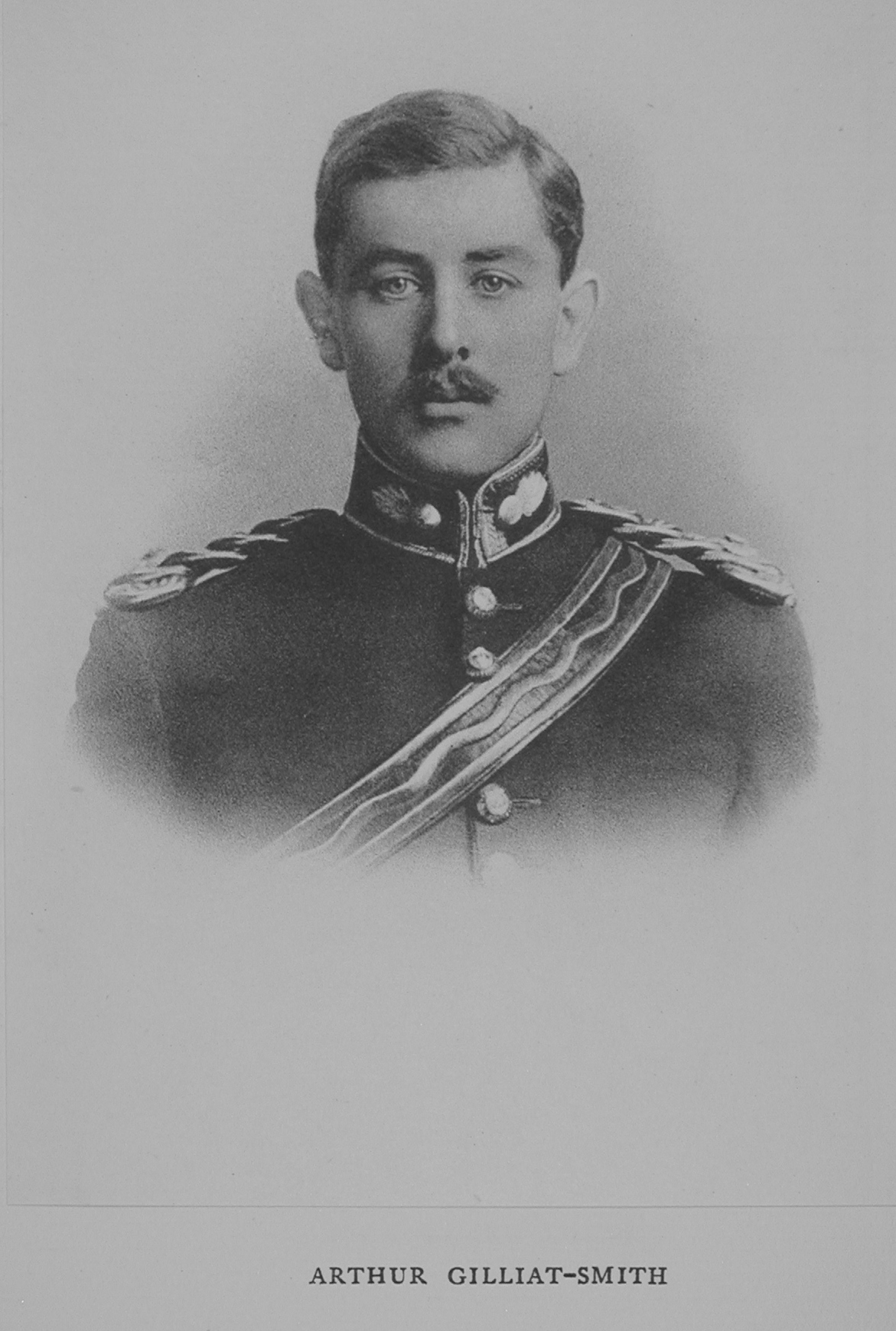
Gilliat-Smith A Lt Royal Engineers

Gilliat-Smith A Lt Royal Engineers

LIEUTENANT A. GILLIAT-SMITH

26TH FIELD COMPANY ROYAL ENGINEERS

ARTHUR GILLIAT-SMITH was the only surviving son of Harold and Sybil Gilliat-Smith.

He entered the School in 1902, and left in 1906. He passed into the R.M.A., Woolwich, and was gazetted to the 26th Field Company R.E., which formed part of the 1st Division of the Expeditionary Force in France.

He was killed near Ypres, on November 1st, 1914. The 26th Company was in reserve, and received orders to reinforce. On arriving at the spot indicated it was found that the attack had been beaten back and the trenches were full. The 26th Company was exposed to a cross fire, and Lieutenant Gilliat-Smith, in endeavouring to get his men under cover, was shot just as it was reached. Age 26.

His Commanding Officer writes:-

“A most keen and efficient Officer, who died gallantly leading his section.”

Source : Memorials Of Rugbeians Who Fell In The Great War Vol 1


Wakinshaw J W Sapper 51464 Royal Engineers

Wakinshaw J W Sapper 51464 Royal Engineers

WAKINSHAW, JAMES WILLIAM, Sapper, No. 51464, Royal Engineers, 3rd 8. of James Wood Wakinshaw, of Wolsingham, Publican, by his wife, Sarah, dau. of John Clark, of Whitton Park, co. Durham; b. Southwick-on-Wear, co. Durham, 31 March, 1891; educ. National Schooi there; was employed at Pickersgill’s Yard, Sunderland, and resided at 43, Wear Street, Southwick, and had been for five years a member of the Durham Territorial R.G.A.; enlisted 10 Sept. 1914, for the period of the war; trained at Chatham and in Ireland; went to the Dardanelles with the Mediterranean Expeditionary Force, and died 15 Aug. 1915, of wounds received in action at Suvla Bay; unm. Wakinshaw was a good oarsman, winning many prizes, including the Molly Pratt Cup, four tankards, four medals, etc.

Source : De Ruvigny’s Roll Of Honour Vol 1