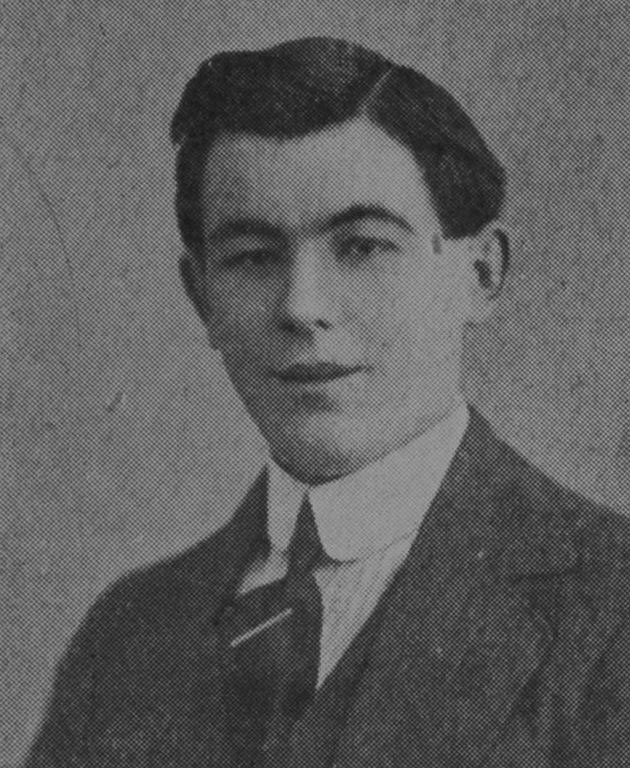
Evans D J Cpl 2459 1st Welsh Guards

Evans D J Cpl Welsh Guards

EVANS, DAVID JOHN, Corpl., No. 2459, Welsh Guards, s. of Job Evans, of Fronfelin, Cwmbach, co. Carmarthen, Farmer, by his wife, Sophia Evans, dau. of William Evans Fron; b. Penhenrhiw, Llanwinnio, co. Carmarthen, 27 Feb. 1896; educ. Council School, Cwmbach, and Whitland; was employed at Porth, by a firm of General Merchants; enlisted 18 Dec. 1915; served with the Expeditionary Force in France and Flanders from June, 1916, and was killed in action at Cam-brai 1 Dec. 1917. Buried at Gouzeaucourt. The Chaplain wrote: “He was buried near battalion headquarters; a cross has been erected over the grave, and I held a service at the burial, which was attended by the Commanding Officer and others of the regiment,” and the Commanding Officer: “I wish to express to you my great appreciation of the way in which your son carried out his duties at all times.” Unm.

Source : De Ruvigny’s Roll Of Honour Vol 3

The Battle of Cambrai (1 December 1917)
Following a major German counter-offensive on 30 November 1917 that briefly captured the village of Gouzeaucourt, the Guards Division was rushed forward to retake the village and stabilize the British line.
  • Pre-Dawn Assembly: During the bitterly cold, frosty night of 30 November–1 December, the 1st Battalion, Welsh Guards marched to the railway line east of Gouzeaucourt and formed up in two lines for a dawn counter-attack toward the high ground around Gonnelieu. 
  • The Assault (6:20 AM): Advancing uphill at 6:20 AM without expected tank support (which had been delayed by mechanical issues), the battalion ran into concealed German barbed wire. 
  • Heavy Casualties: As the first wave crossed the skyline, German flares illuminated the men and heavy machine-gun fire swept the slope. The Battalion War Diary records 6 officers and 70 other ranks killed alongside roughly 200 wounded—nearly all within the first 20 minutes of the attack. Corporal Evans was likely killed during this initial morning assault.
  • Eventual Objective Taken: Once a delayed British tank arrived to suppress the enemy machine-gun nests, the Welsh Guards successfully carried the ridge, capturing 26 machine guns and 300 prisoners.

According to the Commonwealth War Graves Commission (CWGC), he is officially recorded as Private David John Evans (Service No. 2459), 1st Battalion, Welsh Guards, died 1 December 1917, and is commemorated on the Cambrai Memorial, Louverval in France. (Note: Official CWGC rolls list his substantive rank as Private rather than his acting or lance rank of Corporal.)

Although the obituary notes that the Chaplain buried him near battalion headquarters at Gouzeaucourt with a wooden cross over his grave, he does not have an identified headstone today:
  • Initial Battlefield Burial: On 1 December 1917, 1st Battalion headquarters was positioned near Gouzeaucourt railway station and the sunken road, where Corporal Evans was given a marked battlefield burial.
  • Subsequent Fighting: Heavy shelling and trench warfare returned to the Gouzeaucourt sector—most notably during the German Spring Offensive in March 1918—destroying many temporary wooden crosses.
  • Post-War Concentration (1919): When Graves Registration units cleared the surrounding battlefields after the Armistice and moved remains into Gouzeaucourt New British Cemetery, the Welsh Guardsmen recovered from that sector could no longer be individually identified and were reburied as unknown soldiers. Consequently, Corporal Evans is commemorated by name among the missing on the Cambrai Memorial at Louverval.
Additional Memorials


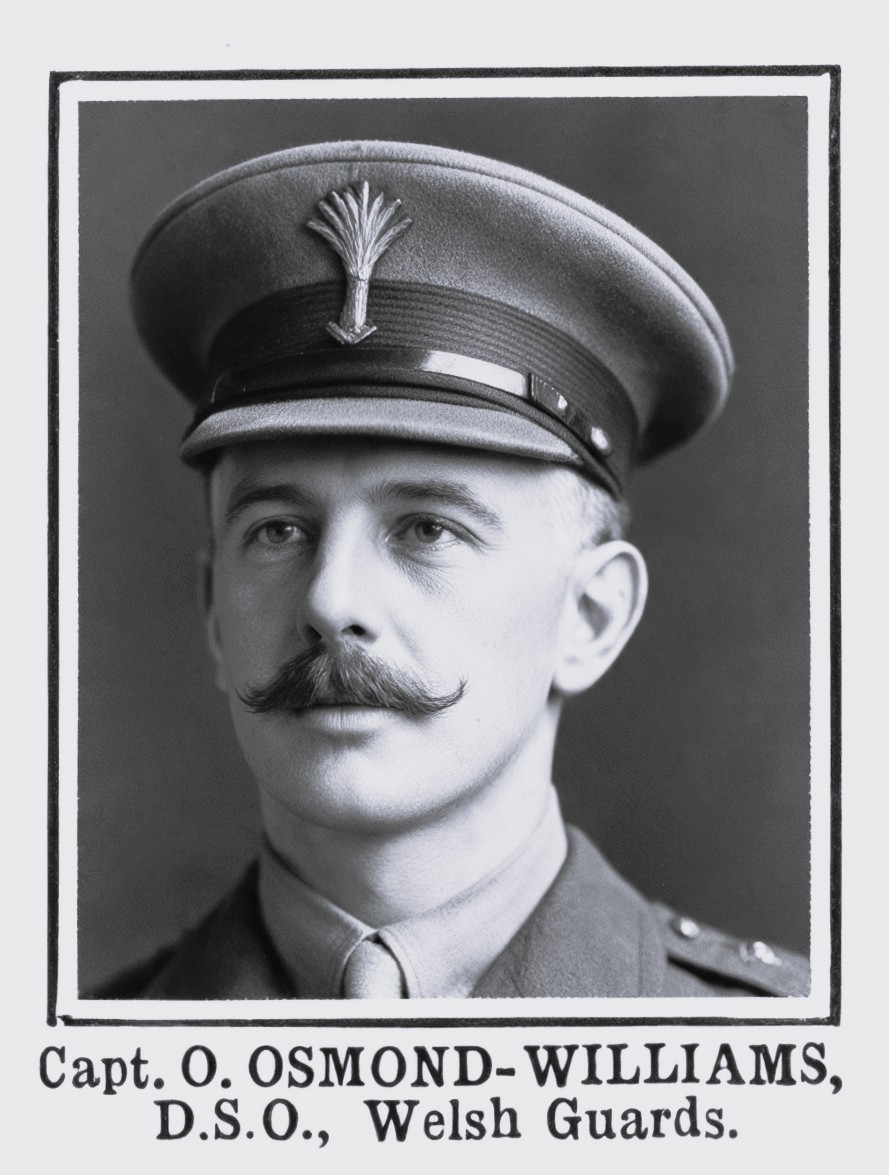
Osmond-Williams O Captain DSO 1st Welsh Guards

Osmond-Williams O Captain DSO Welsh Guards

Source : The War Illustrated Vol 5

Captain Osmond Trahairn Deudraeth Williams, D.S.O. 1st Welsh Guards (1883–1915)

  • Rank & Unit: Captain, 1st Battalion, Welsh Guards (previously served in the South African War with the 19th Royal Hussars and in WWI with the Royal Dragoons / Scots Greys) 

  • Decoration: Companion of the Distinguished Service Order (D.S.O.) 

  • Death & Burial: Died of wounds in late September 1915 following action at the Battle of Loos and is buried at Lapugnoy Military Cemetery in France.
War Diary & Regimental Accounts
  • The Wounding (Night of 27 September 1915): Commanding the Prince of Wales’s Company, Captain Osmond-Williams led his men in an assault toward Hill 70 / Chalk Pit Wood after dark. Caught in heavy German fire illuminated by star-shells, every officer in his company was hit.
  • Commanding Officer’s Entry (Lt-Col. Murray-Threipland): In the battalion’s casualty notes preserved in WO 95/1224/1, his injury is recorded as: Osmond-Williams. Wounded back of neck – I fear bad, as he lay out till this morning & was suffering from shock. Since died.”
  • Date Discrepancy: While the Commonwealth War Graves Commission and his grave at Lapugnoy Military Cemetery list his date of death as 30 September 1915, regimental accounts (including C.H. Dudley Ward’s History of the Welsh Guards) state that after lying out wounded until the morning of 28 September, he was evacuated to a casualty clearing station/hospital and died shortly after—variously cited in historical summaries as 28 September or 30 September 1915.

DSO

Captain Osmond Trahairn Deudraeth Williams won the Distinguished Service Order (D.S.O.) for his actions during a dismounted attack at Wytschaete in late 1914 while serving as a Second Lieutenant with the 2nd Dragoons (Royal Scots Greys).

The Action at Wytschaete (October–November 1914): Having originally enlisted in the ranks after being refused a commission on medical grounds from a 1908 polo injury, he served as personal orderly to Brigadier-General Sir Philip Chetwode during the Retreat from Mons and the Advance to the Aisne. Following a special field commission from Sir John French in November 1914 as a Second Lieutenant in the Scots Greys, he earned the D.S.O. during a dismounted assault at Wytschaete. [1]

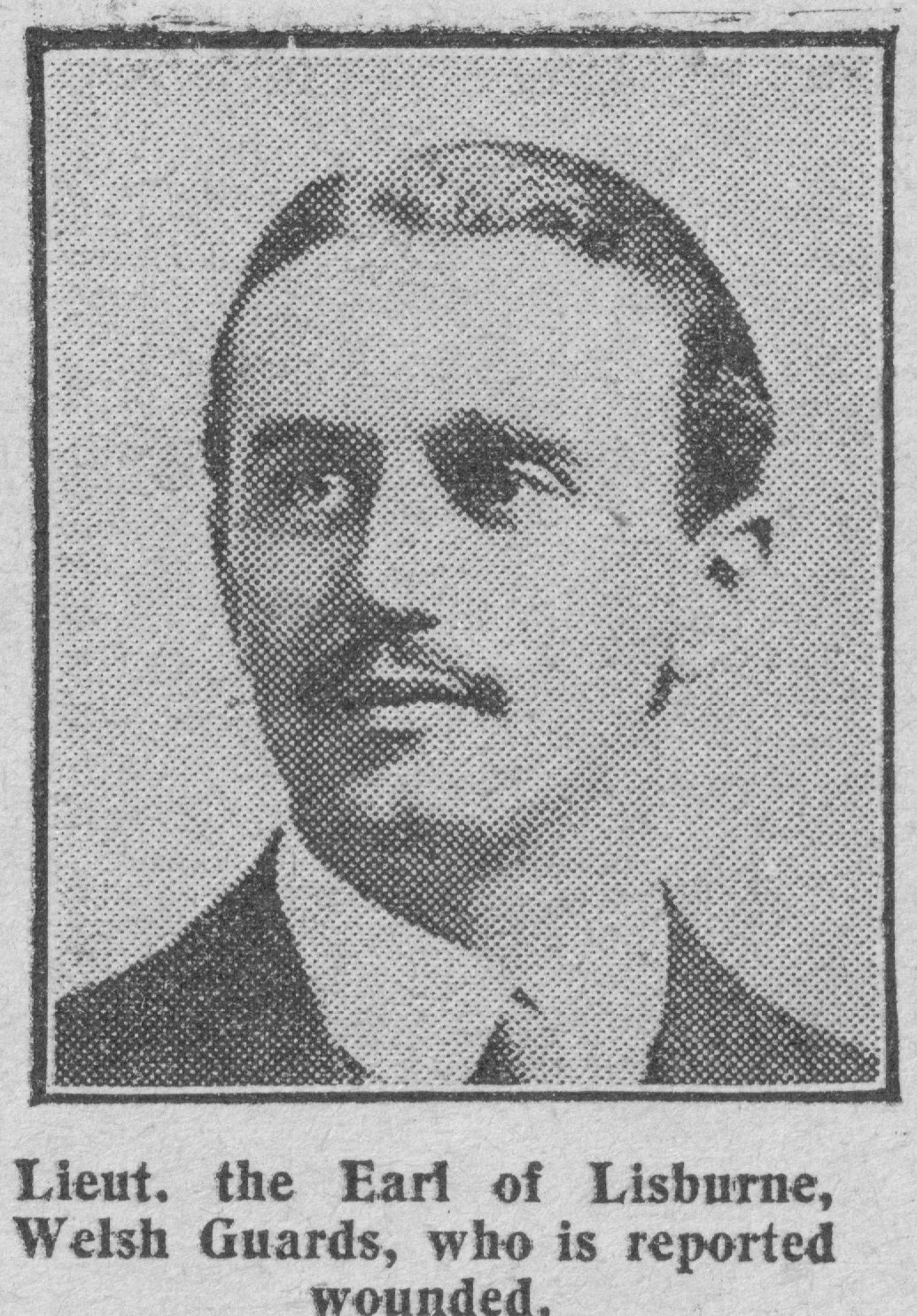
Lisburne E E H M Captain Welsh Guards

Lisburne E E H M Captain Welsh Guards

Lieut. the Earl of Lisburne, Welsh Guards, who is reported wounded.

Source : The Graphic 7th Oct 1916

Timeline of Military Service
  • Early Service (1912–1914). He was first commissioned as a probationary Second Lieutenant in the Scots Guards in February 1912, later resigning his commission in April 1914 just months before the outbreak of war.
  • First World War (1914–1918). Following the formation of the Welsh Guards in 1915, he joined the regiment and fought on the Western Front. During the conflict, he was wounded in action and was formally mentioned in dispatches for his service.
  • Interwar Period (1921–1927). His wartime rank was made permanent in 1921, and he continued serving until resigning his commission again in 1927.
  • Second World War (1939–1945). He returned to active duty with the Welsh Guards, serving as a Captain during the Second World War before retiring from the army for the final time in 1945 with the honorary rank of Major

Ernest Vaughan, 7th Earl of Lisburne married twice and had four children, making his family home at the ancestral estate of Trawsgoed near Llanafan in Cardiganshire (now Ceredigion), Wales.

Early Life & Heritage

Parents. He was the son of George Henry Arthur Vaughan, 6th Earl of Lisburne, and Evelyn Probyn. Following his father’s death in September 1899, Ernest succeeded to the earldom at just seven years old.
Education. He was educated at Eton College.
Marriages
First Marriage (1914–1944). Just weeks before WWI began, on 16 July 1914, he wed Maria Regina de Bittencourt (daughter of Don Julio de Bittencourt) at St Paul’s Church in Knightsbridge, London. Their marriage lasted nearly three decades until her death in January 1944.
Second Marriage (1961–1965). Later in life, on 14 November 1961, he married Audrey Meakin, daughter of James Meakin and stepdaughter of the 3rd Earl Sondes.