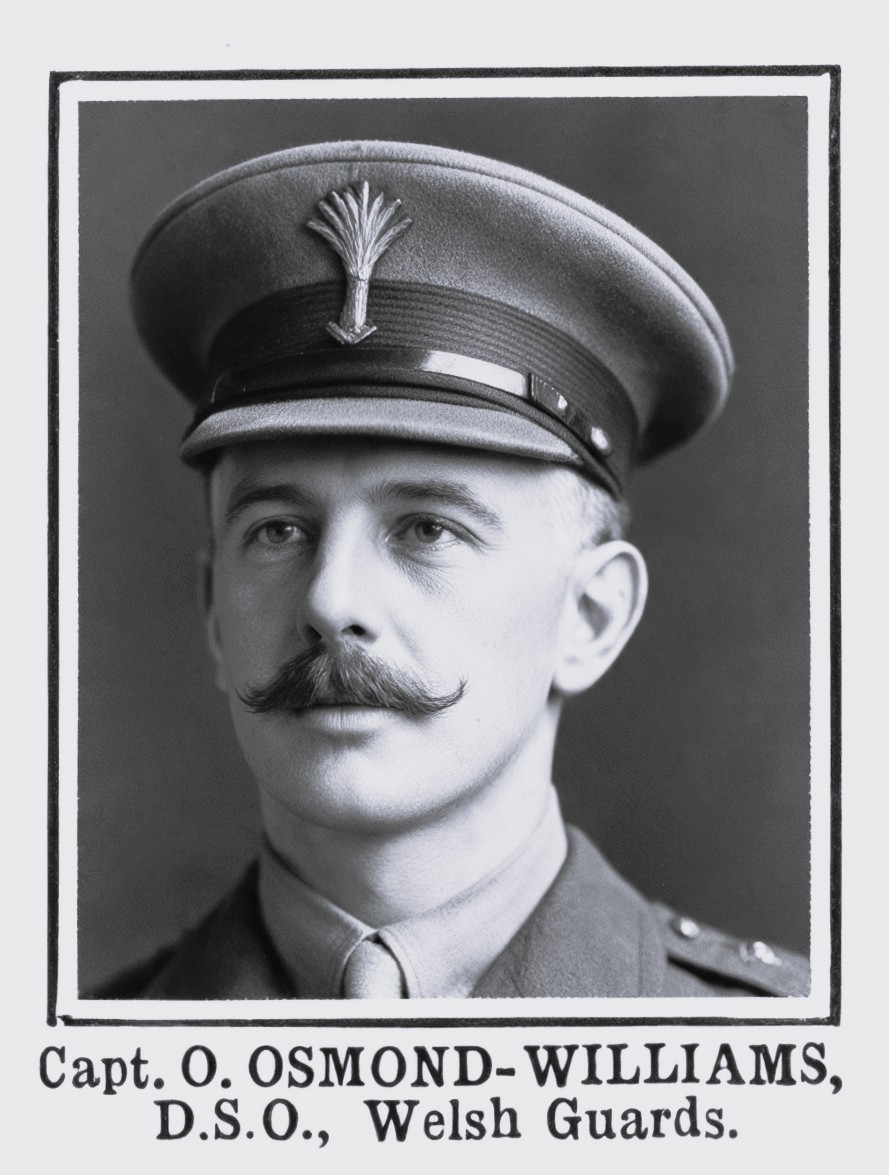
Osmond-Williams O Captain DSO Welsh Guards
Source : The War Illustrated Vol 5
Captain Osmond Trahairn Deudraeth Williams, D.S.O. 1st Welsh Guards (1883–1915)
- Rank & Unit: Captain, 1st Battalion, Welsh Guards (previously served in the South African War with the 19th Royal Hussars and in WWI with the Royal Dragoons / Scots Greys)
- Decoration: Companion of the Distinguished Service Order (D.S.O.)
- Death & Burial: Died of wounds in late September 1915 following action at the Battle of Loos and is buried at Lapugnoy Military Cemetery in France.
- The Wounding (Night of 27 September 1915): Commanding the Prince of Wales’s Company, Captain Osmond-Williams led his men in an assault toward Hill 70 / Chalk Pit Wood after dark. Caught in heavy German fire illuminated by star-shells, every officer in his company was hit.
- Commanding Officer’s Entry (Lt-Col. Murray-Threipland): In the battalion’s casualty notes preserved in WO 95/1224/1, his injury is recorded as: Osmond-Williams. Wounded back of neck – I fear bad, as he lay out till this morning & was suffering from shock. Since died.”
- Date Discrepancy: While the Commonwealth War Graves Commission and his grave at Lapugnoy Military Cemetery list his date of death as 30 September 1915, regimental accounts (including C.H. Dudley Ward’s History of the Welsh Guards) state that after lying out wounded until the morning of 28 September, he was evacuated to a casualty clearing station/hospital and died shortly after—variously cited in historical summaries as 28 September or 30 September 1915.
DSO
Captain Osmond Trahairn Deudraeth Williams won the Distinguished Service Order (D.S.O.) for his actions during a dismounted attack at Wytschaete in late 1914 while serving as a Second Lieutenant with the 2nd Dragoons (Royal Scots Greys).
The Action at Wytschaete (October–November 1914): Having originally enlisted in the ranks after being refused a commission on medical grounds from a 1908 polo injury, he served as personal orderly to Brigadier-General Sir Philip Chetwode during the Retreat from Mons and the Advance to the Aisne. Following a special field commission from Sir John French in November 1914 as a Second Lieutenant in the Scots Greys, he earned the D.S.O. during a dismounted assault at Wytschaete. [1]