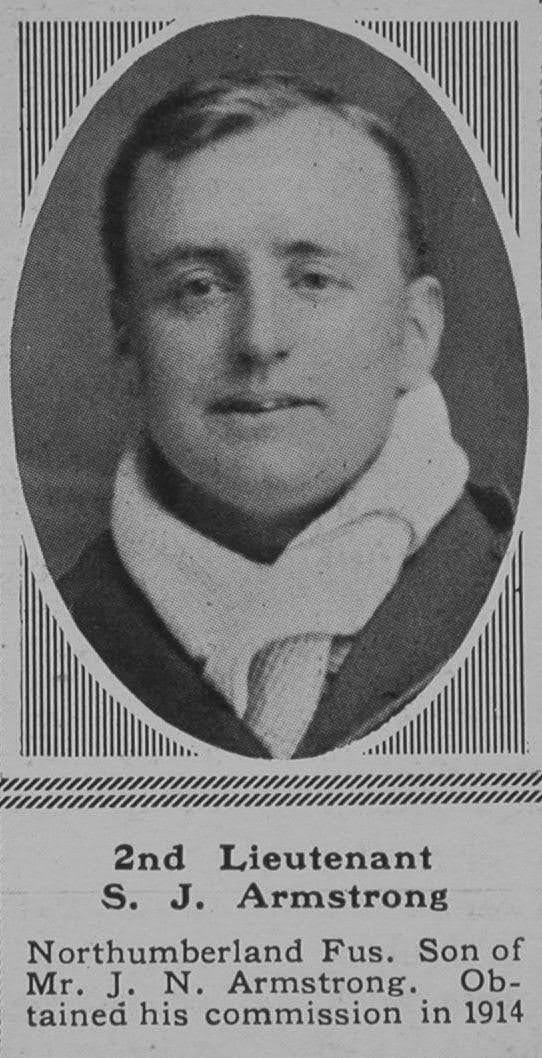
Armstrong S J 2nd Lt 12th Northumberland Fusiliers
2nd Lieutenant S. J. Armstrong Northumberland Fus. Son of Mr. J. N. Armstrong. Obtained his commission in 1914
Source : The Sphere 6th May 1916
ARMSTRONG, SYDNEY JOHN, B.A., 2nd Lieut., 12th (Service) Battn. The Northumberland Fusiliers, 3rd s. of John Nixon Armstrong, Head Master Skerton Council Schools, Lancaster, by his wife, Mary Ann, dau. of the late T. V. Barlow, of Lancaster; b. Skerton, Lancaster, 6 Nov. 1883; educ. Friends’ School, Lancaster, and Dublin University (B.A.); was an Assistant Master at Wigan Grammar School; volunteered and enlisted in the Public Schools Battn. in Sept. 1914; was gazetted 2nd Lieut. (temp.) on the 23 Dec. following; served with the Expeditionary Force in France, and was shot on the morning of the 26 Sept. 1915, while leading his men in an attack on a German trench near Loos, Flanders. The trench had been taken by the Northumberland Fusiliers, who were bombed out by the enemy and unable to retain it. His C.O. wrote: “He went forward with his platoon, and must have got ahead with others in the line. There are only seven men now with us from that platoon. We fear he is killed, but we can only return him as missing. No one has seen him either killed or wounded. Possibly he is a prisoner, but I gravely fear he is not.” Unm.
Summary of Events (25–26 September 1915)
- Arrival at the Front (25 September): Having only landed in France on 10 September, the battalion marched to Noyelles-lès-Vermelles before advancing at 3:00 p.m. behind the 8th and 10th Yorkshire Regiments. By 5:30 p.m., the 12th Northumberland Fusiliers extended on the left of the Lens Road and occupied former German trenches, coming under heavy shell fire for the first time around 7:15 p.m..
- Move into Loos (Night of 25 September): At 9:25 p.m., the battalion moved into Loos village, halting near the church square before a patrol led them up toward the Tower Bridge and cinder heap, where they suffered their first shelling casualties.
- The Attack on Hill 70 (Morning of 26 September): In the confusion during the night, a company of the 12th Battalion was sent forward to Hill 70, which the exhausted 9th Black Watch and 10th Gordon Highlanders mistook for a general relief—leaving the Northumberland Fusiliers exposed on the slopes. On the morning of 26 September, the battalion attacked the German trenches on Hill 70, briefly capturing a position before being overwhelmed by enemy bombing (grenade) counter-attacks and forced back, matching the exact circumstances described in 2nd Lt. Armstrong’s biographical notice.
Second Lieutenant Sidney (Sydney) John Armstrong has no known grave and is officially commemorated on the Loos Memorial in France, as well as on local memorials in the UK.
Official Military Memorial
• Loos Memorial (Pas-de-Calais, France): His name is inscribed on Panel 20 to 22. The memorial forms the side and rear walls of Dud Corner Cemetery in Loos-en-Gohelle and commemorates over 20,000 British and Commonwealth servicemen who fell in the sector with no known grave.
Local & Civic Memorials
According to Lancaster University’s Streets of Mourning archive, he is also listed on rolls of honour connected to his home and career:
• John O’Gaunt Rowing Club Roll of Honour (Lancaster)
• Lancaster Civic / Local War Memorials (his family resided at 1 Slyne Road, Lancaster)
• Wigan Grammar School (where he worked as a schoolmaster prior to his commission)