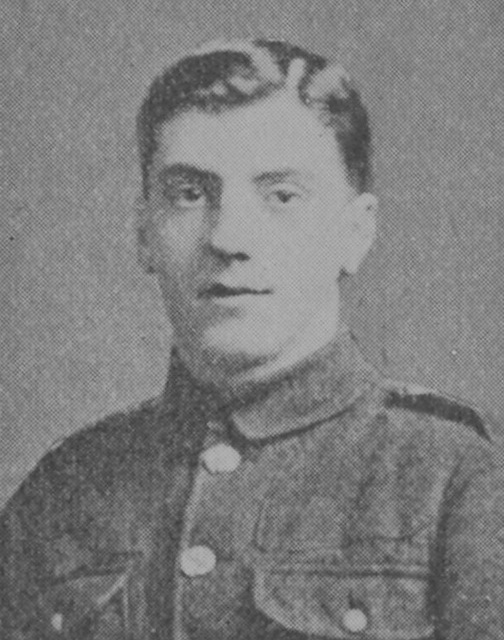
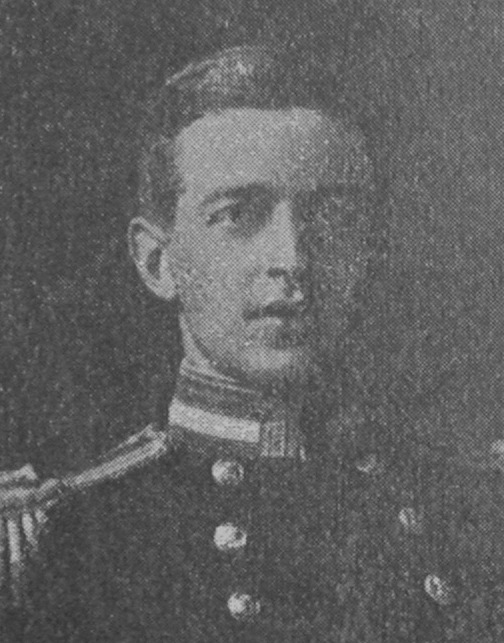
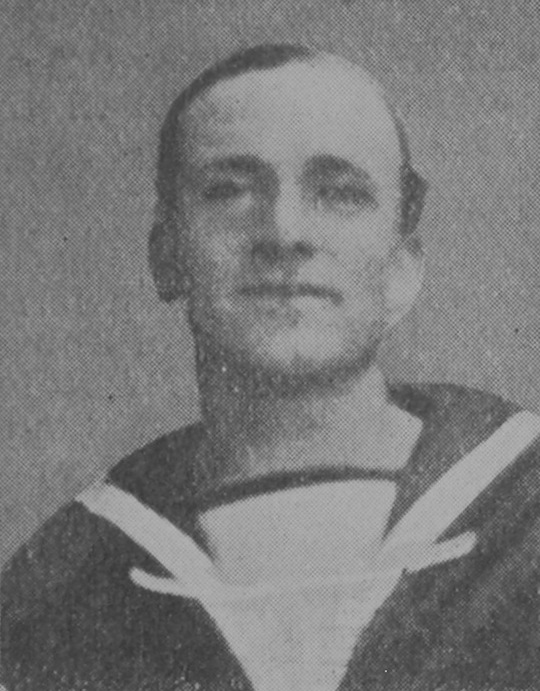
Clarke S A Sergt G/2659 6th East Kent Regiment

Clarke S A Sergt G/2659 6th East Kent Regiment

SERGEANT STEWART ALGERNON CLARKE, The Buffs, was the sixth son of the late Rev. James S. Clarke, vicar of Goudhurst, Kent, and was born in 1881.

Educated at Cranbrook Grammar School and Tonbridge, he entered the office of Ricardo and Robertson in 1895 and became a member of the Stock Exchange nine years later.

Until he injured his knee he was manager of “B” team of Blackheath Football Club. He was an enthusiastic collector of antiques, a connoisseur in old table glass, and a member of the British Numismatic and of the Kent Numismatic Societies.

During August 1914 he served in Kent as a motor-cyclist patrol and despatch rider. In September he enlisted in the 6th Battalion The Buffs, and was trained with them at Purfleet, Sandling, and Aldershot before they were sent to France in June 1915.

Before that Stewart Clarke had qualified at Hythe in Machine Gun work, and had been appointed Machine Gun Sergeant-Instructor to the battalion.

He was killed in action on the night of October 1915 near 13 Hulluch, in the course of the operations following the battle of Loos. His Machine Gun Officer wrote thus of him: “We were attacking a portion of the German trenches, and he was in charge of one of the guns which had to advance to the captured trench. He died whilst leading his team in the most gallant fashion.”

“Of all that he meant to me I can give no idea. I always looked upon him as a brother officer to whom I could go for advice, and whose advice was always worth taking. The men of the Machine Gun section absolutely worshipped him and, whatever hardships they had to go through, there was never any complaint because they knew they could trust their sergeant to get the best possible for them.”

Source : The Stock Exchange War Memorial 1914-1918

Clarke S A Sergt G/2659 6th East Kent Regiment

SERGT. STEWART ALGERNON CLARKE, 6TH BATTN. THE BUFFS (EAST KENT REGT.). KILLED IN ACTION AT THE HOHENZOLLERN REDOUBT, NEAR HULLUCH, OCTOBER 13TH, 1915. AGED 34.

At the School 1893-95 (Day Boy). Stewart Algernon Clarke was the sixth son of the late Rev. James Sanderson Clarke, Vicar of Goudhurst, Kent, and Mrs. Clarke, of 198, Denmark Hill, S.E., and a brother of the Rev. Kenneth Clarke (P.S. 1889-93; Sixth Form 1892-93; XI. 1891-2-3; XV. 1892; Sizar of St. John’s College, Cambridge, 1893; B.A. 1896), for long Vicar of St. Mark’s, Lewisham, S.E. He had been on the Stock Exchange ever since. he left School, and became a Member of the House in 1904. He was a Member of the Kent Numismatic Society, and his great hobby lately had been “tokens.” He was, says a correspondent, a “real good fellow and a delightful companion with a host of friends.”

On the outbreak of war he acted as a Cycle Patrol on the Kentish coast and then enlisted with the other men in the 6th Battn. of the Buffs and in time became Machine Gun Sergeant. He was offered one or two Commissions, but would not take them as he was unwilling to leave the men he enlisted with and wanted to serve in the Buffs, as East Kent was his home.

His officer writes: “He was killed on the night of the 13-14th (October). We were attacking a portion of the German trenches and he was in charge of the gun which had to advance to the captured trench. He died whilst leading his team in the most gallant fashion. In the whole Battalion there was hardly a man more looked up to than Sergt. Clarke, and this regard he had won for himself entirely by his own personal merit. Of all that he meant to me I can give you no idea. I always looked on him as a brother officer to whom I could go for advice and whose advice was always worth taking. The men of the machine gun section absolutely worshipped him, and whatever hardship they have had to go through there was never any complaint, because they knew they could trust their Sergeant to get the best possible for them.”

One of his brothers, the third son, Basil Edward Clarke, who was serving as a Private in the 7th Battn. of the 1st Canadian Contingent, was reported missing when the Canadians lost so heavily near Ypres on April 24th, 1915, and his death was ultimately presumed. Two other brothers served and were both wounded.

Source : Tonbridge School And The Great War Of 1914-1919

Chinnery H B Lt 13th Kings Royal Rifle Corps

Chinnery H B Lt 13th Kings Royal Rifle Corps

LIEUTENANT HARRY BRODRICK CHINNERY, King’s Royal Rifle Corps, second son of the late W. M. Chinnery of Hatchford Park, Cobham, Surrey, was born in 1876 and educated at Eton.

His name was long famous in the cricketing world. He played for Eton against Harrow in 1894 and 1895, and was afterwards a regular member first of the Surrey and then of the Middlesex Eleven. He became a member of the Stock Exchange in 1898, and a partner in his late father’s firm, Chinnery Bros.

As soon as war broke out he offered his services to the War Office and was given a commission in the 13th (Service) Battalion of the 60th (King’s Royal Rifles).

He was killed in France on 28 May 1916, in circumstances that are thus described by his Company Commander: “He was in the middle of his men, encouraging them in a moment of danger. He was killed by the last shell fired at a night working party which was advancing our line nearer to the enemy. It was a trying night, and he did splendidly all the earlier part of it in keeping them at their work and keeping up their spirits.”

His Colonel wrote: “He will be greatly missed by his brother- officers and the men of his Company, while by his death the Battalion has lost a valuable officer whom it would be difficult to replace.”

Lieut. Chinnery’s popularity with his men may be judged by the following extracts from a letter written by a rifleman “on behalf of the fellows in his Platoon and myself”:

“Mr. Chinnery was loved and respected by all of us that he came in contact with. While in charge of the Machine Gun Section in England, and last Autumn out here, he was looked upon as something more than a good officer and a perfect gentleman; and although he had only been with No. 6 Platoon six weeks, yet no Officer was more respected and had their complete confidence.”

“Many are the stories told by his men of his splendid courage and coolness on Sunday night (the night of his death); always first in his area to go to a wounded man, to assist and cheer with a kindly word.”

Source : The Stock Exchange War Memorial 1914-1918

Chappell E R Lt Royal Garrison Artillery

Chappell E R Lt Royal Garrison Artillery

SECOND LIEUT. ERNEST ROWLAND CHAPPELL, Royal Garrison Artillery, became a member of The Stock Exchange in 1909 and was with the firm of Richardson and Co.

He met his death just before the Armistice while on duty with his battery outside Loos, being mortally wounded by a shell. His Commanding Officer wrote to his widow: ” Your splendid husband stuck to his guns and did his job when others less stout- hearted might have left them after the first salvo of shells came.”

Source : The Stock Exchange War Memorial 1914-1918

Carter W J 2nd Lt 10th Essex Regiment

Carter W J 2nd Lt 10th Essex Regiment#

SECOND LIEUTENANT WILLIAM JAMES CARTER, 10th Essex Regiment, was the elder son of the late R. J. Carter of Ilford and the Stock Exchange. Born in April 1885, he was educated at Mercers’ School and Chigwell School, Essex. He was in the cricket and football elevens, and a member of the Cadet Corps.

He joined his father’s firm, Messrs. Henry T. Brice and Co., in 1903 and became a member of the Stock Exchange in 1914.

In December 1915 he attested under the Derby Scheme, and voluntarily enlisted in June 1916. He served as a lance-corporal in the Argyll and Sutherland Highlanders, and qualified with distinction as a first-class Instructor in Bombing. After a period with an Officers Cadet Battalion he was gazetted to a commission in January 1918. For three months he remained in training at Felixstowe before joining the 3rd Battalion, Essex Regiment, later proceeding to France with the 1st Battalion.

He was killed at Ronssoy, during the final great advance on 21 September 1918.

His Commanding Officer wrote: “He was a very painstaking and keen officer and always looked after his men well.’

Source : The Stock Exchange War Memorial 1914-1918

Stoddart S Sergt 12038 10th Durham Light Infantry

Stoddart S Sergt 12038 10th Durham Light Infantry

STODDART, SYDNEY, Sergt., No. 12038, Machine-gun Section, 10th (Service) Battn. Durham L.I., only s. of Edward Stoddart, of 3, Brantwood Terrace, Tindale Crescent, Bishop Auckland, Cordwainer, by his wife, Margaret, dau. of the late Joseph Brown; b. Barnard Castle, co. Durham, 21 Sept. 1889; educ. there; and was afterwards a Ticket Collector at Crook Station, North Eastern Railway; volunteered on the outbreak of war and enlisted in the 10th Durham L.I., 12 Aug. 1914; went to France, 19 May, 1915, was promoted Sergt. on or about 29 May, and was killed in action at Ypres, 21 July, 1915; unm. Buried in the 43rd Brigade Cemetery there. Lieut. John B. Rosher wrote to his mother: “I know so well what a splendid fellow he was, as he has been in my machine-gun section so long. Always cheery under the most adverse circumstances, and always ready to help in every way possible. He is a great loss to my section, and I feel that his loss is a personal one. We have worked the gun together several times and I had many opportunities of admiring his coolness and courage.”

Source : De Ruvigny’s Roll Of Honour Vol 1


Stock F E Drummer 1137 4th East Yorkshire Regiment

Stock F E Drummer 1137 4th East Yorkshire Regiment

STOCK, FREDERICK ERNEST, Drummer, No. 1137, B Coy., 4th Battn. The East Yorkshire Regt. (T.F.), 3rd s. of James Stock, of 87, Brunswick Avenue, Hull, formerly of Ramsgate, late Sergt. in the 1st Norfolk Artillery Volunteers at Great Yarmouth, by his wife, Charlotte, dau. of James Wright, of Great Yarmouth; b. Hull, co. York, 19 Aug. 1894; educ. Christ Church School there, and was a member of the St. Paul’s Church Lads’ Brigade. A Coppersmith by trade, he served his apprenticeship with Messrs. George Clark & Sons, Waterhouse Lane, where his brother, Herbert, who is now (1916) on active service, was also employed. He enlisted in the Hull Rifles in 1910, and was in training at Newcastle on the outbreak of war, when he immediately volunteered for foreign service. He went with his regt. to the Front, took part in all the engagements of his battn., witnessed some of the most severe battles in Flanders, and was killed in action at Ypres, 29 June, 1915, and was buried in R.E. Farm, near Wulverghem (Ref. 1/40,000, Map N 35d 9-7); unm. A comrade wrote: “He was shot through the head at 4.15 a.m. on 28 June, and died at 4.40 a.m. the same day. I was with him all the time waiting for him to come round, but he went without gaining consciousness.”

Source : De Ruvigny’s Roll Of Honour Vol 1

Stirling W D Lt HMS Monmouth Royal Navy

Stirling W D Lt HMS Monmouth Royal Navy

STIRLING, WILFRED DIXON, Lieut., Royal Navy, s. of Col. James Wilfrid Stirling, of The Grange, Rockbeare, Devon, now commanding 72nd Brigade, Royal Field Artillery, by his wife, Cecil Mary, dau. of Major-Gen. Dixon Edward Hoste, C.B., R.A.; b. Pennycross, near Devonport, 12 Sept. 1886; educ. Cheltenham College, and passed direct into H.M.S. Britannia in 1901 and passed out 5th in his term in Dec. 1902, having been awarded the Diploma of Honour as selected Candidate of his term for His Majesty’s medal; entered the Navy as Midshipman, 16 Dec. 1902; promoted Sub- Lieut., 15 March, 1906, and Lieut., 16 June, 1907; served as Midshipman in H.M.S. Bacchante, under Capt. (afterwards Admiral Sir) Christopher Cradock; qualified as Navigating Officer in 1907, and acted in that capacity successively in H.M. ships Ringdove, Media, Attentive and Grafton; was Instructor in Navigation to Cadets at Dartmouth, Jan. 1913, to Aug. 1914; appointed Navigating Lieut., H.M.S. Monmouth (Capt. Brandt), Aug. 1914, and was lost when that ship was sunk in the battle off Coronel, on the coast of Chili, 1 Nov. 1914; unm.

From many appreciative letters the following sentence is taken from that of a brother officer: “His was a glorious example, and if anything can lessen the terrible sorrow you and Col. Stirling are suffering it must be the knowledge that his life was well lived and his duty nobly done.”

Source : De Ruvigny’s Roll Of Honour Vol 1


Stirling J Captain 3rd Attd 1st Cameronians

Stirling J Captain 3rd Attd 1st Cameronians

STIRLING, JAMES, Capt., 3rd., attd. 1st, Battn. The Cameronians (Scottish Rifles), eldest s. of Col. James Wilfrid Stirling, of The Grange, Rockbeare, Devon, now commanding 72nd Brigade, Royal Field Artillery, by his wife, Cecil Mary, dau. of Major-Gen. Dixon Edward Hoste, C.B., R.A.; b. Hong Kong, 7 June, 1884; educ. Wellington College and the Royal Military College, Sandhurst; gazetted 2nd Lieut. to the 2nd Cameronians, 22 April, 1903, and promoted Lieut., 5 Oct. 1907; retired in 1911 and joined the 3rd Battn. at Hamilton for Special Reserve duty; appointed Capt., 1912; rejoined on the outbreak of war; went to the Front from England, 6 Oct. 1914, where he was attached to the 1st Battn., and was killed in the trenches near Armentières, 2 Jan. 1915; unm.

His Colonel wrote: “The loss of your dear son is irreparable. As his late commanding officer I deeply feel his sad but glorious end; he was one of the most honourable, conscientious and reliable of all my officers.” A bronze tablet was placed in Rockbeare Parish Church to the memory of himself and his younger brother, Lieut. W. D. Stirling, R.N. (see following notice).

Source : De Ruvigny’s Roll Of Honour Vol 1


Stiling W C H Sig 216012 HMS Monmouth Royal Navy

Stiling W C H Sig 216012 HMS Monmouth Royal Navy

STILING, WILLIAM CHARLES HENRY, Signalman, No. 216012, Royal Navy, H.M.S. Monmouth, eldest s. of the late Charles Henry Stiling, of The Minories, by his wife, Phoebe (7, Circus, Minories, Aldgate, E.), dau. of William Thomas Pugh; b. St. George’s, E., 1 Dec. 1885; educ. Sir John Cass’ School, Minories; enlisted in the Devonshire Regt., 25 June, 1901, but was claimed out by his mother (29 June), being only 15, and then in the 5th Battn. Rifle Brigade, but was again claimed out; joined the Navy as a Boy (2nd class), 19 July, 1901; became Boy (1st class), 5 June, 1902; Signalman, 2 Dec. 1903; Ordinary Signalman, 1 Oct. 1907; Signalman, 26 Nov. 1907; served in H.M.S. Impregnable, Vivid, Royal Oak, Cambridge, Hogue, Cornwall, Mars, Hibernia, Crescent, Orontes, Egmont, Sutlej and Monmouth (appointed 30 July, 1914), and was lost on H.M.S. Monmouth when that ship was sunk in the battle off Coronel, on the coast of Chili, 1 Nov. 1914; unm. His brother, Thomas Edward, Leading Seaman, served at the Dardanelles on the Swiftshire, and is now (1916) on active service on H.M.S. Royal Oak in the North Sea.

Source : De Ruvigny’s Roll Of Honour Vol 1

Stiff H Pte 13118 1st Suffolk Regiment

STIFF, HARRY, Private, No. 13118, 1st Battn. Suffolk Regt., s. of William Stiff, of Wickhambrook, co. Suffolk, Agricultural Labourer, by his wife, Sarah Ann, dau. of William Willingham; b. Chedburgh, near Bury St. Edmunds, co. Suffolk, 16 Sept. 1886; educ. Hargrave, and served for six years in the 3rd Battn. Suffolk Regt., being discharged with exemplary character. On the outbreak of war he re-enlisted in the 1st Battn. Suffolk Regt., served in France and Flanders, and was killed in action south of Ypres, 18 Feb. 1915; unm.

Source : De Ruvigny’s Roll Of Honour Vol 1