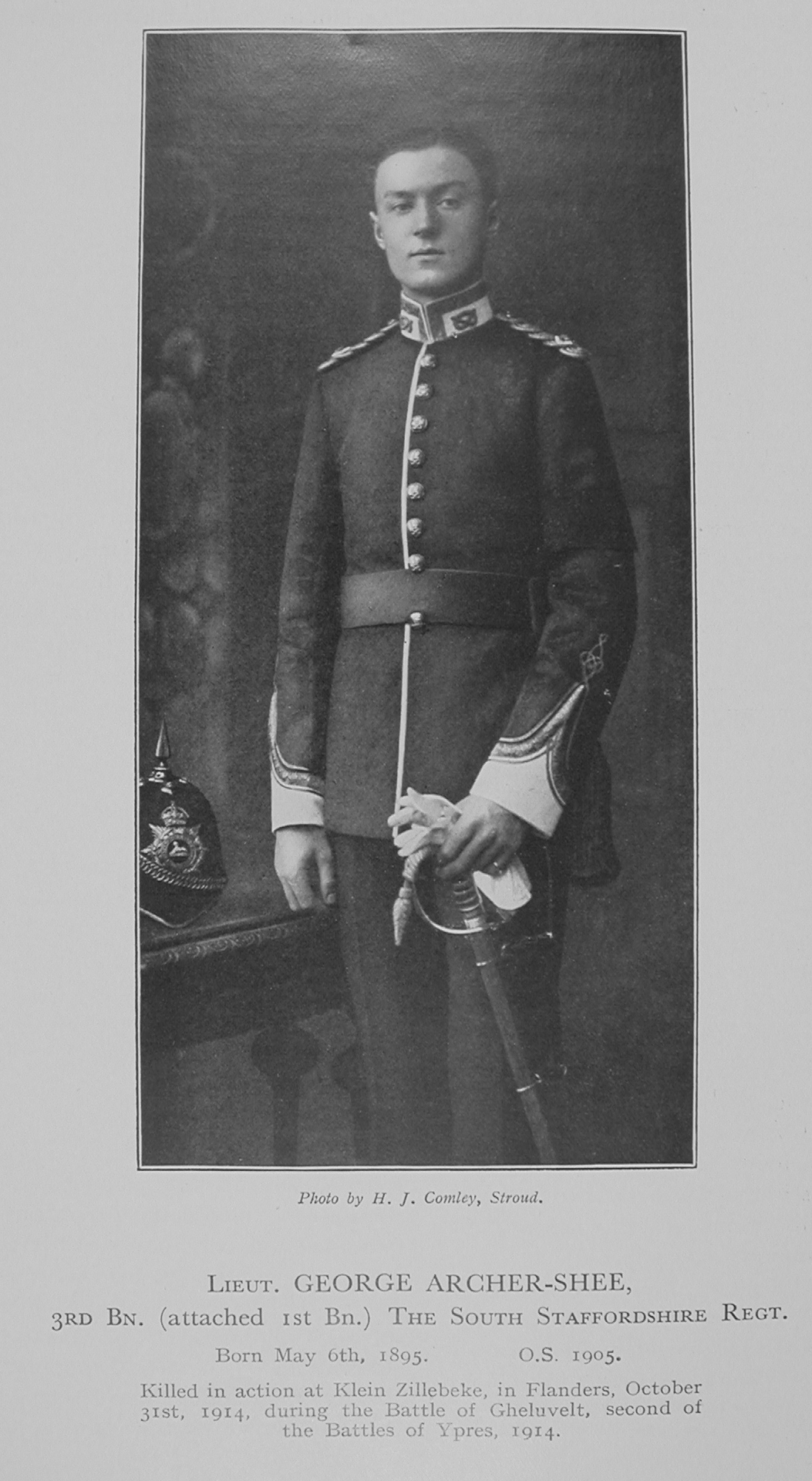
Archer-Shee G Lt 1st South Staffs Regiment

Archer-Shee G Lt 1st South Staffs Regiment


Lieut. GEORGE ARCHER-SHEE, 3rd Bn Staffordshire Regt. (attached 1st Bn.)

The death of this young officer, so well known and popular at Stonyhurst, caused deep regret to his many College friends. Our sympathy is intensified by the recollection of the very trying ordeal he had to pass through some years ago as a boy cadet at Osborne, where he was mistakenly accused and dismissed on a charge of petty theft. During the legal proceedings which followed, it will be remembered that the College authorities, who knew him well, and were convinced of his innocence, sent representatives to give evidence in court as to the high character he had always borne as a boy at Stonyhurst.

The details of the trial-the cause célèbre of the year and the subsequent debates on it in Parliament are so well known that we need not recall them here. They resulted in what every newspaper in the country described as “a complete vindication of his character.” He received an ample apology from Mr. McKenna, then First Lord of the Admiralty, and was awarded £7,000 damages.

After leaving Osborne he was welcomed back to Stonyhurst, where he remained till of age. to enter the Army. It is pleasant to recall the fact that not only did his schoolfellows at Stonyhurst believe him guiltless of the charge, but that his fellow-cadets at Osborne were unanimously in his favour.

The newspapers, in recording his death, one and all concurred in tributes of special sympathy.

The Daily Mail, under the heading “Romance of a Hero,” concluded with the words, “Driven from the Navy by injustice, Lieut. Archer-Shee has won fame and honour in the Army, and- he has served his country well.”

The following notice is from The Times :- “Lieut. George Archer-Shee, 1st Bn. The South Staffordshire Regt., who was killed near Ypres on October 31st, aged 19 years, was the younger son of the late Martin Archer-Shee and Mrs. Archer-Shee, of Woodchester,

He joined the Royal Naval College, Osborne, in 1908, but was removed. in circumstances which afterwards formed the subject of legal proceedings in the King’s Bench, the result of which was the complete vindication of his character.

Colonel Ovens, C.M.G., the officer commanding the 1st Bn. The South Staffordshire Regt., writes of him to his mother-

He was a most promising young officer, and in the short time he was in the 1st Bn. The South Staffordshire Regt. he earned the love and respect of both officers. and men, and by his bravery and example contributed largely to the success of the battalion in the actions. near Ypres.'”

Although the evidence of his death on October 31st, at Klein Zillebeke, near Ypres, was confirmed later, his relatives and friends. had been kept in suspense as to his fate from October to May, during which period his name had been officially posted as “missing.”

By all accounts received from his brother officers and the men of his regiment, he had borne himself with special gallantry throughout the fighting in which he took part.

His death at the Battle of Gheluvelt is thus described in a letter from an officer of the 1st Bn. The South Staffordshire Regt. at Ypres, to Major Archer-Shee :-

Jan. 14th, 1915.

It seems that during the retirement of the Division he was in charge of a platoon in an exposed portion of the line; other units of other corps, it seems, had received orders to retire, but the order had not reached him. Someone, it is said, pointed out to him that the units on each side of him were retiring; he replied that he did not care what they did, but no one of his men was to retire till he gave them orders to do so, and so they held on against great odds.

Later a message seems to have reached him, for he gave the order to the men to retire as best they could. He, it is said, was the last to retire, and a man, since killed, reported that he looked round and saw him lying face downwards on the ground, motionless, though killed instantly, his head towards the enemy He earned the highest opinions of his brother officer, and his loss is most keenly felt by all who knew him. He was such a charming and interesting young fellow. and had seen such a lot of the world for his years, that he was a most pleasant companion at all times and made many friends.

Source : Stonyhurst War Record

Amoroso M Lt Royal Field Artillery

Amoroso M Lt Royal Field Artillery

Lieut. MICHELE AMOROSO, 95th Brigade Royal Field Artillery.

Lieut. Amoroso, son of the late Mr. Michele Amoroso, shipbroker, of Liverpool, and Mrs. Amoroso, of  “Ellerslie,” New Brighton, was killed in action on July 3rd, 1916, aged 24 years. He was educated at Stonyhurst College, and was a member of the Racket and Liverpool Ramblers football clubs. He joined the Liverpool Scottish on August 4th, 1914, and after three months’ training in Edinburgh, obtained a commission in the R.F.A. He was sent to the front on September 1st, 1915, and went through the battle of Loos, where he distinguished himself, and was promoted Lieutenant.

Lieut. Amoroso served continuously for over ten months with the R.F.A. in France, and took part in much heavy fighting. His fighting record during the last few days of his life had been distinguished by several acts of conspicuous bravery.

On July 1st, Lieut. Amoroso, with a brother officer, succeeded in bringing in wounded men over the front line parapet under heavy fire.

On July 2nd, with great coolness and thoroughness, he ran his telephone wire out over a shell-swept area in front of our troops, establishing connection with an advanced post of importance known as the “Crucifix.” Owing to the care with which his line was laid, communication with his battery was never interrupted throughout the day. In the evening he led a small party of bombers, and cleared the “Crucifix” trench for a distance of a hundred yards beyond the point designed as an artillery observation post near Fricourt.

Next day, July 3rd, working parties were being worried by snipers close in front of his trench. To investigate this annoyance, Lieut. Amoroso took charge of a machine gun, which he worked until he was killed by a sniper at the close range of thirty yards.

His brother officers and men were keenly affected by his loss. His unflinching devotion to duty, and notably the way in which he was always ready to sacrifice his own convenience to relieve others of irksome duties, had made him a general favourite.

The expression of his face in repose, as seen in our illustration, might convey an impression of sternness. But in reality his was a merry nature, always kindly and equable. Thus he is remembered by the many Stonyhurst friends, who regret his untimely end.

The Chaplain who buried him, and knew him well, bears testimony to the high character he bore, his personal attachment to the practices of his religion, and his zeal for the religious welfare of his men.

Source : Stonyhurst War Record

Allanson W G Lt Royal Air Force

Allanson W G Lt Royal Air Force

Lieut. WILFRID GEORGE ALLANSON Royal Air Force

Wilfrid Allanson was a boy who won the respect of masters and boys alike. His talents were above the average, and he had a career of distinction as a student. He came here into Second Figures in September, 1909. Each year of his course he was a prizeman. In Syntax, in 1912, he gained the first medal; in Rudiments, 1910, and Poetry, 1913, the second medal. In 1912 and 1913 he gained prizes in Classical Honours, and the first B.C.A. prize in the latter year.

He passed the Lower Certificate in 1911, with first classes in Latin and English; the School Certificate in 1912, and the Higher Certificate in 1914. The next year he matriculated at the London University.

In November, 1915, he joined the Inns of Court O.T.C. (His brother Gerald held a commission in the M.G.C.)

His preliminary training in the Inns of Court O.T.C. was at Berkhamstead, where he passed the Lewis-gun course, obtaining 99 per cent. of the possible marks. In March, 1917, he was transferred to the Royal Flying Corps. After qualifying at Oxford, he was gazetted on May 25th, 1917, and shortly afterwards was attached to the School of Aerial Gunnery, Hythe, as Pilot Instructor. There is no doubt that his mental and physical attainments were much above the average, and had he survived, he gave every promise of going far in his profession. He loved flying, and was really a first-rate pilot.

In March, 1918, he went to France, and on September 21st he was shot down, while fighting five hostile machines, at Cassel, in North France.

His C.O. wrote:- He was one of the most popular officers there has ever been in this squadron, and excellent, too, at his work. I cannot tell you how much we shall miss him. The following copy of a letter from a Church of England Chaplain shows the high esteem in which he was held by the squadron:-

No. 7 Squadron, R.A.F., October 3rd, 1918.

I have just returned from leave and learn with the utmost sorrow of the death in action of your son, Lieut. W. G. Allanson. I cannot find words adequately to express my grief, but I want to offer you my very true and heartfelt sympathy, and to tell you how deeply every member of the squadron feels his loss. It is no exaggeration to say that everybody loved him, for he had one of those very attractive dispositions which won him friends wherever he went. He was always the same bright, cheery, sympathetic friend, good all through, and a pillar of strength in the squadron.

Born in 1897, Lieut. Allanson was the son of Mr. G. Allanson and Mrs. Allanson, of “Belmont,” King’s Avenue, Clapham Park, London, S.W.

He was laid to rest in the British Cemetery Proven two miles inside the Belgian at frontier by the side of his observer, Lieut. W. R. Anderson, who was killed at the same time.

Source : Stonyhurst War Record

Steele M J L/Cpl 2478 4th East Yorkshire Regiment

Steele M J L/Cpl 2478 4th East Yorkshire Regiment

STEELE, MATTHEW JAMES, L/Corpl., No 2476, 1/4th Battn. East Yorkshire Regt. (T.F.), 3rd s. of Thomas Steele, of Hull, Cab Proprietor, by his wife, Maria Elizabeth, dau. of James Outram; b. Hull, 27 April, 1892; educ. Warne Street Council School there; was an Assistant Steward, Hull and Barnsley Railway Head Offices; volunteered on the outbreak of war in Aug. 1914, and joined the 4th East Yorkshires; went to France, 17 April, 1915, and was killed in action east of Ypres, 26 May, 1915. From letters received it appears that one of his comrades had been shot by a sniper, and that Steele, thinking he might still be alive, went to his assistance and was himself shot through the heart. He m. at St. Stephen’s Church, Hull, 1 March, 1913, Kathleen (76, Portland Street, Hull), dau. of John (and Ada) Moorhead, and had a son, Kenneth James, b. 13 June,1914.

Source : De Ruvigny’s Roll Of Honour Vol 1

Steel J Mechanical Stoker 276964 HMS Goliath Royal Navy

STEEL, JOHN, Mechanical Stoker (R.F.R., B. 1557), 276964; b. Dublin, 25 Dec. 18.., served in the European War, and was lost in H.M.S. Goliath at the Dardanelles, 12 May, 1915. He m., 22 Sept. 1900, Fanny (10, Harbour Village, Goodwick, co. Pembroke), dau. of (-), and had two sons: Richard John, b. 28 June, 1901; and Edward James, b. 31 Oct. 1906. He had the medal for saving life.

Source : De Ruvigny’s Roll Of Honour Vol 1

Stearns E G 2nd Lt 4th Royal Fusiliers

Stearns E G 2nd Lt 4th Royal Fusiliers

STEARNS, ERIC GORDON, 2nd Lieut., 4th Battn. Royal Fusiliers, yr. s. of Thomas Robert Stearns, of Lansdowne, Woodridings, Hatch End, co. Middlesex, Insurance Official, by his wife, Alice, dau. of James Grant, of Ipswich and Belize; b. Hornsey, 25 March, 1895; educ. St. John’s College, and Lower School, Harrow was a Clerk in the Sun Insurance Office; joined the Artists’ Rifles (28th London Regt.) in 1912; volunteered for foreign service on the outbreak of war; was given a commission as 2nd Lieut. 6 April, 1915, and posted to the Royal Fusiliers; went to France in Oct. 1914, and died at Abeele of wounds received in action in Belgium, while in charge of a party digging a new trench; unm. His commanding officer, Lieut.-Col. W. F. Sweny, wrote: “I have seen enough of your son to realise what a useful and cool officer he was “; Sergt. F. H. Smith: “Mr. Stearns was almost worshipped by the men under his command; they would have followed him anywhere, for they knew he was a man. He had not an atom of fear in him, and he had always a smile and a cheery word for everybody. I do not think anybody could be more liked and respected than he was and Private W. H. Leighton: “The bullet caught him just above the hip and passed upwards. We did everything we possibly could but all in vain, worse luck. He bore it extremely well, as he always did everything, being a very brave officer and one whom the men had the greatest confidence in and would have followed him anywhere.”

Source : De Ruvigny’s Roll Of Honour Vol 1


Steane P H Pte 2631 15th London Regiment

Steane P H Pte 2631 15th London Regiment

STEANE, PERCY HOWARD, Private No. 2631, 15th Battn. (Prince of Wales’s Own Civil Service Rifles) London Regt. (T.F.), only s. of Frederick Houston Steane, Solicitor’s Managing Clerk; b. Balham, 31 Oct. 1892; educ. Balham Grammar School; was in the service of the Ocean Insurance Company, but on the outbreak of war enlisted Aug. 1914, and was killed at Festubert, 18 May, 1915, while on sentry duty in the trenches. Capt. H. B. Farquhar wrote: “Your son was ever of the most conscientious character, doing his duty thoroughly and cheerfully, was ready to share all hardships and lighten the burdens of others.”

Source : De Ruvigny’s Roll Of Honour Vol 1

Steadman A Pte 2289 4th East Kent Regiment

Steadman A Pte 2289 4th East Kent Regiment

STEADMAN, ALBERT, Private, No 2289, 1/4th Battn. East Kent Regt.

(The Buffs), eldest s. of Frederick Steadman, of 70, Beaver Road, South Ashford, Kent, employee in S. E. & C. Railway Works, Ashford, by his wife, Hannah Jane, dau. of Robert Hatton, of Dover; b. South Ashford aforesaid, 9 Dec. 1893; educ. S. E. & C. Railway Schools there; was a Clerk in the Ashford Branch of the Commercial Union Assurance Co., Ltd.; enlisted 4 Sept. 1914; went to India with his regt. in Dec. which was stationed at Mhow, Central India, till July 1915, when it was sent to Aden. He died of heatstroke at As Sela Sheikh Othman, 25 Sept. 1915, while taking part in the repulse of the Turkish attack on Aden; unm. He was fond of swimming, and represented his company in the regimental swimming contests at Mhow.

Source : De Ruvigny’s Roll Of Honour Vol 1


Starr T A Pte 11380 8th Welsh Regiment

STARR, THOMAS ADIN, Private, No. 11380, 8th Battn. Welsh Regt., only s. of Thomas Starr, of 2, Bolt Street, Newport, Monmouth; b. 4 Sept. 1887; served with the Mediterranean Expeditionary Force at the Dardanelles from 14 June to 8 Aug. 1915, on which date he was killed in action there; unm.

Source : De Ruvigny’s Roll Of Honour Vol 1

Barber-Starkey W H J Captain Royal Field Artillery

Barber-Starkey W H J Captain Royal Field Artillery

Barber-Starkey W H J Captain Royal Field Artillery

CAPTAIN W. H. J. BARBER-STARKEY Royal Field Artillery

Small Houses 94-96 Aged 34

Sept. 10th, 1914

ELDEST Son of William Joseph Starkey Barber-Starkey, J.P., B.A., of Aldenham Park, Bridgnorth, Co. Salop, and Margaret Aimée, third daughter of Sir George Kinloch, 1st Baronet, of Kinloch.

Trinity College, Cambridge.

Captain Barber-Starkey was gazetted to the Royal Field Artillery from the Forfarshire Militia in 1900, was promoted Lieutenant in 1903, and Captain in 1912. He went to France with the Expeditionary Force on August 17th, 1914. He died from wounds, received on August 26th, 1914, in the Battle of Le Cateau.

On September 2nd he was officially reported missing,’ and was twice afterwards unofficially reported a prisoner of war at Torgau, unwounded. His parents received information of his death through the Red Cross International Agency of Prisoners of War, Geneva. He died, on September 10th, 1914, in a German Field Hospital at Le Cateau, where he is buried.

Source : Harrow Memorials Of The Great War 1914-1918 Vol 1


Barber-Starkey W H J Captain Royal Field Artillery

Source : The Illustrated London News 21st Nov 1914

Barber-Starkey W H J Captain Royal Field Artillery

BARBER-STARKEY, WILLIAM HENRY JOSEPH, Capt., 52nd Battery, Royal Field Artillery, eldest s. of William Joseph Starkey Barber-Starkey, Aldenham Park, Bridgenorth, co. Salop, J.P., B.A., by his wife, Margaret Aimeé, 3rd dau. of Sir George Kinloch, of Kinloch, 1st Bart., J.P., D.L.; b. The Hall, Huttons Ambo, co. York, 4 March, 1880; educ. Harrow, and Trinity College, Cambridge; gazetted 2nd Lieut. in the R.F A. from the Militia, 6 Oct. 1900; promoted Lieut. 24 Oct. 1903, and Capt. 9 May, 1912; served with the Expeditionary Force in France, etc., from 17 Aug.1914, and died a prisoner of war in a German Field Hospital, 10 Sept. following, from wounds. received in action at Le Cateau, 26 Aug. previously; unm. Buried at Le Cateau.

Source : De Ruvigny’s Roll Of Honour Vol 1