Todderingham W 1st Class Stoker K/12824 HMS Monmouth Royal Navy

TODDERINGHAM, WILLIAM, 1st Class Stoker, No. K. 12824, R.N., eldest s. of the late William Todderingham, Seaman, by his wife, Bridget (40, Tredegar Street, Cardiff), dau. of (-) Landers, of Cardiff; b. Cardiff, 10 May, 1892; educ. St. Peter’s R.C. Schools there; entered the Navy, 1909, and was lost when H.M.S. Monmouth was sunk in the Battle off Coronel, on the coast of Chili, 1 Nov. 1914; unm.

Source : De Ruvigny’s Roll Of Honour
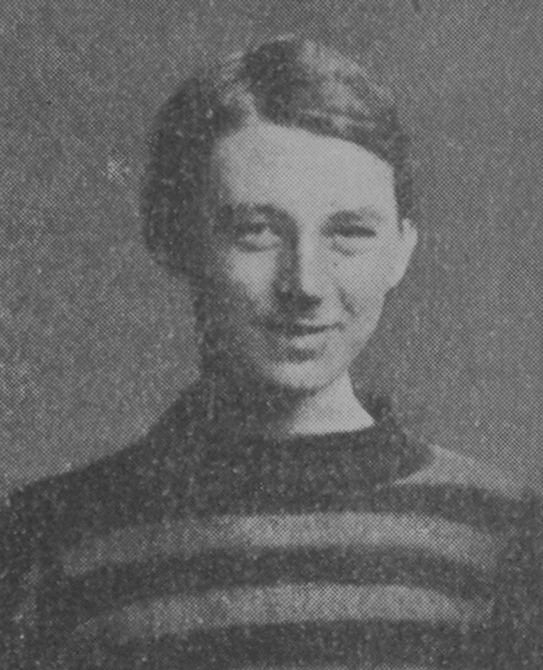
Tod B D Pte 1828 14th London Regiment

Tod B D Pte 1828 14th London Regiment

TOD, BERNARD DOUGLAS, Private, No. 1828, A Coy. 1/14th Battn. (London Scottish) London Regt. (T.F.), only s. of James Tod, of 7, Bennochy Terrace, Kirkcaldy; b. North Berwick, East Lothian, 30 Jan. 1896; educ. Kirkcaldy High School (where he was a member of the O.T.C.), and Rouen; was a member of the staff of Messrs. Steel Bros. & Co., Ltd., East India Merchants, of 6, Fenchurch Avenue, E.C.; joined the London Scottish about March, 1913; volunteered for Imperial Service on the outbreak of war, and left for France, 15 Sept. 1914; took part in the charge of the London Scottish at Messines, and in the gallant defence of the trenches at Zillebeke, and was killed in action in the trenches at Givenchy, 23 Dec. 1914. Buried in a disused part of the trench; unm. A comrade wrote: “He was without fear, and his whole thought was to do his duty for those at home.”

Source : De Ruvigny’s Roll Of Honour Vol 1

Titterington R Pte 11281 3rd Coldstream Guards

Titterington R Pte 11281 3rd Coldstream Guards

TITTERINGTON, ROGER, Private, No. 11281, 3rd Battn. Coldstream Guards, 1st s. of James Titterington, of Elim Grove, Bowness on Windermere, co. Westmoreland, by his wife, Sarah, dau.of Roger Aldren, of Carnforth, Lancs.; b. Bowness on Windermere, 30 March, 1894; educ. Bowness Elementary School; en- listed 31 Aug. 1914, and was killed in action at Rue de l’Epinette, 31 Dec. 1914; unm. Buried in Soldiers’ Cemetery, Rue du Bois, on road from Bethune to Richebourg, about a mile beyond Le Touret.

Source : De Ruvigny’s Roll Of Honour Vol 1

Tippins J Cpl 3105 2nd Essex Regiment

Tippins J Cpl 3105 2nd Essex Regiment

TIPPINS, JOHN, Corpl. and Acting Sergt., No. 3105, 2nd Battn. Essex Regt., s. of Luke R. Tippins, of Mistley, Essex, Schoolmaster and Rifle Expert; b. Winsford, co. Somerset, 10 March, 1887; educ. Norman School, Mistley, and privately; served first in 2nd Vol. Battn. Essex Regt., then in the 5th Essex (T.F.) as Machine Gun Sergt., and finally in 8th Essex (T.F.) as Motor Cycle Sergt. ; joined 2nd Battn. as Private 18 Sept. 1914, in order to get at once to the Front, and was appointed Corpl., and left for France the following day, and was killed in action at a farm near Armentières, 26 Nov. 1914, having been appointed Acting Sergt. in charge of a machine gun a few days previously. Buried in 2nd Essex Cemetery, near Armentières; unm.

John Tippins was one of the finest rifle shots in the United Kingdom. He qualified for the final stage of the King’s Prize Competition at Bisley in the years 1908-11 inclusive and in 1913; he won the Wimbledon Cup, 1910, the Association Cup, 1909, the Aggregate Service Rifle Championship, 1911, and took first place in the second stage of the Albert Competition the same year. He shot in the Elcho, Mackinnon, and Challenge Trophy teams, and was one of the Empire Team chosen to go out to Australia, whose departure was prevented by the outbreak of war. On the night he fell, he had gone himself to get water for the Maxim in his charge, as it was a dangerous job in daylight, and was killed on his return. Capt. Binstead (since killed) wrote: “He had already gained for himself a reputation as a daring sniper and splendid shot, which had spread far beyond his own regt., and which, had he not been shot, would, I feel sure, have obtained for him a coveted distinction.”

Source : De Ruvigny’s Roll Of Honour Vol 1


Tipper G Pte 7730 3rd Coldstream Guards

Tipper G Pte 7730 3rd Coldstream Guards

TIPPER, GEORGE, Private, No. 7730, 3rd Battn. Coldstream Guards, only child of Fred Tipper, of 7, Back, 11, Blythe Street, Ladywood, Birmingham, Builder’s Labourer, by his wife, Ada, daughter of Isaac Morgan; b. Selly Oak, co. Worcester, 14 Feb. 1889; educ. St. Barnabas’ Church School, Ryland Street, Birmingham; enlisted, 4 March, 1908; went to France, Aug. 1914, and was killed at Givenchy, France, 16 April, 1915; unm. He was relieved from sentry duty in the trenches, at 6 a.m. that morning, and then went to attend a class for bomb throwing and at 11 a.m. a bomb exploded in his hand killing him and Lieut. Crawford. He was buried by the Bishop of Khartoum, just behind the firing-line.

Source : De Ruvigny’s Roll Of Honour Vol 1


Tinne E P J Lt HMS Hogue Royal Naval Reserve

TINNE, ERNEST PERCY JAMES, Lieut., R.N.R., 4th s. of John Ernest Tinne, of Liverpool, Merchant; b. Aigburth, Liverpool, 30 Dec. 1882; educ. Liverpool College, and H.M.S. Conway; joined the R.N.R., and became Lieut., Oct. 1909; joined H.M.S. Hogue at Chatham, 3 Aug. 1914, and was lost when that ship was torpedoed in the North Sea, 22 Sept. 1914. He m. at Paignton, South Devon, 4 May, 1907, Annie Amelia Kate, dau. of (-) Bartlett, and had three children: Maurice Herman James, b. 21 Feb. 1914; Hester Petronella, b. 26 Feb. 1908, and Margery Bertha Denise, b. 31 Oct. 1909.

Source : De Ruvigny’s Roll Of Honour Vol 1

Timbrell G Sergt 225 3rd Australian Light Horse

Timbrell G Sergt 225 3rd Australian Light Horse

TIMBRELL, GORDON, Sergt., No. 225, 3rd Light Horse, Australian Expeditionary Force, 2nd s. of the late Samuel Timbrell, for many years Manager of the Central Station Hotel, Glasgow, by his wife, Charlotte Whyte (now wife of Anderson Rodger, of 59, Longridge Road, Earl’s Court, S. W.), dau. of George Gordon, of Aberdeen; b. Glasgow, 13 April, 1891; educ. Glasgow High School, and on leaving there in 1906 went to Stubbington House, Fareham, to be prepared for entrance in the Royal Navy as an Engineer Cadet. This idea had to be abandoned owing to the new age limit (12 years) coming into force, bringing Engineers under the same regulations as the Executive Cadets. Shortly afterwards he entered the office of a shipping firm in Stettin, with the purpose of learning the German language in combination with business training, and on leaving there, returned to Glasgow where he served a brief apprenticeship in a stockbroker’s office, and then went to Australia in 1910. He first took up sheep farming, but city life lured him, first to Melbourne, where he gained some experience in the wool trade, and then to Adelaide, where he managed the shipping department of Messrs. Bagot, Shakes & Lewis, Ltd. He had been with them three years when war broke out. He immediately volunteered and joined the Light Horse as a private, but being a fluent speaker of French and German, and a hard and fearless worker, he quickly won promotion and was appointed Sergt. early in March. He was killed in action at the Dardanelles, 1 July, 1915; unm.

In a letter from Sergt. Smith under date of 26 June, printed in the Glasgow High School Magazine, Dec. 1915, p. 37, is the following passage: “My outlook on the world and things in general just now is even brighter than usual. Timmy (Sergt Gordon Timbrell) is a wonderful boy and yesterday secured all manner of good things. We dined last night on turtle soup, thick mutton stew, pineapple, cakes, dates and coffee, and wound up with cigarettes. This morning for breakfast we had porridge and milk as a preliminary to what was in itself a splendid feed.’ When Timmy is purveyor we are sure to be all right. The hardships of war! They have not existed so far.” And in a later letter he wrote: “You will no doubt have heard of poor Timmy’s death. He was killed in the trench last Thursday evening. You don’t know how I miss him. We have been the best of pals all the time. He was as game as you make ’em.” The secretary of his firm wrote: “He was a courageous and chivalrous young fellow, and had done uncommonly well in our firm. We were only awaiting his return, and the return of something like normal conditions to give him that lift which he had so well earned.”

Source : De Ruvigny’s Roll Of Honour Vol 1

Tibbo J J Pte 1017 1st Newfoundland Regiment

Tibbo J J Pte 1017 1st Newfoundland Regiment

TIBBO, JAMES JOSEPH, Private, No. 1017 James Joseph Tibbo. D Coy. 1st Newfoundland Regt., 2nd s. of Richard Tibbo, of 7, Lime Street, St. John’s, Newfoundland, Labourer, by his wife, Mary Ann, dau. of Richard Roach; b. St. John’s aforesaid, 12 Nov. 1894; educ. St. Patrick’s Hall and Holy Cross Christian Brothers’ Schools; was a Seaman; joined the Newfoundland Regt. 13 Jan. 1915; left for England, 20 March; went to the Dardanelles, and was killed in action there, 1 Dec. 1915, while gallantly assisting a stretcher bearer to remove the wounded: unm.

Source : De Ruvigny’s Roll Of Honour Vol 1