Ionides A C Lt 15th Attd 9th Kings Royal Rifle Corps

Ionides A C Lt 15th Attd 9th Kings Royal Rifle Corps

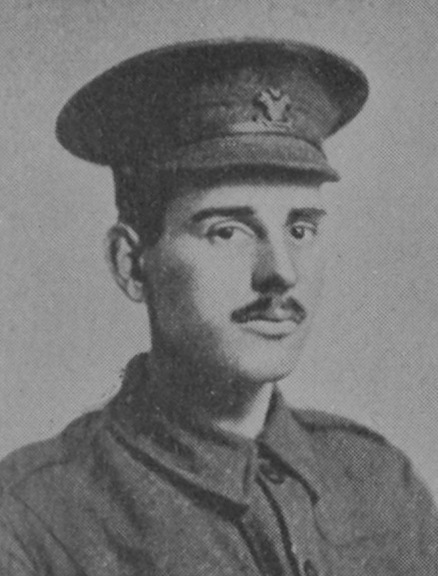
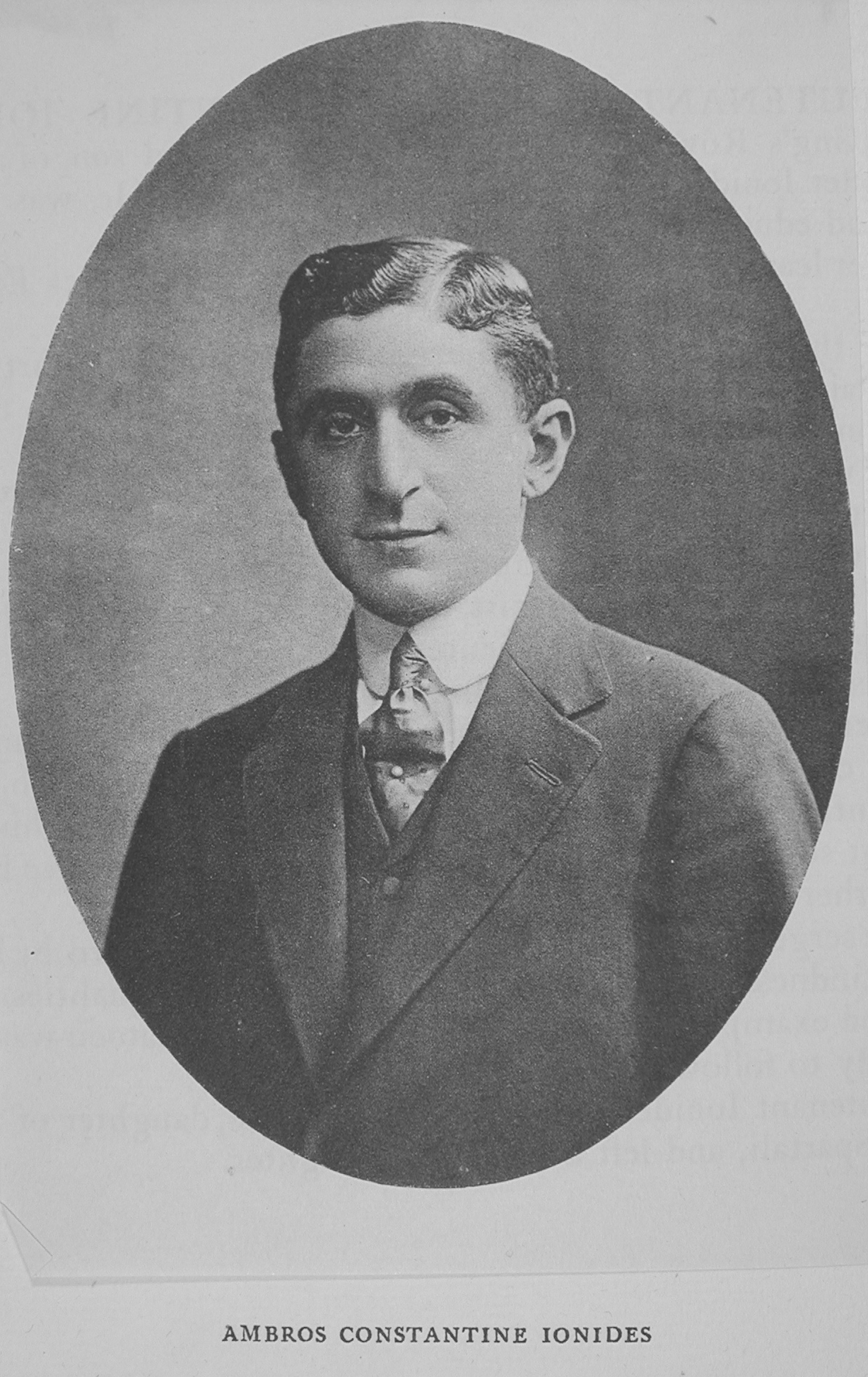
LIEUTENANT AMBROS CONSTANTINE IONIDES, King’s Royal Rifle Corps, was the second son of the late Alexander Ionides, Consul-General for Greece. He was born in 1878 and educated at Eton.

After leaving school he became a member of the Stock Exchange in 1900.

On the outbreak of war he joined the Inns of Court O.T.C. and obtained his commission in the following January in the 15th Battalion, King’s Royal Rifle Corps.

He went to the Front in August 1915 and was drafted to the 9th Battalion of his Regiment.

He was killed on 16 October, whilst out with a wiring party in front of the trenches. The mist, under cover of which they had been working, suddenly lifted. Lieutenant Ionides ordered his men to lie down, but remained standing himself till all his men had got the order. In so doing he himself was seen by the Germans.

His colonel wrote: “Although he had only been with us for a few months he was extremely popular, and had proved himself an excellent soldier. We all liked him and are proud to have had him as a brother officer.”

The sergeant of his platoon wrote: “He was loved by his men for his kindness, his bravery and his many soldierly qualities. He set us a good example of coolness under fire, and his platoon was willing and ready to follow him anywhere.”

Lieutenant Ionides married in 1911, Effie, daughter of the late D. M. Spartali, and left a son and a daughter.

Source : The Stock Exchange War Memorial 1914-1918

Inman L Y 2nd Lt 3rd Royal Scots

Inman L Y 2nd Lt 3rd Royal Scots

SECOND LIEUTENANT LESLIE YARDLEY INMAN, Royal Scots, attached 5th Wiltshire Regiment, was the younger son of G. Talfourd Inman, of Highmoor Hall, Oxon, and the Stock Exchange, and was born in 1888. Educated at Radley, where he was in the football eleven and captain of cricket, he proceeded to Hertford College, Oxford.

He became a member of the Stock Exchange, and a partner in the firm of Inman and Co. in 1914.

On the outbreak of war he enlisted in the Public Schools and University Corps, and obtained a commission in the Royal Scots in May 1915. In October he took out a draft of the 5th Wilts to Gallipoli, to which regiment he was attached, and was present at the evacuation of Suvla and Helles.

Thence he went with the 5th Wilts to Mesopotamia. He was fatally wounded, being then in command of his company, in the attempt to relieve Kut, 6 April 1916.

“One of the gallant 13th Division.”

Source : The Stock Exchange War Memorial 1914-1918

Hose R H 2nd Lt 2nd Bedfordshire Regiment

Hose R H 2nd Lt 2nd Bedfordshire Regiment

LIEUTENANT ROBERT HENRY HOSE, Bedfordshire Regiment, was the son of Robert John Hose of Bromley, Kent, and was born in 1887. He was educated at Forest School.

On leaving school he joined the firm of John Gibbs, Son and Smith, and became a member of the Stock Exchange in 1910.

Early in 1915 Lieutenant Hose joined the Royal Naval Anti-Aircraft Corps as a despatch-rider. In October he transferred to the 3/5 Bedfordshire Regiment in which he was given a commission. He was appointed Adjutant in the following March.

He remained with this battalion, which was on East Coast Defence duty, till January 1917, when he volunteered for foreign service and joined the 2nd Battalion in France in the following month.

Lieutenant Hose was killed at Arras on 18 March 1917. He left a widow and one son.

Source : The Stock Exchange War Memorial 1914-1918

Hoare W J G Captain DSO 11th Royal Fusiliers

Hoare W J G Captain DSO 11th Royal Fusiliers

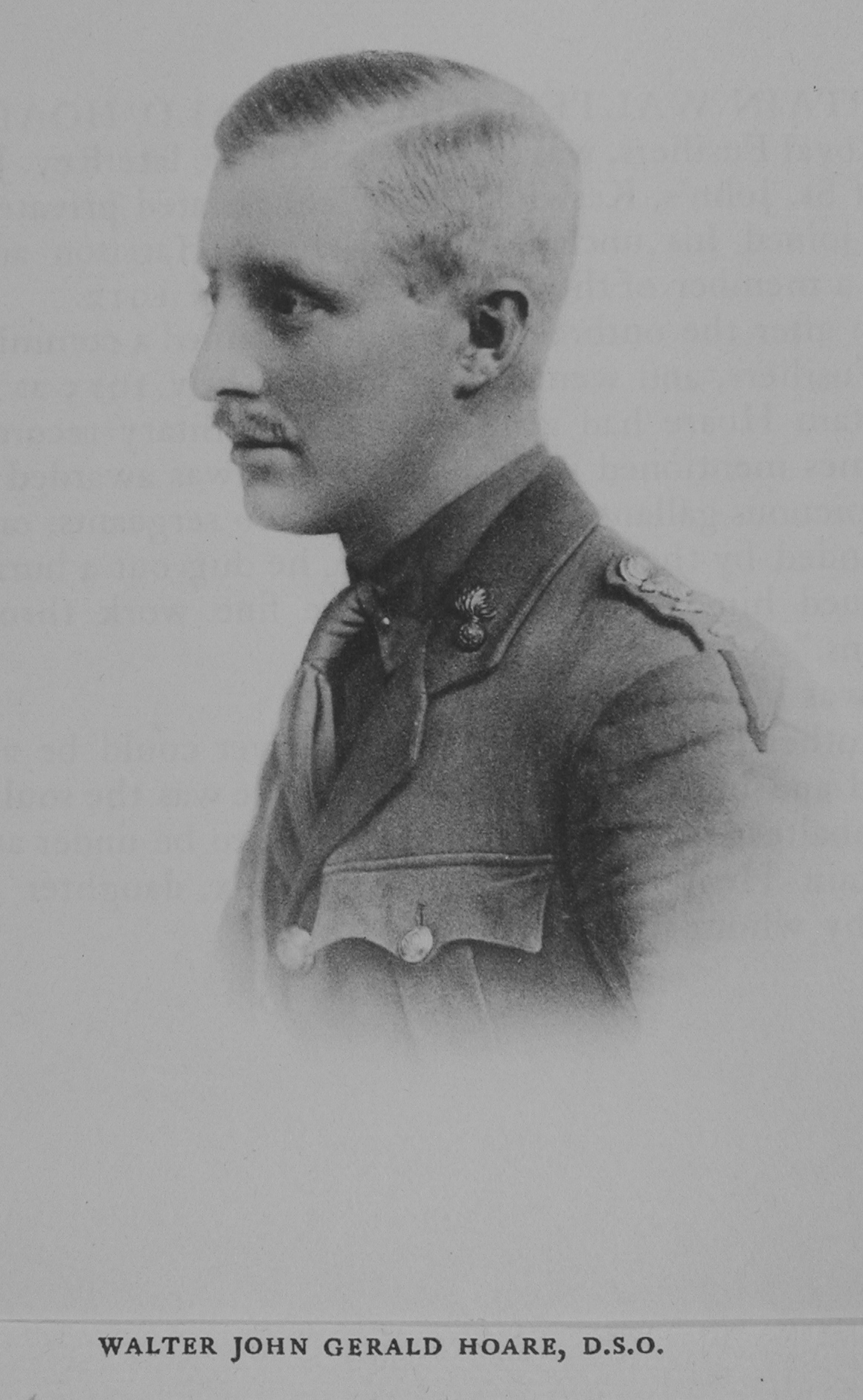
CAPTAIN WALTER JOHN GERALD HOARE, D.S.O., Royal Fusiliers as the only son of the late Rev John Hoare, Vicar of St. John’s, Keswick. He was educated privately.

He joined his uncle’s firm, Hichens, Harrison and Co., and became a member of the Stock Exchange in 1912.

Soon after the outbreak of war he obtained a commission in the Royal Fusiliers, and went to the front in July 1915 as a Captain.

Captain Hoare had a distinguished military record. He was three times mentioned in despatches, and was awarded the D.S.O. for conspicuous gallantry when “with two sergeants, one of whom was wounded by the intense shell-fire, he dug out a buried sergeant and rescued him alive. He has done fine work throughout the operations.”

He was killed on 25 October 1916.

A brother officer wrote: “There never could be a man more respected and loved in the Regiment. He was the soul of kindness to the subalterns; we should never want to be under anyone else.”

Captain Hoare married in 1915 Alix, daughter of Maurice Ruffer, by whom he had one son.

Source : The Stock Exchange War Memorial 1914-1918

Hilder H S 2nd Lt 7th East Kent Regiment

Hilder H S 2nd Lt 7th East Kent Regiment

SECOND LIEUTENANT HAROLD SALTON HILDER, The Buffs, was born in 1885 and educated at Ardingly and King’s College, Cambridge. He represented his school at cricket. He became a member of the Stock Exchange in 1914.

On the outbreak of war he joined the 10th Battalion of the Royal Fusiliers and afterwards was given his commission in the 7th Battalion, East Kent Regiment (The Buffs).

He was reported wounded and missing at Cherisy on 3 May 1917, and it is presumed he was killed on that day.

Source : The Stock Exchange War Memorial 1914-1918

Hichens J B Lt 16th Kings Royal Rifle Corps

Hichens J B Lt 16th Kings Royal Rifle Corps

L IEUTENANT JAMES BYRN HICHENS, 16th Battalion, King’s Royal Rifle Corps, was the son of the late J. K. J. Hichens of Sunninghill, a former chairman of the Stock Exchange Committee. While at Winchester he lost the sight of one eye playing football. He went to Magdalen College, Oxford, in 1891, took a First in Moderations and a Second in “Greats” and graduated in 1895. He became a member in 1900 and joined his father’s firm (Hichens, Harrison and Co.).

He always took a keen and active interest in local affairs and in 1900 helped to found the Sunninghill Church Lads’ Brigade, to which he never ceased to devote a good deal of his time, becoming Captain of the company. Though over forty-one when war was declared, he at once offered himself for the Army. He was three times rejected but persisted in his efforts, until he at length obtained his commission in a K.R.R. Battalion that was mainly recruited from the Church Lads’ Brigade.

In the autumn of 1915 he went to France. He took part in various engagements before the Battle of the Somme opened, and was injured in a German gas attack. Speedily recovering, he re- joined his Battalion. He was killed in action near High Wood on 15 July 1916. Earlier in the day he had been wounded but refused to retire and went on with his men.

‘He was one of the pluckiest of men I ever met,” wrote his Major, “and was most popular with both officers and men.”

Source : The Stock Exchange War Memorial 1914-1918

Taylor A C B Lt 6th Manchester Regiment

Taylor A C B Lt 6th Manchester Regiment

TAYLOR, ARTHUR CUTHBERT BROOKE, A.M.I.C.E., Lieut., 6th Battn. Manchester Regt. (T.F.), 2nd s. of Col. Herbert Brooke Taylor, of The Close, Bakewell, Derbyshire, Solicitor, and his wife, Mary Taitt, dau. of the Rev. William Mallalieu; b. West Bank, Bakewell afsd., 15 March, 1888; educ. Lady Manners’ School, Bakewell; and Cheltenham College, and on leaving there took the Engineering Course at Manchester University, obtaining the Engineering Certificate. He afterwards joined the firm of Saunders & Taylor, Ltd., and was elected an Associate Member of the Institute of Civil Engineers. He obtained a commission as 2nd Lieut. in the 2nd Vol. Battn. of the Sherwood Foresters (Notts and Derby Regt.), and while serving with this battn. passed the Hythe Course with distinction, and was appointed to command the machine gun section. His method of adapting machine guns to mountain warfare when manoeuvring in the North Derbyshire hills demonstrated the possibilities of machine gun warfare which the present war has so immensely developed. He was promoted Lieut. in Sept. 1907. The 2nd Vol. Battn. Sherwood Foresters was a 13-company battn., and when the Territorial scheme came into operation was nearly 1,500 strong. The reduction of the infantry quota of Derbyshire necessitated the reduction of the battn. to eight companies. As a result Lieut. Brooke Taylor reverted to the rank of 2nd Lieut. rather than retain his rank and pass to the reserve. As his business necessitated his residence nearer Manchester than Bakewell, he applied to be attached for training to the 6th Manchesters, and declining a captaincy in his old battn., was transferred as a Lieut. to this reg., in the spring of 1914. He was shortly afterwards appointed instructor of musketry to the battn., and held that position at the time of his death. On the outbreak of hostilities he volunteered and went to Egypt with the East Lancashire Division, and eventually to Gallipoli, where he landed early in May, 1915. was killed in action there 4 June following; unm.

A fortnight before, on the death of the senior Capt. of his company, he had been appointed second in command, and his Colonel wrote: “I do not think it would be possible to speak too highly of his character and qualities. During the time of training, from mobilisation up to the end of our time in Egypt, he was untiring in his special work of pushing on the musketry instruction of the men, and was always full of work, valuable ideas and suggestions. With his keenness and attractive character he could, of course, do anything with the men, and he had a large share in making the battn. the splendid fighting force it proved to be. No one was keener or more anxious to see service.” And a brother officer: “Brooke Taylor did the work of four men. His energy and fearlessness was an example to everyone.”

Source : De Ruvigny’s Roll Of Honour Vol 1


Herbert R B Captain 13th London Regiment Attd Royal Engineers

Herbert R B Captain 13th London Regiment Attd Royal Engineers

Source : Croydon Roll Of Honour 1914-1918

Herbert R B Captain 13th London Regiment Attd Royal Engineers

Source : The Sphere 6th Nov 1915

CAPTAIN ROBERT BINGLEY HERBERT, London Regiment, was the fourth son of Edward Herbert, a member of the Stock Exchange.

Born at Croydon in 1882, he was educated at Bradfield College. He became a member of the Stock Exchange in 1907, and joined the firm founded by his grandfather, G. S. Herbert and Sons.

For some years before the war he had held a commission in the 13th London Regiment (Kensingtons). He had specialized in signalling, and soon after the outbreak of war was seconded to the Royal Engineers, and placed in command of a section of the 47th Divisional Signal Company.

He was killed at the battle of Loos on 30 September 1915. His Divisional General wrote: “He has proved himself through out regardless of danger and only anxious to perform his duties to the utmost of his power. He was certain, had he lived, of advancement and distinction.”

His Brigadier wrote: “He gained the devotion of his men as well as the love and admiration of his colleagues. We shall always think of him as a fine type of British officer.”

The men of his section have placed an In Memoriam notice in the “Times” every year on the anniversary of his death in these terms: “In loyal and loving memory of our gallant officer, Captain R. B. Herbert. His Boys.’

Captain Herbert married in 1913 Margery, daughter of Richard Joseph Grant of Croydon, and left two children, a girl and a boy.

Source : The Stock Exchange War Memorial 1914-1918

Hedderwick R Y Pte 1113 Honourable Artillery Company

Hedderwick R Y Pte 1113 Honourable Artillery Company

PRIVATE RONALD YOUNG HEDDERWICK, Honourable Artillery Company was the son of Robert Hunter Hedderwick of the Stock Exchange. He was born in 1888, and educated at Haileybury College and London University. He played for his school at cricket and was a keen Rugby half-back.

A member of the Blackheath Amateur Dramatic Society he wrote several plays in which he himself took part.

He became a member of the Stock Exchange in 1914.

On the outbreak of war he joined the H.A.C. and went to France with them in November 1914.

He was killed 16 May 1915, the day before he was to have gone back to be trained for his commission.

Through getting up concerts and entertainments in which he himself took a leading part, “Bunny,” as he was called, was well . known in his own and other regiments. His genial and cheerful disposition made him a very general favourite.

His platoon officer wrote: ” Every man in the regiment knew him, and those who were privileged to come directly in touch with him loved him.”

One of his comrades wrote: “Popular and admired more than any man in the regiment; it was the privilege of his chosen friend to understand his heroism and unselfishness. We have lost one of the most lovable and unselfish men in the world. I shall never forget how in the winter’s appalling times it was always he who volunteered to lead parties to the trenches.”

Source : The Stock Exchange War Memorial 1914-1918

Hartley F L 2nd Lt 1st East Surrey Regiment

Hartley F L 2nd Lt 1st East Surrey Regiment

SECOND LIEUTENANT FREDERICK LYNN HARTLEY, East Surrey Regiment, was the son of Mrs. Hartley of Hampstead and a godson of the late Mrs. Lynn Linton. Born in 1885, he was educated at Merchant Taylors’ School, where he distinguished himself in mathematics and won his football colours. He went on the Stock Exchange in 1903 and became a member in 1909.

He enlisted in September 1914, in the 19th (St. Pancras) Battalion, London Regiment, and declined a commission when it was offered him, on the plea that he had no experience and preferred to serve with the men. He was promoted Sergeant before his battalion left England, first for France, early in 1916, and later for the Balkans.

In 1917 he came home to take a commission, and after a period with an O.T.C. at Berkhamsted, was gazetted in December to the 1st Battalion, Queen’s (Royal West Surrey) Regiment. He served in France with that regiment and was then transferred to the 3rd East Surreys.

It was at the end of the three days’ battle for Bapaume, on 23 August 1918, that he was killed, leading his men on their final objective. “He had established a magnificent reputation,” wrote his Colonel, “as a first-rate leader of men, and always showed the greatest cheerfulness under the most trying conditions.” A brother- officer in the Queen’s wrote: “No man could have wished for a more loyal and cheerful comrade. His courage and devotion to duty were proverbial, and he was loved by both officers and men, and none were more sorry to hear the news than the latter.”

Lieutenant Hartley married in June 1916, the younger daughter of Mr. and Mrs. W. S. Daffam of Valewood, Haslemere.

Source : The Stock Exchange War Memorial 1914-1918