Barnett H W Captain 13th London Regiment

Barnett H W Captain 13th London Regiment

Barnett H W Captain 13th London Regiment

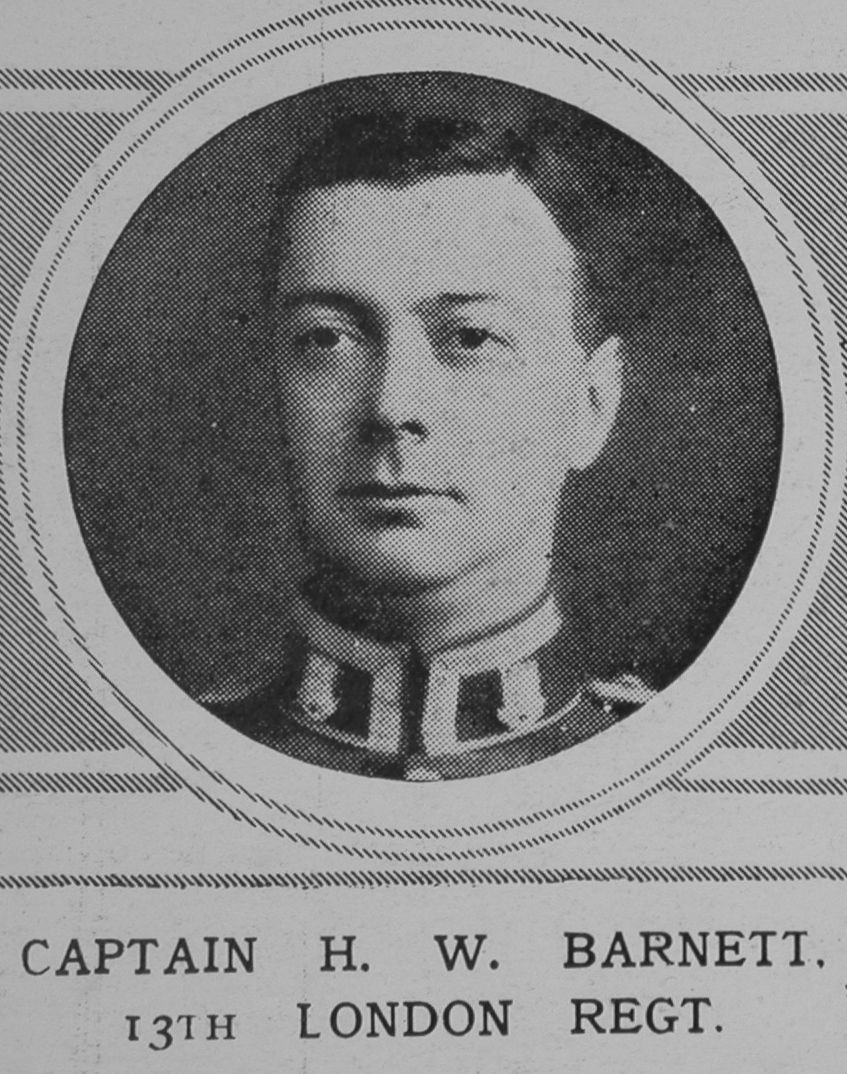
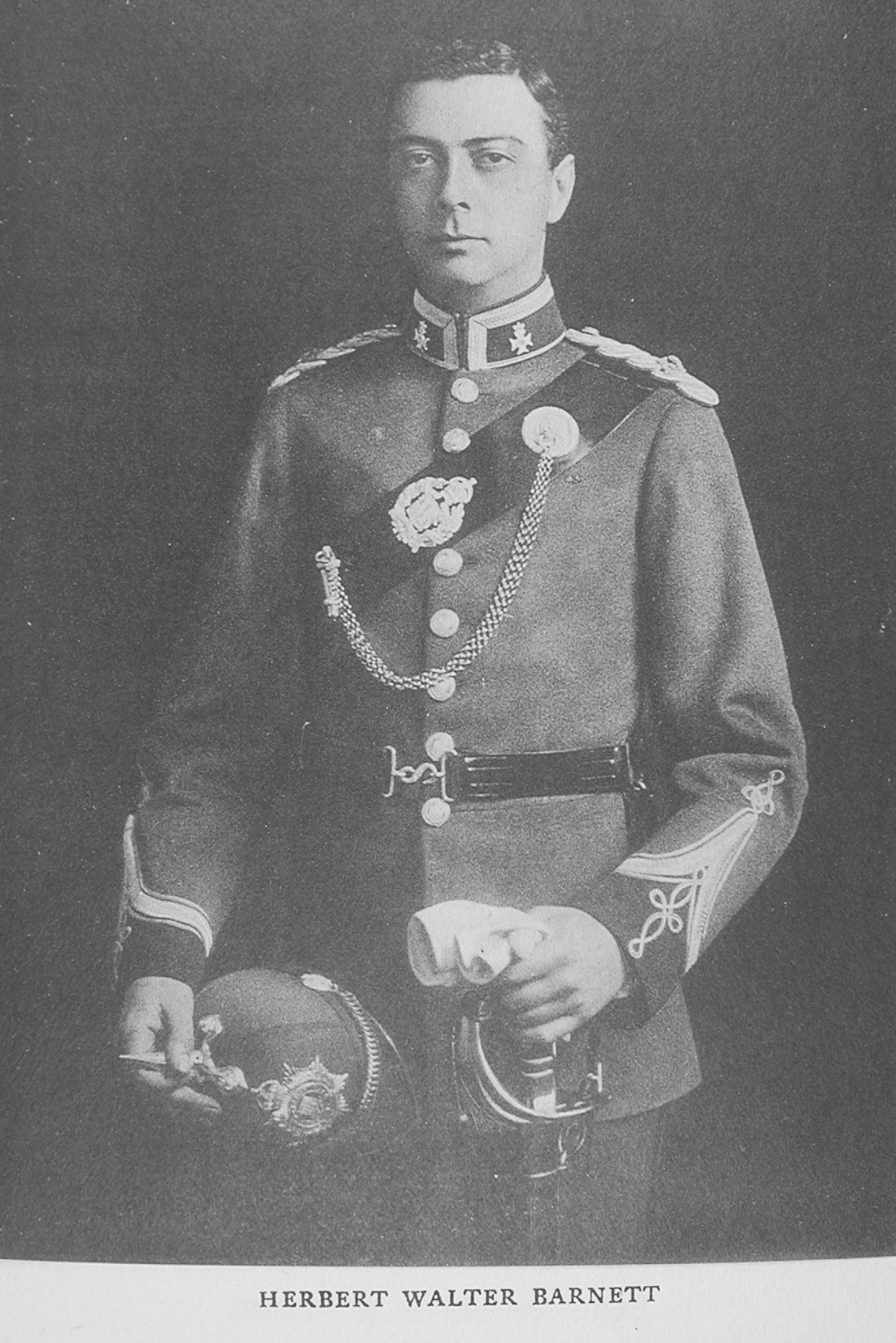
CAPTAIN HERBERT WALTER BARNETT, 13th Battalion, London Regiment, was the son of Maurice H. Barnett, and was born in 1879. Educated at University College School, he joined the Stock Exchange at the age of twenty, and five years later became a member. For some years he was a junior partner in the firm of Bensinger and Co.

He was given a commission in 1907 in the 4th Middlesex Volunteer Rifle Corps, which, on the formation of the Territorial Force, was converted into the 13th (Kensington) Battalion, London Regiment. He was promoted Captain in 1912. From the time of joining the Regiment he devoted himself with the greatest keenness to the promotion of its well-being and efficiency and in so doing became a most efficient and popular officer.

His Battalion went to France in November 1914 and he took part in its activities through those critical months in which little was left of the Old Army, and the New Armies were not yet in being. He was killed at the head of his men in the attack on Aubers Ridge of 9 May 1915, an historic engagement in which his battalion played a notable part.

“He died,” wrote his Major, “leading his men in the true British way, and under the most exacting conditions that any troops could be called on to face.” And his Colonel wrote: “His memory will remain with us as a keen and capable English gentleman, always ready to do his share.”

The work of the Kensingtons on that day was described by General Sir Henry Rawlinson, then commanding the 4th Army Corps, as “a feat of arms surpassed by no battalion in this great war.”

Source : The Stock Exchange War Memorial 1914-1918

Barnett H W Captain 13th London Regiment

Source : The Illustrated London News 29th May 1915

Ballance L A Captain 2nd Kings Royal Rifle Corps

Ballance L A Captain 2nd Kings Royal Rifle Corps

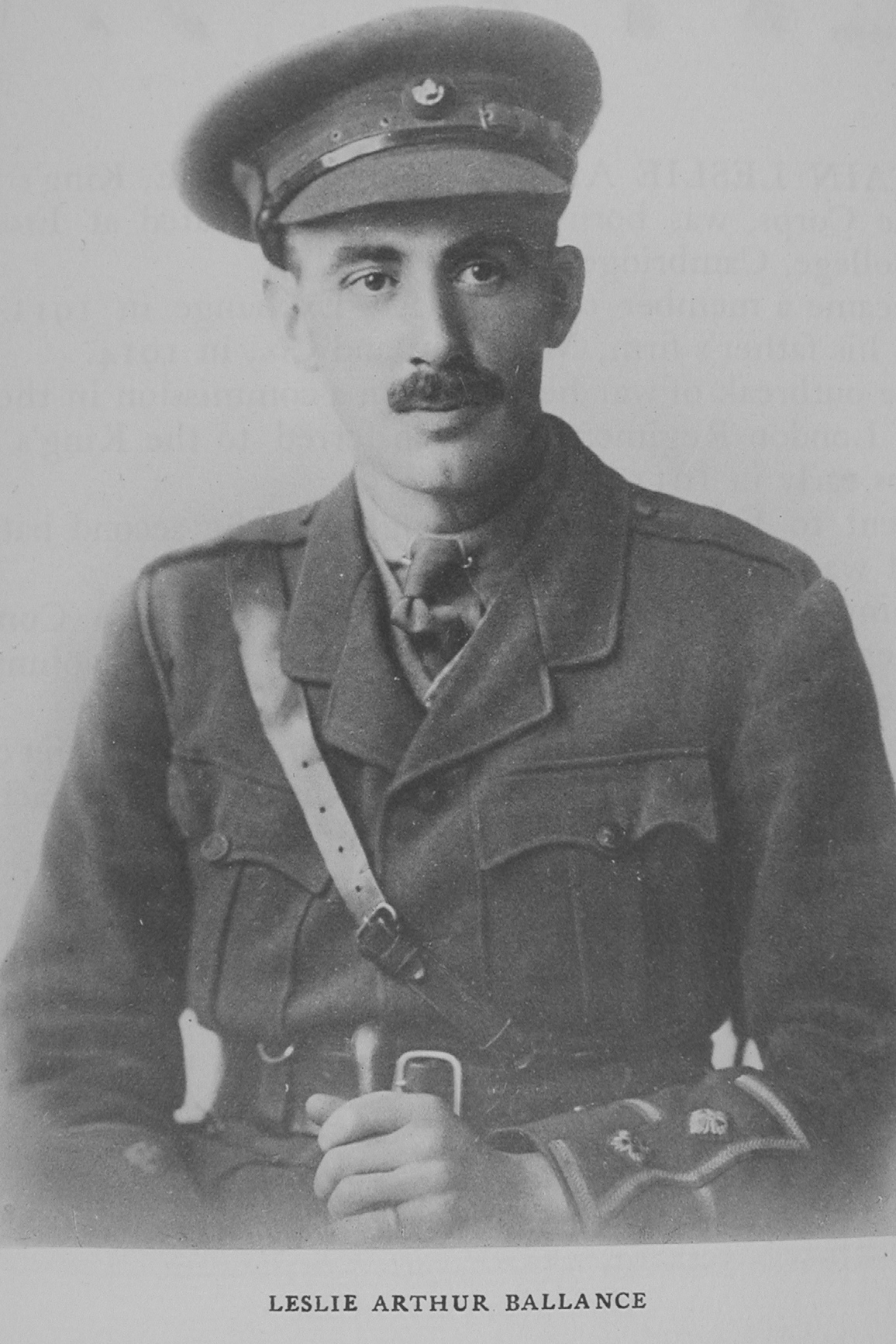
CAPTAIN LESLIE ARTHUR BALLANCE, King’s Royal Rifle Corps, was born in 1889, and educated at Eton and Trinity College, Cambridge.

He became a member of the Stock Exchange in 1911 and a partner in his father’s firm, Marnham and Co., in 1914.

On the outbreak of war he was given a commission in the 15th County of London Regiment, but transferred to the King’s Royal Rifle Corps early in 1915.

He went to France in May, fought in the second battle of Ypres, and was invalided home in August.

Rejoining his regiment in September 1916 as a Company Commander, he was killed on 27 September. He had volunteered for a dangerous duty and lost his life in its execution.

His Colonel wrote: “I at once fell under the same quiet charm which he exercised over all with whom he came in contact. He was fearless to a fault and a very gallant officer.”

A brother officer wrote: “A better and finer character I never knew in all my life, and we always wanted to serve together out here. He simply was too wonderful in the show, never had a fear, and was so calm and splendid. The men just loved him and did anything for him . . . I can only say he was the finest man I ever knew.”

Source : The Stock Exchange War Memorial 1914-1918

BALLANCE, LESLIE ARTHUR, Capt. 2nd Battn. (60th Foot) The King’s Royal Rifle Corps, s. of Arthur William Ballance, of Park Lodge, Blackheath Park, London, S.E., and the Manor House, Herringswell, co. Suffolk, by his wife, Jane Peek, dau. of G. M. Frean; b. London, 9 Jan. 1889; educ. Eton, and Trinity College, Cambridge. In Aug. 1914, he obtained a commission in the 15th County of London Regt., but was transferred to the King’s Royal Rifle Corps, March, 1915; served with the Expeditionary Force in France and Flanders; was present at the Second Battle of Ypres, and was invalided home 12 Sept. 1915; rejoined his regiment on recovery, and was killed in action during the Battle of the Somme 27 Oct. 1916. Buried at Flers. His Colonel wrote: “It is with the deepest regret I write to tell you all about your son’s death. At about 4 p.m. on 27 Sept., when a bombing attack on the Germans in the line was in progress, a report was received by me that the Germans were giving ground. It was essential that the battalion on our right should have the information at once, so as to co-operate, and for greater chance of success I wanted to send an officer, but none was available. You son Leslie, hearing this, volunteered, and ran across towards the battalion on our right. . . . After he had gone about 60 yards out of the 100 yards, I heard a bullet fired from a distance. Your son ran on, but almost at once a bullet struck him. . . He fell on his face and never moved again. He was fearless to a fault, and a very gallant officer, . . . He is most  sorely missed by all.” Unm.

Source : De Ruvigny’s Roll Of Honour Vol 3

Baker C D Captain 1st Grenadier Guards

Baker C D Captain 1st Grenadier Guards

CAPTAIN CECIL DOUGLAS BAKER, Grenadier Guards, CA was the third son of the late A. H. Baker, J.P., of Beckenham, and of Mrs. Baker of 68 Princes Gate.

Born in 1870, he was educated at the Abbey School, Beckenham, at Sherborne and Merton College, Oxford.

He played cricket and football for Sherborne, and won his Rugby “blue” at Oxford in 1891, being captain in 1893. He became a member of the Stock Exchange in 1895.

On the outbreak of war he was given a commission in the R.N.V.R., Anti-Aircraft Corps, but was transferred to the Grenadier Guards in September 1915.

He was killed in action on 29 July 1917, and left a widow.

Source : The Stock Exchange War Memorial 1914-1918

BAKER, CECIL DOUGLAS, Capt. (Special Reserve), Grenadier Guards, 3rd s. of Arthur Henry Baker, of Elderslie, Beckenham, co. Kent. J.P., by his wife, Clara (68, Prince’s Gate, London, S. W.), dau. of Julius Try Mortimer; b. 6 Dec. 1870; educ. The Abbey School, Beckenham; Sherborne, and Merton College, Oxford, where he graduated in 1893; became a member of the London Stock Exchange in 1895; obtained a commission as 2nd Lieut. in the R.N.V.R. Anti-Aircraft Corps in Sept. 1914; transferred to the Grenadier Guards in Sept. 1915, being promoted Lieut. Jan. 1916, and Acting Capt. Jan. 1917; served with the Expeditionary Force in France and Flanders from 28 Oct. 1915; was wounded in April, 1916, and was killed in action at Le Bois des Crapouillots 29 July, 1917. He was a good all-round athlete; played in the Abbey School XI.. and in both the XI. and XV. at Sherborne, and while at Oxford played in the University XV. in 1891, 1892 and 1893, being captain in 1892. He m. at St. Paul’s, Knightsbridge, 6 Oct. 1898, Gwendoline, dau. of the late Alexander Peyman.

Source : De Ruvigny’s Roll Of Honour Vol 3

Bagot-Chester G J M Major 2nd Scots Guards

Bagot-Chester G J M Major 2nd Scots Guards

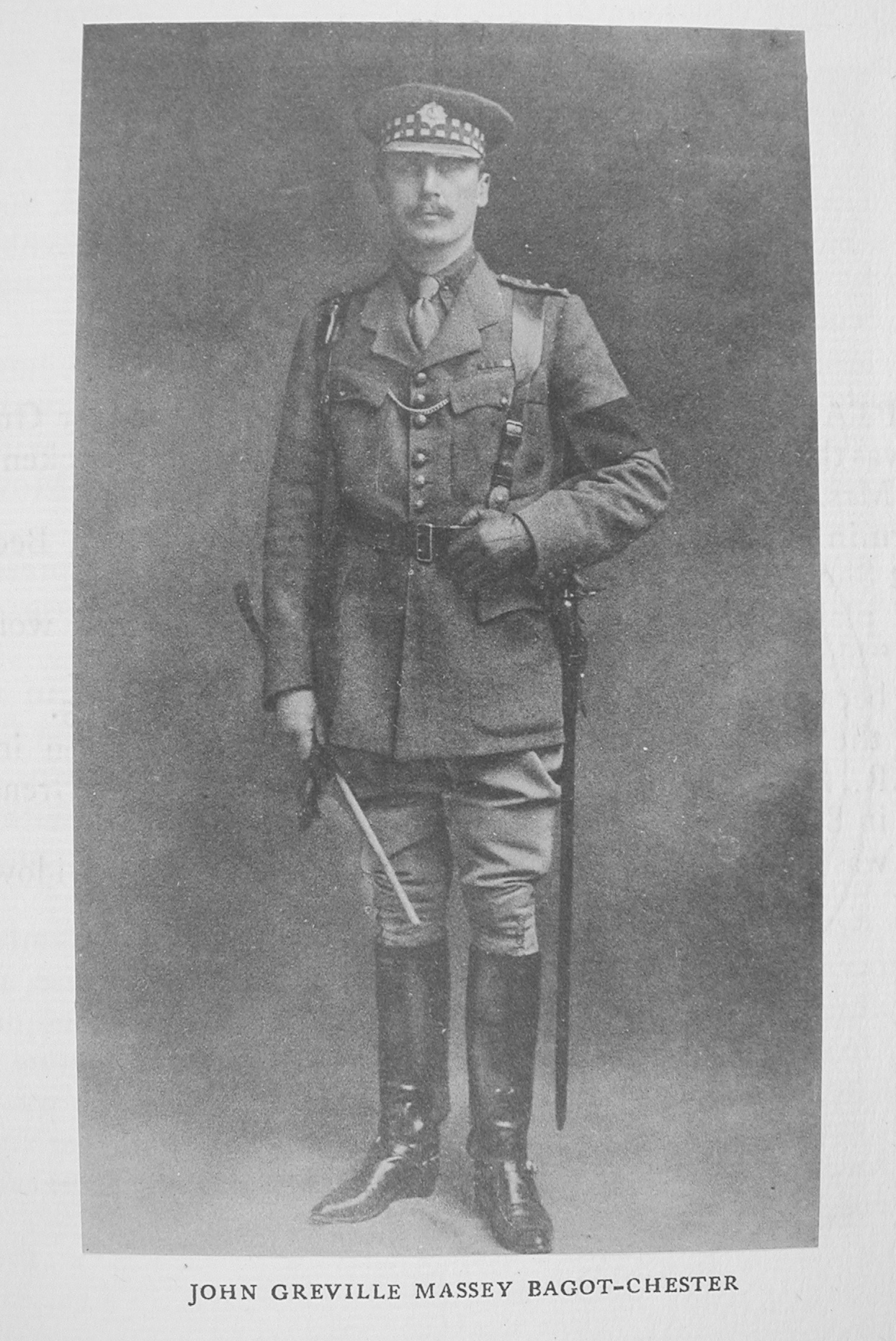
MAJOR JOHN GREVILLE MASSEY BAGOT-CHESTER, Scots Guards, was born in 1868, the eldest son of Colonel Heneage Bagot-Chester, at Henstead Hall, Suffolk. He was educated at Elstree and afterwards went to Brackenbury’s, the Army coach at Wimbledon, from there entering the 2nd Bat

talion, Scots Guards.

He was a fine athlete and won many running and jumping competitions, and once for a £100 bet he rode, ran, and walked a mile in under twenty minutes. He was very well-known with the Belvoir and Quorn Foxhounds and hunted from Melton Mowbray for several seasons.

He was all through the South African War and was present at the following engagements: Belmont, Modder River, Graspan, and Magersfontein.

On the Stock Exchange, where he became a member in 1910, he was connected for some years with the firm of Linton Clarke and Co., and later on with Lionel Robinson, Clark and Co.

He was the senior Major in the Brigade of Guards, with over twenty years’ service, when he retired. He rejoined the moment the war broke out.

His death took place in the course of the battle for Cambrai in November 1917, which opened with the famous surprise attack with tanks. He was hit by a shell and is buried near Flesquières. A letter from a brother officer said: “Poor Bubbles has gone. His loss will be felt throughout the Brigade of Guards, for he was ever a brave, gallant, and very popular officer, and we shall one and all mourn his loss.” Another officer wrote: “He was a gallant officer, true friend, and knew no fear.”

Source : The Stock Exchange War Memorial 1914-1918

Atkin F H Pte 7332 4th Queen’s Own Royal West Kent Regiment

Atkin F H Pte 7332 4th Queen’s Own Royal West Kent Regiment

ROOPER FRANK HERBERT ATKIN, West Kent TR Yeomanry, the son of John Atkin, was born in 1881 and educated at Lady Owen’s School. On leaving school in his seventeenth year he went into the offices of Miles and Co., of Throgmorton Street, and was for some time in the House as one of their unauthorized clerks. On the firm’s dissolving partnership he joined W. A. Kolckmann and Co. of Austin Friars, being made authorized clerk after some time with this firm. In April 1911 he became a member of the Stock Exchange. When war broke out he was with R. Fletcher and Co. of Copthall Chambers.

He joined the West Kent Yeomanry in 1915, and at the end of the following year he was invalided home and sent to the Military Hospital, Edmonton, where he died of consumption on 4 February 1917, at the age of thirty-five.

Source : The Stock Exchange War Memorial 1914-1918

Alexander G R 2nd Lt 13th East Surrey Regiment

Alexander G R 2nd Lt 13th East Surrey Regiment

SECOND LIEUT. GORDON REUBEN ALEXANDER, Royal Sussex Regiment attached 13th East Surreys, as  born in 1885 and educated at Harrow. He became a member of the Stock Exchange, and of his father’s firm, J. M. Alexander and Co. in 1908. A keen all-round sportsman, he was a member of the Corinthian Yacht Club, the Felixstowe and Coombe Golf Clubs, and the Sword Club. He won several trophies on the links, was Amateur Foils Champion of Great Britain, and took part in the Olympic Games.

Immediately on the outbreak of war he enlisted in the 10th (Stock Exchange) Battalion of the Royal Fusiliers, refused the commission that was offered to him in that regiment, and went to France with them in 1915 as a N.C.O. In the following year he accepted a commission in the 10th East Surreys, was transferred to the Royal Sussex and afterwards attached to the 13th East Surreys.

He was killed on 24 April, 1917, in an attack on Villers Plouich, north of Peronne. His death is thus described by a sergeant in his Company: “Everything went very well in the attack, and we captured the first machine gun and many prisoners. After the objective was gained and the men were digging in under his supervision, one was badly hit and Lieutenant Alexander told a man to go to his assistance, but went himself instead as there was a lot of shelling, and while bandaging the man they were both killed by a heavy shell.”

The same sergeant relates how on one occasion when he went round the Company for volunteers for a risky enterprise, the men volunteered “too freely” on learning that Alexander was in charge. “He happened to overhear some of it and told me afterwards that it was the greatest satisfaction he got out of the war-it paid him for everything.

“He died the death of a hero,” wrote a brother-officer,” and deserved the V.C. He was a man absolutely without fear and commanded the respect and affections of his Company to such an extent that I think every man would have cheerfully died for him.”

The Padre of his battalion wrote to his father: “We all loved him, and the camaraderie that existed between him and the other officers was really extraordinary. It was just like him to give his life in looking after one of his men.”

“He was a very gallant officer and liked by all,” wrote his Commanding Officer. Second Lieutenant Alexander was mentioned in Dispatches “for gallant and distinguished service in the Field.”

Source : The Stock Exchange War Memorial 1914-1918

Abrahams M N Major 16th Rifle Brigade

Abrahams M N Major 16th Rifle Brigade

Abrahams M N Major 16th Rifle Brigade

M AJOR MONTAGUE NATHAN ABRAHAMS, Rifle Brigade, was the son of Louis Abrahams of Northgate House, Regent’s Park. Born in 1875, he was educated at University College School. He entered his father’s business and in 1909 became a member of the Stock Exchange. He married in 1902 Annette, daughter of the late Sir Joseph Duveen.

On the outbreak of war he enlisted in the Old Boys’ Corps and became a platoon-commander. In April 1915 he was granted a commission as Captain, and with Lieut.-Colonel H. F. Darrell was mainly responsible for raising the 16th Battalion, Rifle Brigade. After training at Winchester and Aldershot, he was promoted Major before the battalion went to France in March 1916, in time to take part in much of the heaviest fighting of the Somme battle.

He was killed while leading his men in the assault on Beaumont Hamel on 3 September 1916, being then forty-one years of age. His Commanding Officer (Lieut.-Colonel Darrell, D.S.O.) wrote: “Every day Monty became dearer to me as a friend and more valuable as an officer. . . . When I say that he was unequalled as a Company Commander in the New Armies, I am not using terms of exaggerated praise but stating an absolute fact that was recognised by all who came into contact with him, from generals downwards. His men absolutely adored him, as well they might, and not only the officers of this regiment loved him but all the officers of the Brigade who had the honour of knowing him.”

Source : The Stock Exchange War Memorial 1914-1918

Steuart A J Sergt 43209 Royal Canadian Engineers

Steuart A J Sergt 43209 Royal Canadian Engineers

STEUART, ALAN JOHN, Sergt., No. 43209, Royal Canadian Engineers, 3rd Field Coy., Canadian Expeditionary Force, 5th s. of the late Capt. Robert Steuart, of Westwood, Linlithgowshire, H.E.I.C.S., J.P., D.L. (died March, 1913), by his wife, Alice Mary (Westwood, West Calder), dau. of Patrick W. V. Dudgeon, and grandson of Robert Steuart, of Carfin and Westwood; b. Westwood House, co. Linlithgow, 6 May, 1888; educ. Blairlodge School, Stirling, and Bromsgrove, co. Worcester; was an Electrical Engineer; went to British Columbia in 1912, and settled at Vancouver, but on the outbreak of war in Aug. 1914 at once enlisted in the Canadian Engineers, was promoted L.-Corpl. in Nov. 1914, and Sergt. in Jan. 1915; came over with the first contingent in Oct.; went to France in Feb. 1915, and was killed in action at Vlamertinghe, 24 April following, during the gas attack by the Germans at the second Battle of Ypres, when the Canadian Engineers (who were in the 3rd Infantry Brigade, establishing contact with the Allies, at the terminus to the north-west of Ypres) were ordered forward to dig protection trenches in front of the oncoming enemy; unm. Buried in Vlamertinghe Cemetery. His commanding officer wrote: “He was a very keen, good soldier, of untiring effort and unfailing cheerfulness. the officers.” As popular with the men as with the officers.

Source : De Ruvigny’s Roll Of Honour Vol 1

Stern L H 2nd Lt 13th London Regiment

Stern L H 2nd Lt 13th London Regiment

SEC.-LIEUT. LEONARD H. STERN, OF THE 13th LONDON REGIMENT.

A brilliant student, as well as a fine and promising Officer, was lost to the country by the death in action at the Battle of Fromelles, Flanders, of Second-Lieutenant Leonard H. Stern.

Born at Synagogue House, Stepney, September 12th, 1891, Second-Lieutenant Stern was the elder son of the Rev. J. F. Stern, the minister of the East London Synagogue, Stepney, and Mrs. Stern.

He was educated at the Preparatory School, Holly Hill, Hampstead, and University College School. Proceeding to Cambridge in 1910 as an Exhibitioner in Classics of Magdalene College, he was elected a Scholar of his College, in the following year. He also held the Cambridge Jewish Exhibition. In June, 1913, he graduated B.A.,taking a First Class in the Classical Tripos in that year, and in the following year a Second Class in the History Tripos.

An athlete as well as a scholar, he obtained his College Football Colours in 1912, and in the same year played for his College against Magdalene College, Oxford. He was a member of his school Cadet Corps, and subsequently joined the Cambridge O. T. C. He was also a member of the Cambridge Union Society.

During the whole time that he was at the University, Second-Lieutenant Stern took an active part in the affairs of the Cambridge Hebrew Congregation, and held in succession the several Synagogue offices. He was an occasional speaker at the Union, and read several papers at College Societies.

A young man always keenly interested in the welfare of others, he devoted a considerable part of his vacations to social work in East London, and was a manager of the Stepney Jewish Lads’ Club and the Oxford and St. George’s Jewish Lads’ Club. He also took a great interest in the Boy Scouts’ movement, and became a Scout Master of the seventh Stepney Troop, B. P. Scouts.

When war broke out he co-operated with other Toynbee Hall workers in the organisation of the East London Scouts for public service in the Metropolis. He enlisted as a private in the 13th County of London (Kensington) Regiment, and, a thorough soldier from the first, was not long before he was promoted to the rank of Sergeant.

In February, 1915, he obtained his Commission, and went to the front in the following month. On Sunday, May 9th, this young soldier, who, had his life been spared, would assuredly have accomplished much noble and useful work, met his heroic death. The Battle of Fromelles, which is the subject of a graphic letter contributed to the “Times” of June 19th, 1915, by an Officer who took part in the engagement, and which appears under the headlines “Kensingtons in Action,” “Imperishable Glory,” and “A famous Sunday described,” will live for ever in history, and though the bitterest sorrow must have been experienced by those who mourn the loss of the gallant men who fell that day, they must also have felt intense pride at the thought of the manner in which they fell.

A Service in memory of Lieutenant Stern was held on May 30th at the East London Synagogue, of which his father has been minister for more than a quarter of a century, when an eloquent tribute to the life and character of his “Son of the Sanctuary” was paid by the Rev. S. Levy, M.A., Minister of the New Synagogue, Stamford Hill, who had known him from his childhood.

How greatly Lieutenant Stern’s courage was admired, and how much he was loved by Officers and men of his Regiment alike, is shown by the following extracts from letters received after his death by his parents.

Col. Fred W. Lewis wrote:-

“You can indeed take consolation in the way your son met his death- he fell gallantly. He had a dangerous job, but he went through with it, setting a fine example to his men. I grieve to think it cost him his life. We have lost a promising Officer.”

Major H. G. Stafford wrote:-

“It may be some small consolation to you to know that he met his death leading his men in the true British way. Although he had only been with us a short time he had already won the esteem of his brother-officers, and gave great promise as an Officer. He was put in charge of the bombers and he showed zeal and initiative in his work. Col. Lewis… desires me to express his great regret at the loss of so promising an Officer.”

And from Captain Kimber, D.S.O., the following frank and sincere tribute was received:

“What splendid work he did with Knight. He was probably coming to tell me what had happened, but as he was hit just before he reached me, of course he had no opportunity…. He was a brave and splendid lad.”

Private Robert Knight, in a letter to his own parents, thus describes the last heroic deed by which Lieutenant Stern met his death:

“The scrap started at 5 a.m. on Sunday and I was a bomber. There was a forty minutes bombardment of their trenches, and then the mine which had been dug under their trench was let off. That was the signal for us to be up and doing. Over the parapet we went, right through their first line and then their second. Alas! they got their machine guns working and then the poor Kensingtons went down like chaff. We got to the third line of German trenches and our job was to bomb them out by walking along the trench. I was carrying the bombs and one bullet amongst them would have meant picking up the pieces. They were in a bag on my back. We got into a trench and could see the heads of five Germans coming along towards us. Mr. Stern (he is the Officer) handed me a bomb and then lit it. I threw it and it went up with four and a half Germans with it, but the other half accounted for me.. As we passed, Mr. Stern yelled, ‘look out,’ and shot off his revolver. This German had got up on his elbow and fired at my back. Mr. Stern’s shot was a fraction of a second earlier and so spoilt his aim. The bullet slid between the bag of bombs from the middle of my back along my ribs, out at my shoulder blade, and then through my left arm. It felt as though someone had hit me with a big stick. Mr. Stern took the bombs and went on alone. Poor fellow, he was seriously wounded further on and was unable to move. We took and held the third line, but supports could not get up in time. Of all the Kensingtons there are but forty-seven left unharmed. Poor 16th Platoon led the charge and were all wiped out. It was terrible. It took me seven hours to crawl out The swines of German snipers were potting at any wounded they saw move.”

The following very short extract, taken from a letter written by Private J. R. Lansberg, sums up, in a few words, the true character of this gallant

English-Jew, who so willingly gave his life for his Country :-

“He was wounded several times and died a hero’s death, thinking of others all the time.”

Source : The British Roll Of Honour Vol 1


Stern L H 2nd Lt 13th London Regiment

STERN, LEONARD HERMAN, 2nd Lieut. 13th Battn. (Princess Louise’s Kensington Battn.) The London Regt. (T.F.), elder s. of the Rev. Joseph Frederick Stern, Minister of the East London Synagogue, Stepney, since 1887; b. Synagogue House, Stepney, 12 Sept. 1891; educ. at The Preparatory School, Holly Hill, Hampstead, and University College School. Proceeding to Cambridge in 1910 as an Exhibitioner in Classics of Magdalene College, he was elected a Scholar of his College in the following year. He also held the Cambridge Jewish Exhibition. He graduated B.A. in 1913, taking a First-Class in the Honours Classical Tripos in that year. In the following year he gained Second-Class Honours in the History Tripos. He obtained his college football colours in 1912, in which year he played in the College team against Magdalen College, Oxford. He was a member of his school Cadet Corps, and subsequently joined the Cambridge O.T.C., in which he obtained the rank of Sergt. Throughout his stay at the University he took an active part in the affairs of the Cambridge Hebrew Congregation, holding in succession the several Synagogue offices. He was an occasional speaker at the Union Society, and read several papers at college societies. He devoted a considerable part of his vacations to social work in East London, being a manager of the Stepney Jewish Lads’ Club and the Oxford and St. George’s Lads’ Club. He also took a keen interest in the Boy Scouts movement, and became a scoutmaster of the 7th Stepney Troop B.P. Scouts.

On the outbreak of war he cooperated with other Toynbee Hall workers in the organisation of the East London Scouts for public service in the Metropolis. He enlisted in the ranks of the Kensington Battn. of The London Regt. with a number of the lads of his troop, and shortly after was made a sergt. of his company. He obtained his commission as 2nd Lieut. in the same regt. 6 Feb. 1915, and left for France on 7 March, was wounded several times, and was killed in action at the Battle of Fromelles, 9 May, 1915; unm. Col. Fred E. Lewis wrote: “He fell gallantly. He had a dangerous job, but he went through with it, setting a fine example to his men. I grieve to think it cost him his life. We have lost a promising officer.” And Major N. E. Stafford, in notifying his death to the Depot Officer of the regt., said: “He met his death leading his men in the true British way. Although he had only been with us a short time, he had already won the esteem of his brother officers, and gave great promise as an officer. He was put in charge of the bombers, and he showed zeal and initiative in his work. Col. Lewis, who has gone to hospital very ill, desires me to express his great regret at the loss of so promising an officer.”

Source : De Ruvigny’s Roll Of Honour Vol 1
Sterling W Pte 9097 1st West Yorkshire Regiment

STERLING, WILLIAM, Private No. 9097, West Yorkshire Regt., s. of William Sterling, of Hebburn, Joiner, by his wife, Isabella, dau. of James Turner; b. Hebburn New Town, co. Durham, 13 Feb. 1897; educ. there; enlisted on outbreak of war, 1914, and went with his regt. to France, 9 Jan. 1915. He died of wounds received while in action at Neuve Chapelle, 14 March, 1915. buried in Bailleul Cemetery; unm. A comrade wrote: “We fought hard all day, not having time to eat, and late at night we went about 50 of us to a billet to eat. Shortly afterwards the Germans shelled our place, and mostly all were either killed or wounded, Private W. Sterling being hit in the back with shrapnel and died two hours afterwards in a hospital near by.’

Source : De Ruvigny’s Roll Of Honour Vol 1