Sturrock D D Cpl 1845 9th Argyll And Sutherland Highlanders

STURROCK, DAVID DUFF, Corpl., No. 1845, 9th Battn. Argyll and Sutherland Highlanders (T.F.), elder s. of Peter Sturrock, of Drummaird, Lenzie, L.R.C.P., and S. Ed., Lieut. R.A.M.C., by his wife, Helen Amelia, dau. of James Swirles, of Edinburgh; b. Jedburgh, 15 Sept. 1894; educ. Jedburgh Grammar School and Lenzie Academy; was an Analytical Chemist; joined the 9th Territorial Battn. of the Argyll and Sutherland Highlanders, 13 April, 1913; volunteered for foreign service on the outbreak of war; went to France, 19 Feb. 1915; was wounded 18 March, 1915, but returned to duty 9 May, and was killed in action at the 2nd Battle of Ypres, on the 10th; unm. Buried near Ypres.

Source : De Ruvigny’s Roll Of Honour Vol 1

Groves L A Lt 11th Royal Sussex Regiment

Groves L A Lt 11th Royal Sussex Regiment

L IEUTENANT LEONARD ALLOWAY GROVES, Royal Sussex Regiment, was the son of Aubrey Groves of Ramsgate, and was born in 1878. He became a member of the Stock Exchange in 1904, trading under his own name.

On the outbreak of war he joined the Inns of Court O.T.C. and eventually received his commission in the 11th Battalion Royal Sussex Regiment.

He went to France early in 1916 and was killed while leading his men to the attack on Beaumont Hamel on September 3rd. For a long time he was reported as missing, but it was finally ascertained that he was killed instantly.

Source : The Stock Exchange War Memorial 1914-1918

Graham A C Captain 1st Grenadier Guards

Graham A C Captain 1st Grenadier Guards

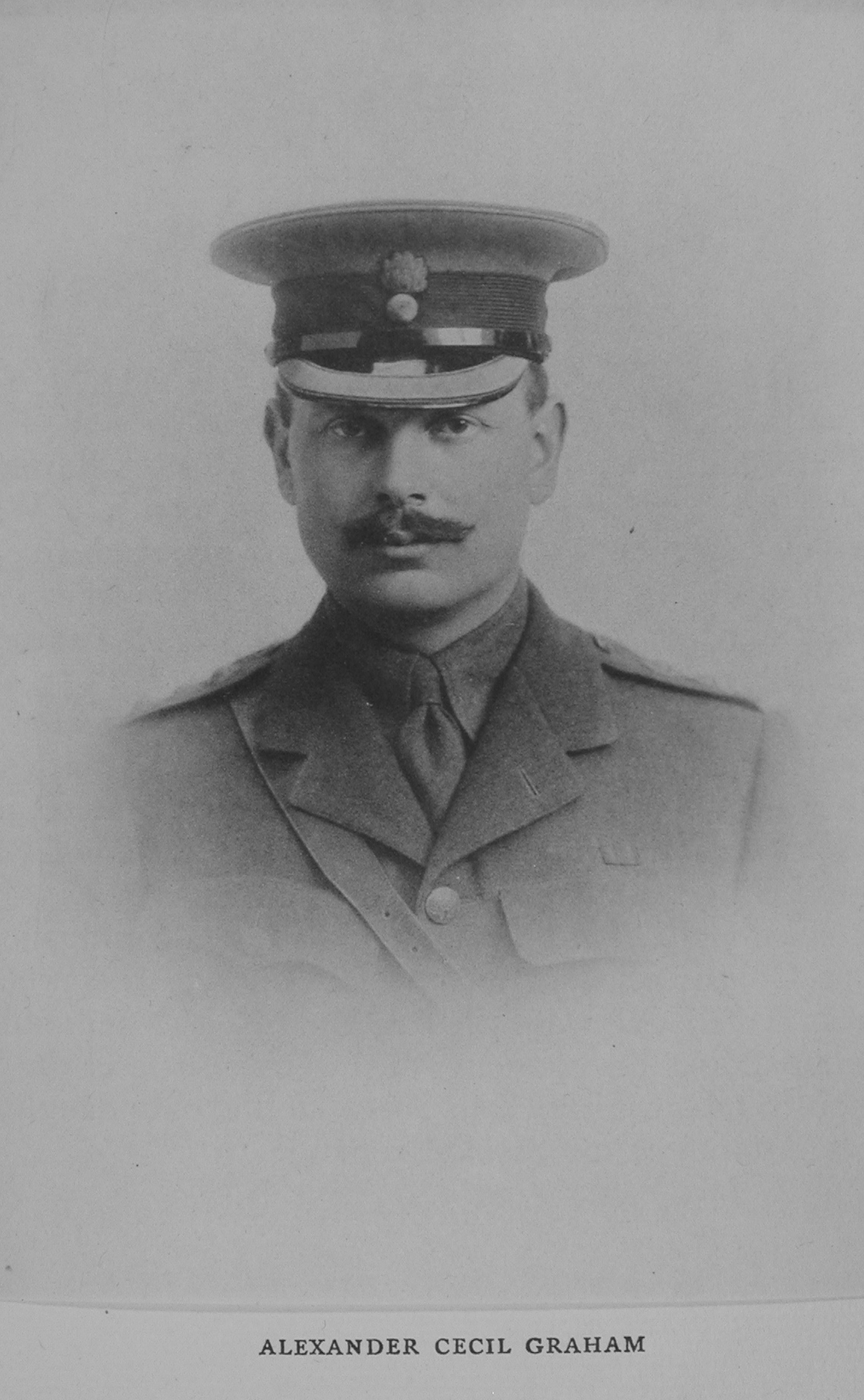
CAPTAIN ALEXANDER CECIL GRAHAM, Grenadier Guards (S.R.), was the son of Mr. and Mrs. F. Graham of Palace Gate, and was educated at Eton and Christ Church, Oxford.

During the South African War, he acted first as a War Correspondent and later joined General French’s Scouts, being wounded and captured at Lindley. On his return to England he went on the Stock Exchange and, joining the firm of H. K. Paxton, became a member in 1905.

In September 1914, he joined the Naval Division as Sub- Lieutenant in the “Hood” Battalion, and went with them to Antwerp. In October of the same year, he was promoted Lieutenant- Commander, and appointed Adjutant of his Battalion. He went to Gallipoli, where he was wounded on 2 May 1915.

In December Captain Graham received a commission in the Grenadier Guards as Captain, Special Reserve, and proceeded to the front in April. He was killed at Ginchy on 12 September 1916, when commanding his company during the battle of the Somme.

Captain Graham married in 1904, Dollie, only daughter of the late H. K. Paxton of the Stock Exchange.

Source : The Stock Exchange War Memorial 1914-1918

Goschen C G Captain 4th Grenadier Guards

Goschen C G Captain 4th Grenadier Guards

CAPTAIN CHRISTOPHER GERARD GOSCHEN, son of Henry Goschen of Addington, Surrey, was born in 1881 and educated at Eton and Balliol College, Oxford, where he graduated in 1903. He was called to the Bar in 1905, but relinquished his work there after a few years to enter the Stock Exchange, of which he became a Member in the Spring of 1910. He joined the firm of Cohen, Laming, Goschen and Co. in that year and remained with them until the outbreak of war, when he obtained a commission in the Grenadier Guards and went to the Front shortly before Christmas, 1914.

During the months that followed he took part in the fighting at Festubert and Neuve Chapelle and in some of the most arduous operations in the Ypres Salient and elsewhere. Soon after he was promoted to a captaincy in the 4th Battalion.

He was twice wounded. On the second occasion he was so anxious to get back to the Front that he refused the sick leave that was offered to him. He rejoined his regiment on 24 September 1916 and was killed on the following day while leading his men in a very severe action during the battle of the Somme.

His Commanding Officer wrote: “Chris’s loss to the regiment is indeed a great one. He was loved by his brother officers and esteemed and respected by his men. He has done extremely well and I have rarely seen a man who took hold of the hearts of all with whom he was associated like he did. His place amongst us will not easily be filled.”

A brother officer concludes a letter about him by saying “he was one of the best and truest of English gentlemen, was so straight and an example to the younger ones.”

Source : The Stock Exchange War Memorial 1914-1918

Goschen C G Captain 4th Grenadier Guards

Christopher Gerard Goschen

He was the son of Henry Goschen, of Heathfield, Addington, and nephew of the first Lord Goschen. At Eton he was in Mr. A. C. Benson’s House, and they were always great friends. Chris came up to Balliol in 1899, a slight and rather shy boy, but during his four years at Oxford he developed a great deal physically and mentally. He took a First in History in 1903. He was not good at games, but he was a keen sportsman, going nearly every year to the Highlands, and loving out-door and country life. He was fond of travel, of wandering about in France or Italy with friends, but he was happiest of all at home, devoted to his family and enjoying with his father a delightful companionship. He made great friends at Oxford and kept them for the rest of his life. During the ten years or so between Oxford and the war he was almost the centre of a group of Balliol friends, one of whom, Ambrose Mavrogordato, died during that time, and many of whom fell in the war.

After leaving Oxford he spent some years at the Bar, but ultimately he became a partner in an important financial firm, where his sound judgment and knowledge of men made him very effective. On the outbreak of war he received a Commission in the Grenadier Guards and went to the Front at the end of 1914. Except for an interval when he was at home recovering from a wound he remained with his battalion till his death in September 1916, going through the battles of Festubert and Neuve Chapelle and some of the heaviest fighting round Ypres. This was a long period of active service compared with that of most of his fellow-officers in those sorely-tried battalions of the Guards. Thoughtful and sensitive, older, and in a short time more experienced than most Company Officers, he could be both an admirable soldier and yet fully alive to the tragedies of war. These he hated, and, quoting Miss Lawless, would long to go to the place of green fields “where old Leisure sits knee-deep in grass.” Yet when at home on leave he was always anxious to get back to play his part. In May 1916 he was given his Captaincy, and was proud to command No. 1 Company in the 4th Battalion of His Majesty’s First Regiment of Foot Guards. The thought of his responsibility and of his men was never really out of his mind. His letters are full of admiration for them, and they were devoted to him. The younger officers found in him constant help and sympathy. Quite early in his time at the Front he refers to “the strange and rather splendid feeling of comradeship which one reveres.”

On September 11, 1916, he was wounded, though slightly, in the head and was sent to a base hospital near Boulogne. But he made every effort to return to his Company rather than be invalided home, and he rejoined on September 24. Next day he was killed while leading his men in a severe but successful action at Les Boeufs.

Source : Balliol College War Memorial Book 1914-1919

Grenadier Guards Officers

ALL IN THE ROLL OF HONOUR.

This photograph of six officers in the Grenadier Guards, which was taken shortly before they left for the front, has a pathetic interest today. All have been either killed or wounded. The three in the back row, Second-Lieut. C. Creed (left), Second-Lieut. the Hon. E. W. Tennant, and Second-Lieut. C. Goschen were killed, and in the front row Second-Lieut. J. Denny was wounded, Second-Lieut. P. Battye was twice wounded, and Second-Lieut. C. Guthrie was seriously wounded. (Photographed by Langfier.)

Source : The Graphic

Gilson G 2nd Lt 5th London Regiment Attd 2/4th London Regiment

Gilson G 2nd Lt 5th London Regiment Attd 2/4th London Regiment

SECOND LIEUTENANT GEORGE GILSON, 2/4th London Regiment, son of Joseph Gilson of Southend-on-Sea, as born in 1880 and educated at Christ’s Hospital, where he was a keen Rugby footballer. He was connected for twenty years with the Stock Exchange and became a member in 1904, being a partner in the firm of Isaacs and Bray. An amateur actor, he was for many years associated with the Southend Operatic and Dramatic Society.

He was twice medically rejected before being passed fit for general service in December 1916. He enlisted in the 3rd Bedfordshire Regiment and trained with them at Felixstowe. Having been made a N.C.O., he was recommended for a commission and sent to the O.T.C. at Oxford. He was gazetted to the London Rifle Brigade in January 1918 and left for France on 2 August, being transferred to the 2/4th London Regiment (Royal Fusiliers).

A month later he was killed at the head of his men, on his first day in action, near Beaucheresnes on the Bapaume-Peronne road.

“Everyone,” wrote his Colonel to his widow, “speaks most highly of the gallant way in which he behaved during the attack. His platoon fought splendidly and gained their objective in a brilliant fashion.”

Source : The Stock Exchange War Memorial 1914-1918

Giles G 2nd Lt 2nd Gordon Highlanders

Giles G 2nd Lt 2nd Gordon Highlanders

SECOND LIEUTENANT GEOFFREY Gordon Highlanders, was born in 1888. He became a member of the Stock Exchange in 1911.

He had been a member of the Artists Rifles before the war, and rejoined at the outbreak of war.

Early in 1915 he was given a commission in the 2nd Gordon Highlanders and was wounded in May of that year.

After recovering from his wounds he returned to the Front and was killed on 1 July 1916-the fiercest day in the history of the British army-in the attack on Mametz.

Source : The Stock Exchange War Memorial 1914-1918

Gibbs W L Paymaster Army Pay Corps

Gibbs W L Paymaster Army Pay Corps

ACTING PAYMASTER WALTER LESLIE GIBBS, Army Pay Department, son of Clement Gibbs, was born in 1875 and educated privately.

He joined the firm of Beckhusen and Gibbs in 1891, and became a partner and a member of the Stock Exchange in 1899.

Soon after war broke out he was taken seriously ill and forced to take a year’s rest.

In September 1915 he was appointed Acting-Paymaster and served in the Pay Office at Preston.

He died of pneumonia on 22 December 1916, and left a widow.

His Commanding Officer spoke of his keenness and loyalty to duty, and a brother officer wrote of his lovable nature which had endeared him to all those under him and to his colleagues who had the privilege of his friendship.

Source : The Stock Exchange War Memorial 1914-1918


Gardom J C Lt Essex Regiment

Gardom J C Lt Essex Regiment

L IEUTENANT JOHN CHARLES GARDOM, Essex Regi- ment, was the eldest son of Mr. and Mrs. Charles H. Gardom of Tadworth, Surrey.

He was born in 1884 and educated at Malvern College. After leaving school he joined his father’s firm C. H. Gardom and Co., and became a member of the Stock Exchange in 1909.

Lieutenant Gardom was a magnificent skater, and won the gold medal of the National Skating Association in 1911.

On the outbreak of war he joined the Honourable Artillery Company, and went to France with them in September 1914.

He was given his commission in the 12th Battalion Essex Regiment in the following February; he was sent out to join the 1st Battalion of his regiment at Gallipoli in May, and was killed at Achi Baba on 6th August, 1915.

Source : The Stock Exchange War Memorial 1914-1918

Gardom J Lt 12th Attd 1st Essex Regiment

Source : Activities of the British Community in Argentina During the Great War 1914-1919

Gardom J C Lt 1st Essex Regiment

Source : The War Illustrated Vol 5


Frymann G A Sergt 624817 2nd Honourable Artillery Company

Frymann G A Sergt 624817 2nd Honourable Artillery Company

ERGEANT GUSTAV ALBERT FRYMANN, Honourable Artillery Company, was born and educated in London.

He began his Stock Exchange career with T. J. Ive and later joined the firm of Albert A. Bendon and Co., becoming a member in 1912.

Ón the outbreak of war he made several attempts to join up, but was each time rejected as unfit. He succeeded at last in joining the H.A.C. as a driver. He rose to the rank of sergeant, but refused a commission, though offered it several times.

After three years service at home he went to the front in June 1917, and was killed by a shell on 4 October, during an attack on the Passchendaele Ridge. He was Acting-Sergeant-Major at the time of his death.

His Captain wrote: “He was a splendid soldier and died a noble death. I could tell you countless incidents when he has shown the utmost contempt of danger. I cannot speak too highly of his courage and devotion to duty. He had earned a decoration many times over. He told the men who were dressing his wounds to leave him and attend to the other men who had more chance of life.”

Source :

Friend P E 2nd Lt Machine Gun Corps

Friend P E 2nd Lt Machine Gun Corps

SECOND LIEUTENANT PHILIP EMLYN FRIEND, East Lancashire Regiment, was the only surviving son of the late W. Latton Friend, of Beckenham, and Mrs. Friend, of 6, Lexham Gardens.

Before the war he was with his uncle, Dale Womersley, on the Stock Exchange, having become a member in 1904.

He had always been a keen rider and on the outbreak of war enlisted in the 11th Hussars. Shortly after he was transferred to the Royal Scots Greys, with whom he trained at Dunbar. In April 1915 he was gazetted to the 3rd East Lancashire Regiment.

He went out in August to the 2nd Battalion, and served with them till January 1916, when he was transferred to the Machine Gun Corps. He was killed on 7 July 1916.

His Colonel wrote to his widow: “I put special value on his courage and constancy. During the heavy fighting last September, after a great part of the defensive works had been demolished by shell fire, he retained such power of command that his platoon manned what remained of the parapet with great gallantry and opened an effective flank fire which drove back every attempt to counter-attack from that quarter. He was always cheerful, and a great favourite.”

A brother officer wrote: “I wish you to know that both the officers and men of this Machine Gun Company feel his loss beyond words. I always thought him a soldier and a gentleman. I never wish to have a finer man under me.”

Source : The Stock Exchange War Memorial 1914-1918