
Source : De Ruvigny’s Roll Of Honour Vol 1
First World War Soldiers Photos
World War One Soldier's Photos, Obituaries And Short Service Records
Source : De Ruvigny’s Roll Of Honour Vol 1

Anderson J V C Captain Indian Army
CAPT. JOHN VICTOR CORTLANDT ANDERSON,
QUEEN VICTORIA’S OWN CORPS OF GUIDES (F.F.), INDIAN ARMY.
KILLED IN ACTION AT EL JELIL, NEAR JAFFA, JUNE 8TH, 1918. AGED 30.
At the School 1901-4 (School House).
Capt. J. V. C. Anderson was the younger son of the late John Philip Cortlandt Anderson, M.I.C.E., and of Mrs. Anderson, of 30, Midvale Road, St. Helier’s, Jersey. His elder brother, Temporary Major H. E. C. Anderson, Leicestershire Regiment, is an old Fettesian, and had been wounded.
Entering the School from Hillside, Godalming, in September, 1901, Victor Anderson left from the Army Class at Christmas, 1904, when he was only a few months over seventeen. He had become a 2nd Corporal in the Cadet Corps, as it was then, and had obtained his 1st XV. colours in his last Term, as a useful 12 st. forward. At the R.M.C.. Sandhurst, also, he was in the XV., and was promoted Sergeant. He was gazetted to the Dorset. Regiment May 4th, 1907, but after about a year transferred, in 1908, to the Indian Army, being posted to the 1st Battn. of Queen Victoria’s Own Corps of Guides (F.F.) (Lumsden’s), and by his fine soldierly qualities proved himself worthy of the best traditions of that famous Corps. He was promoted Lieutenant August 4th, 1909, Temporary Captain September 1st, 1915, and Captain May 4th, 1916, this being subsequently antedated to the date on which he became Temporary Captain. He did very well indeed in the frontier fighting in India in the early days of the War and took part in the operations against the Bunerwals in 1915, and against the Mohmands in 1916. From March to December, 1917, he served in Mesopo- tamia with his Regiment and took part in the Tigris Operations, including the fighting at Tikrit in November.
Early in January, 1918, the Guides were transferred to Palestine, and when on June 8th they were selected and specially brought up to attack, in co-operation with the Black Watch, a very strong Turkish position on a height called the “Two Sisters,” near the coast, about seven miles north of Jaffa, the honour of leading them was conferred on Captain Anderson. In spite of a very heavy enemy barrage and terrible losses, he fearlessly led his men absolutely “plumb straight” to their objective. The Regiment captured the position, but while they were consolidating a shrapnel burst right in front of him and he fell mortally wounded with bullets through the head and heart. He was buried, with two other Guides officers, in the neighbouring cemetery of El Jelil, but after the War was re-interred in the Military Cemetery at Ramleh.
Letters from the second in command, who had been in the Regiment for nearly fourteen years, contained the following:-
“Every one liked him, and ever since I’ve known him I never heard a word against him from any one either in or out of the Regiment. He was the life and soul of our Mess – always cheery and merry and bright, and you know what a lot that means on service. As a regimental soldier he was absolutely unsurpassable.
“I’ve always had a great admiration for him. He was a real soldier if ever there was one, and without exception the best Company Commander I’ve ever met anywhere. He had a wonderful hold over his men and they would have followed him anywhere. He was such a fine fellow and so straight-one of the whitest’ men I’ve ever met. I never knew a fellow who commanded more respect than J. V. did. I know of no one who had consistently done more for the Regiment. He has left his mark all right and his good work will have its effect for many a long day to come.”
The C.O. also described him as the best Company Commander in the Regiment,” and added, “You can’t think what a loss it has been to us. He was such a favourite, one of the best officers I have ever met, and a grand soldier “; and in his recommendation of Captain Anderson for a Mention in Despatches, the only honour except the V.C. for which an officer who has been killed may be recommended, he wrote:-
“I specially chose this officer to lead the advance, as I knew the success of the operations must depend to a great extent on the direction maintained and the dash with which the advance was carried out through the enemy’s barrage. Nothing could have gone better; and it was only when the final objective was reached that he fell mortally wounded. His utter disregard for his own personal safety and his devotion to duty were the chief cause of the success of the whole operations.”
Source : Tonbridge School And The Great War Of 1914-1919

Ambler E S Lt 2nd Scots Guards
LIEUT. EDWARD SHARP AMBLER,
SCOTS GUARDS (S.R.), ATTD. 2ND BATTN.
ACCIDENTALLY KILLED ON NIGHT PATROL NEAR WARLINCOURT, MAY 8TH, 1918.
AGED 20.
At the School 1912-15 (Ferox Hall).
Lieut. E. S. Ambler was the eldest son of Mr. and Mrs. Sam Ambler, of Hoyle Court, Baildon, Yorks. Entering the School in September, 1912, from Horton School, Biggleswade, he coxed the School Four in 1914 and 1915 and had become a Lance-Corporal in the O.T.C. On leaving School at Christmas, 1915, he went to Jeremiah Ambler & Sons, Ltd., Midland Mills, Bradford, to learn the business. In September, 1916, as soon as he was old enough, he joined an Officer Cadet Battalion at Trinity College, Cambridge, in which he did very well, and also distinguished himself by winning the five-mile cross-country race by 1 minutes out of a field of 200. He received his commission in the Scots Guards (S.R.) December 19th, 1916, and joined his Battalion at Wellington Barracks. Going out to France on June 9th, 1917, he saw much fighting in Bourlon Wood and elsewhere in the course of the next eleven months. The Quartermaster of the Battalion tells how he seemed to bear a charmed life, and had indeed, “pointing to his shell-torn clothes,” exclaimed, “You see, they cannot hurt me!” Nor did the enemy succeed in doing so, for he eventually fell a victim, on the night of May 8th, 1918, to one of those tragic accidents which no precautions can render impossible. The officer who was in command of the Battalion at the time wrote:-
“He was going the rounds at night of our forward posts, missed his way, and came upon the post from the direction in which they expected the Germans. His party did not hear the challenge, and the sentries, who had been warned to use the utmost vigilance, fired. The nights have been terribly dark, the line is very difficult and tricky. I really cannot blame anybody. He had done a first-rate bit of scouting work the night before. . . . He was one of our most promising future Company Commanders. I have been nigh three years continuously with this Battalion in France, so I have seen. many young officers. I have never seen one more cool-headed in action or more dependable. . . . His men all knew and recognised him as a right good officer.”
The Chaplain wrote:-
“We older men feel that we have lost a younger brother of whom we were both proud and very fond,” and told how on the previous night, the night on which he had been out scouting, Lieut. Ambler had narrowly escaped a similar accident. He had been fired on by a Lewis gun post and ran in and ” asked in his bright way if they were the people who had tried to shoot him,” and then told them that they had done quite right. It was, he said, the unanimous opinion of the men that Lieut. Ambler fell a victim to his own keen regard for their safety, for he had impressed upon them that they were to take no risks but to shoot at once if any one approached from the enemy side in the dark. He was buried in the British cemetery at Warlincourt Halte on the Doulens-Arras Road. His Company Commander wrote :-
“I was very fond of him; he was such a nice. boy and such a good officer, too, quite the best subaltern I had. He was doing splendidly too;” and, after alluding to his smallness, tells how the big guardsmen used to call him The Nipper ” a sure sign of their affection for him. His servant, after testifying to his popularity, described him as a grand soldier who had no fear of anything.” The C.O. of the Battalion, who was not in the lines at the time, wrote:-
“Your son was one of the best boys in my Battalion and was liked by all. He was a great soldier and always gave me confidence, while his keenness in work and play was an example to all.” The Colonel of the Regiment wrote:- “I have had nothing but the most excellent reports of your boy. He was much liked by all ranks and did his work so splendidly. He will be much missed both as an excellent and most promising officer and also as a cheery and bright companion and brother officer.”
Source : Tonbridge School And The Great War Of 1914-1919
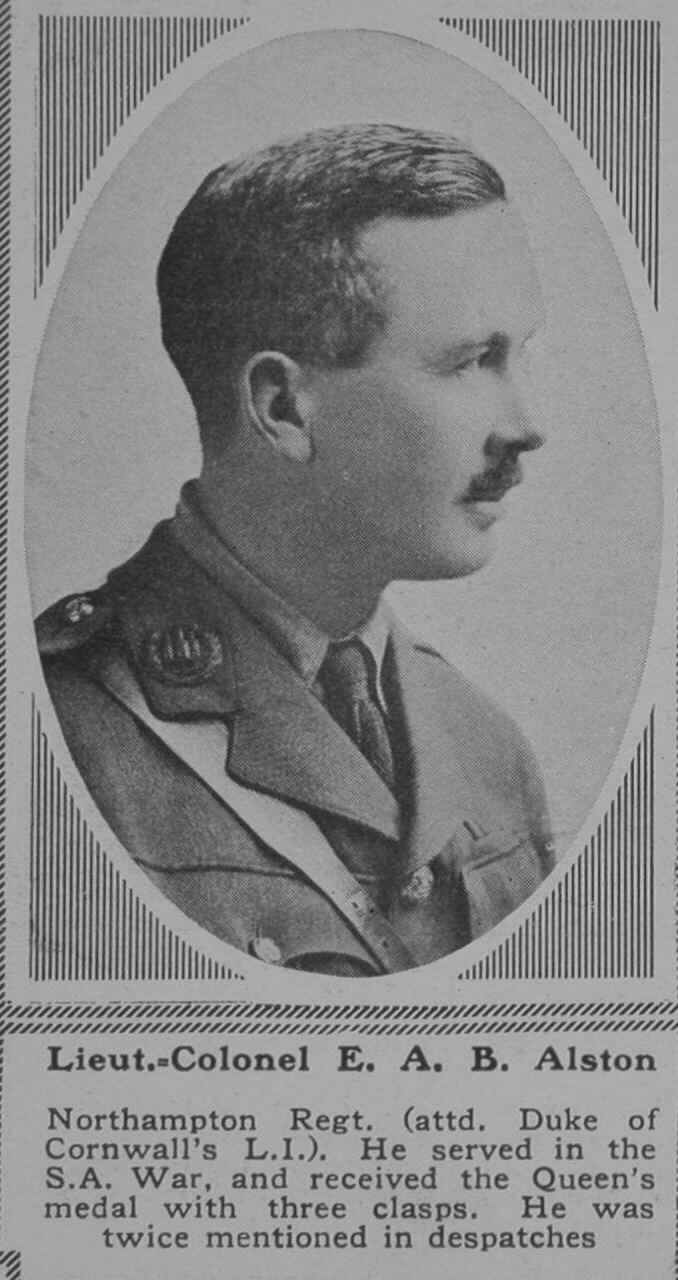
Alston E A B Lt Col Northants Regiment Attd Duke Of Cornwall’s Light Infantry
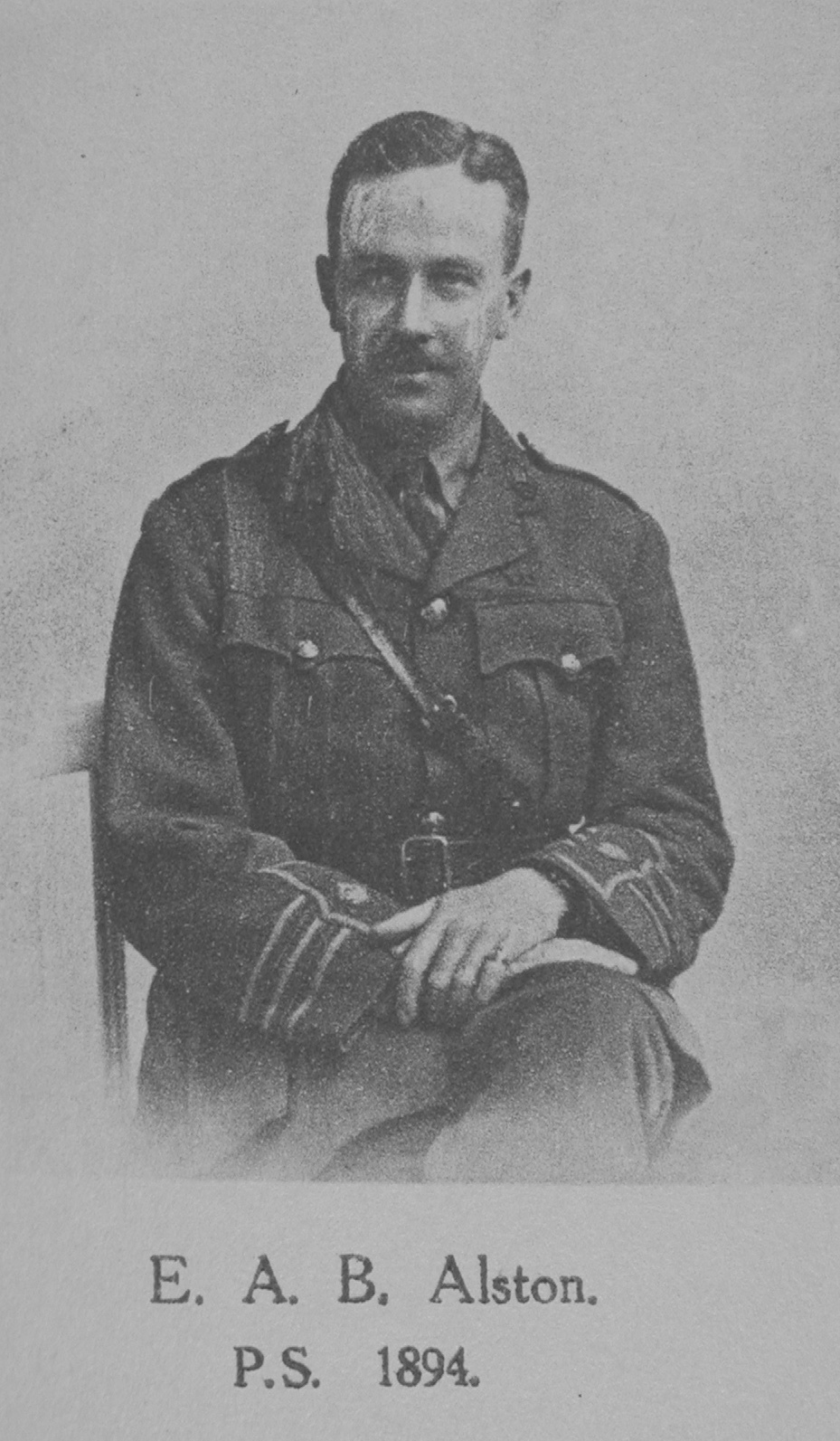
Alston A E Lt Col Northamptonshire Regiment Attd 10th Duke Of Cornwall’s Light Infantry
LIEUT.-COL. ERNEST ALFRED BROOKE ALSTON
MAJOR, NORTHAMPTONSHIRE REGT
O.C. 10TH BATTN. DUKE OF CORNWALL’S LIGHT INFANTRY.
KILLED IN ACTION NEAR DUNKIRK, AUGUST 11TH, 1917. AGED 39.
At the School 1893-94 (Parkside).
Lieut.-Col. E. A. B. Alston was the fourth son of the late Surg.-Major William Evelyn Alston and of Mrs. Alston, of East Cliffe House, Sandgate, Kent, and husband of Eileen Alston, formerly of 25, Iverna Court, Kensington, W., and now Mrs. Trevor Finnis, of 9, Kensington Crescent, W.
Entering the School in May, 1893, E. A. B. Alston left at the age of sixteen at Easter, 1894, and entered the Militia in the following year. At the outbreak of the South African War he was gazetted to a commission in the Northamptonshire Regiment, with which he served in South Africa, 1899-1900, being present at the Battles of Belmont, Graspan, and Modder River, and receiving the Queen’s Medal with three clasps.
He was promoted to his Captaincy in July, 1908, and soon after the outbreak of war was gazetted as Temporary Major, October 29th, 1914, to the 5th Battn. (Pioneers) of his own Regiment, and went to the Front with this Battalion in May, 1915. He was promoted to substantive rank as Major, September 1st, 1915, took part in the Actions of the Hohenzollern Redoubt in October, 1915, subsequent to the Battle of Loos, and was mentioned in Despatches for services in France in 1915.
On May 1st, 1916, he was appointed as Temporary Lieut.-Colonel to the command of the 10th (Service) Battn. of the Duke of Cornwall’s L.I. With the exception of six weeks in England after he took over this command, whilst his new Battalion were completing their training, he was on continuous active service abroad from May, 1915, till the day of his death. He commanded this Battalion in the Battles of the Somme, 1916, and in the Battles of Arras in April and May, 1917, and finally on the Belgian Coast, after being for a time in the neighbourhood of the Ypres Salient. He was again mentioned for distinguished services in Sir D. Haig’s Despatch dated November 11th, 1916, and published ou January 1st, 1917, and a third “mention ” appeared after his death, in the Despatch dated November 7th, 1917.
On August 11th, 1917, he and the Major, second in command, and the Adjutant, were asleep at the Battalion Headquarters, near Dunkirk, several miles behind the front line, when the hut was struck by two shells, and he and the Major were instantaneously killed, and the Adjutant mortally wounded. His last thought had been for the guard, whom he had ordered to take cover. He was buried in St. George’s Cemetery, Newport, Dunkirk. The Medical Officer wrote expressing the heartfelt sympathy of the whole Battalion and their great sense of loss, adding that he had been constantly with Col. Alston and had learned to know and to admire him as a true friend. Capt. H. L. Stanistreet, O.T. (P.H. 1914), who was one of his Company Commanders, after telling of their great loss, wrote:- “It is hardly necessary to add that the C.O. is a very sad loss to the Battalion as he was so popular amongst the officers and The C.O. of the 5th Northamptonshires, under whom he served for a year and a half-wrote:- “It seems incredible that one won’t see his genial, cheery face again. He was a gallant officer and nothing ever upset his natural cheerfulness. No one could possibly help liking him, and he was a general favourite with every one. When he was with us I have seen him in one or two pretty hot places, but he was always smiling and joking, and had a cheery word for every one a most gallant officer and a thorough gentleman.”
Source : Tonbridge School And The Great War Of 1914-1919

Allies A E Lt 8th Royal Welsh Fusiliers.
LIEUTENANT ALFRIC EUAN ALLIES, the younger son of Mr. and Mrs. Alfred Edward Allies, was born at “Bewell” Alfrick, Worcester on October 16th, 1890.
He was educated at Yardley Court Preparatory School, Tonbridge, at Tonbridge School and at Brasenose College, Oxford. At the latter he took his degree with Honours in Jurisprudence in 1913 and, intending ultimately to practise at the Bar joined the Inner Temple, but the outbreak of war diverted his thoughts and energies to the service of King and Country.
He had been a member of King Edward’s Horse, but on leaving Oxford resigned his membership of that body,he was free to accept a Commission. He was gazetted Temp Second Lieut. in the Royal Welsh Fusiliers on September 9th 1914 was promoted Lieutenant on February 1st. 1915, and in June of that year went out with his battalion to the Dardanelles, and here on August 16th he fell at Anzac.
His Commanding Officer wrote:- “I had to send a small party out in the early morning of the 16th to destroy some Turkish loopholes that had been erected during the night, thirty yards from our trenches. We were able to cover their advance across the open with our machine guns, so it was thought we could effect our objective in comparative safety. Your son most gallantly led the men, and was the first to reach the loopholes-here he was seen to fall wounded, and he rolled down the hillside towards the Turks and was not seen again.
For some time it was hoped that Lieutenant Allies might be a prisoner in Turkish hands, but this slender hope had finally to be relinquished.
A fuller and more detailed account of his last gallant action is given by the Captain of his Company:-
“On the night of the 15th-16th, we had been holding a line of trenches at the head of a dangerous salient, and these trenches were practically exposed to fire from three sides. . . . . In the morning when it was daylight, we discovered that the enemy had fixed four steel loopholes concealed by leaves, behind which they doubtless expected to snipe our bivouac area. We had sent a small party of four in the night to try and bomb them, but with practically no effect. After a good deal of consultation, it was decided by the C.O. to send out your son who was picked out as an enterprising and capable Officer, with a bayonet party of twelve men to charge the trench, drive away the snipers and destroy the steel loopholes.”
“Accordingly about 6 o’clock yesterday morning in full daylight he started off covered by one of our machine guns, rallied the party at once and charged gallantly 15 yards ahead of his men who immediately came under enfilade fire from the enemy. Your son reached the trench, was seen to fire his revolver into it and fell over the ridge towards the Turks, shouting something as if he had been badly wounded. He was then seen crawling back up the hill endeavouring to return, but was fired at again and he has not been seen or heard of since. It was his wish I should let know if anything happened to him, and I can only assure you how we all admire him for the gallant way in which he led his men.”
The following exquisite appreciation of the young Officer appeared in the Brasenose College Magazine from the pen of the Vice-Principal:-
“Here at Oxford he had been the life and soul of his friends. He was no athlete, but he could play golf well and hit a cricket ball hard; he was no scholar, but he had many intellectual interests, quick wits, and a lively understanding. By sheer force of personality he won for himself a unique position in College life. He was endowed with a rich vein of natural humour, of the truest and best kind. It was Falstaffian. It flowed from the depths of his nature, and was as gentle and as gracious as it was unforced. By choice his favourite butt was himself. Singularly high-minded, singularly pure, he was happy himself and spread cheerfulness and good temper about him. He bore the follies of his friends with tolerance; the discomforts and dangers of a soldier’s life he bore with fortitude. We shall long and sorely miss the sunny nature of one who brightened our lives so greatly whilst he was with us here on earth.”
Source : The British Roll Of Honour Vol 2

Allies A E Lt 8th Royal Welsh Fusiliers
Source : The Sphere 30th Sep 1916
LIEUT. ALFRIC EUAN ALLIES, 8TH BATTN. ROYAL WELCH FUSILIERS
KILLED IN ACTION AT ANZAC, GALLIPOLI, AUGUST 16TH, 1915. AGED 24.
At the School 1905-9 (Day Boy).
Lieut. A. E. Allies was the younger son of Mr. and Mrs. Alfred Edward Allies, of Bewell, Alfrick, Worcester, and, until recently of Glenburn, Yardley Park Road, Tonbridge. After six years at Mr. Bickmore’s, Yardley Court School, he came to the School in 1905, and leaving in 1909, worked for a year with Mr. J. Le Fleming at Eton House before going up to Brasenose College, Oxford, in 1910. He took his degree with Honours in Jurisprudence in 1913 and, intending ultimately to practise at the Bar, joined the Inner Temple. The following, from the pen of the Vice-Principal of Brasenose, appeared in May, 1916, in the Oxford Magazine, and in the Brazen Nose, the College magazine:-
“Destined for the Bar, the outbreak of war found him at Cox’s Bank. He had been a member of King Edward’s Horse, but increasing weight had compelled him to resign his membership of that body, and he was free to accept a commission. He went to Churn with most of his Oxford friends. Here at Oxford he had been the life and soul of his friends. He was no athlete, but he could play golf well and hit a cricket ball hard; he was no scholar, but he had many intellectual interests, quick wits, and a lively understanding. By sheer force of personality he won for himself a unique position in College life.
“He was endowed with a rich vein of natural humour, of the truest and best kind. It was Falstaffian. It flowed from the depths of his nature, and was as gentle and gracious as it was unforced: it was universal in its character. By choice his favourite butt was himself. No matter what his theme the peccadilloes of his friends, his own laboured ascent of Cader Idris, the difficulties of the law, the intricacies of high finance as seen from the point of view of a clerk at Cox’s, the discomforts of camp life, or the too great reality of sham trench-warfare, the same refreshing humour played over and illuminated the whole subject; for his was the humour which comes of vision. With the Principal no less than with the callowest Freshman he conreneed in a tone of the most delightful persiflage. It showed itself in hundreds of ways. Like Sir Francis Drake, where five reasons could be invented he was never content with one, however convincing and genuine that one might be. He did not wish to deceive, nor did he deceive: his excuses were born of the joy of creation. Humour of this type is elusive, but Allies had the unusual gift of imparting some of the flavour of his conversation to the written word. Those of our readers who read the Letters of a Subaltern in the Dardanelles,’ which we published last Term, will (notwithstanding the activities of the Censors) have some idea of what we mean. They will know, too, the manner in which he gave his life. Those letters are the way in which his promise to the Magazine to write an account in the manner of Caesar of the Crossing of the Rhine in 1915 has unfortunately been fulfilled.
“Singularly high-minded, singularly pure, he was happy himself and spread cheerfulness and good temper about him. He bore the follies of his friends with tolerance; the discomforts and dangers of a soldier’s life he bore with fortitude.
“The best natures have the homing instinct strong within them. Allies loved dearly the shady lawn of his home at Bewell; he loved no less the University where he spent three happy years. For under all his humour there lay a depth of feeling which only seldom came to the surface. We saw him often after he had taken his degree; we listened in wonder while he unfolded the tale of his doings in London or in camp, and we shall long and sorely miss the sunny nature of one who brightened our lives so greatly whilst he was with us here on earth.”
He was gazetted a Temporary 2nd Lieut. in the 8th (Service) Battn. of the Royal Welch Fusiliers on September 9th, 1914, and promoted Lieutenant February 1st, 1915. On June 29th the
Battalion went out to the Dardanelles. The following account is taken from the letters of his Commanding Officer and his Company Commander :-
“On August 15th two companies of the Battalion were holding a line of trenches at the head of a dangerous salient, and the Turks were driving a sap up from their main trench some 70 yards distant, with a view to bombing our trench from a ridge that also commanded the bivouac area of the Battalion. On the night of the 15th a small bombing party had failed to dislodge the Turks, who had even succeeded in erecting four steel loopholes concealed by leaves on the ridge within 30 yards of our trench. After consultation, the C.Ó. decided to send out a bayonet party of 12 men, and selected Lieut. Allies as an enterprising and capable officer. Though it was daylight, he hoped that our machine-gun fire would enable them to effect their object in comparative safety. Lieut. Allies charged gallantly 15 yards in front of his men, but they immediately came under enfilade fire. He was the first to reach the loopholes and was seen to fire his revolver into the trench, but then fell over the ridge towards the Turks, evidently wounded. He was seen crawling back up the slope of the ridge, but was again fired on, rolled back out of sight, and has not been seen or heard of since. Six of his men were also missing, and no sign of any of them was discovered by a bombing party that reached the trench on the following night. His Company Commander testified to the universal sorrow at the loss the Battalion had sustained, and to their admiration of the gallant way in which Lieut. Allies had led his men; and both he and the C.O. expressed their conviction that, if he was a prisoner, he would be well treated by the Turks.”
As all efforts to obtain news of him had proved fruitless, the War Office at last determined to presume that he was killed on that day, August 16th, 1915, at “The Apex,” Rhododendron Spur, Anzac.
Source : Tonbridge School And The Great War Of 1914-1919

Allen R G R Captain 5th West Yorkshire Regiment Attd Royal Flying Corps
CAPT. RICHARD GERRARD ROSS ALLEN,
5TH BATTN. PRINCE OF WALES’S OWN (WEST YORKSHIRE REGT.) (T.F.).
FLYING OFFICER, R.F.C.
KILLED IN AERIAL ACTION NEAR BEAUMONT HAMEL, NOVEMBER 16TH, 1916. AGED 26.
At the School 1903-8 (School House).
Capt. R. G. Ross Allen was the only son of the late Richard Allen, Clerk of the Crown and Peace for County Leitrim, and of Mrs. Allen, of Cambrian House, Burgess Hill, Sussex, and formerly of Cavan, County Cavan, Ireland. He entered the School in September, 1903, from Mr. R. H. Bookey’s School at Aravon, Bray, County Wicklow, and left in July, 1908. In the Cadet Corps, as it then was, he became a Corporal in September, 1906, Sergeant in January, 1907, and C.S.M. in May, 1908. He also won the Swimming Points Cup in 1907 and 1908, and was appointed a House Præpostor in September, 1907, and a School Præpostor in his last Term. On leaving School he went up to Jesus College, Cambridge, and rowed No. 7 in the Jesus Boat in the Lent and May races for two years. After taking his degree in January, 1912, he took up Land Agency in Yorkshire.
Having volunteered for service very early in the War, he received a commission dated October 14th, 1914, in the Prince of Wales’s Own (West Yorkshire Regt.). In March, 1915, he went out to France, and came in for the end of the great Neuve Chapelle fighting. In the course of the next fourteen months he took part in much stern work at Festubert, Hooge, Ypres, etc., and came through all these months of front line trench fighting without being wounded. Early in the Somme Battle he was offered an appointment as Observer in the R.F.C. and was seconded and afterwards transferred to the R.F.C. On the morning of November 16th, 1916, he went out as Observer on artillery work during the great fighting then in progress, and what was presumed to be his machine was seen engaged with an enemy machine and was seen to go down in a steep spiral within the German lines. It was impossible to see precisely where it landed or fell. He was reported “missing” at the time, but it was hoped that he might have effected a landing, his brother officers believing that even if his pilot had been hit and disabled, Capt. Allen, being very experienced, would have been able to achieve this. However, five days later a patrol visited an aeroplane that had fallen in enemy lines and found under it the body of an officer of the West Yorkshires, but were unable to remove the body or to identify it, as there was no time or light. On April 19th, 1917, an official telegram stated that he was believed to have been killed on November 16th, 1916. It was subsequently officially reported that a grave had been found with an inscription. giving his name and regimental description in full. It would therefore appear that his body was removed and buried by the Germans before the machine was completely destroyed by shell fire in the subsequent advance as previously reported.
“He was,” wrote one officer, “one of the best Observers in the Squadron, and was one of three chosen for the specially difficult and dangerous work of contact patrol,” and an officer of the Yorkshire Regiment wrote:-
“We were all very sorry when Ross left us to go to the Flying Corps, because we had all learned to love one who was always cheery and a splendid fellow in every way.”
His Flight-Commander wrote:- “I was only transferred here as Flight- Commander ten days ago, but even in that short time I had come to like him very much. He was very popular in the mess, and took over a lot of extra work for us, managing our mess accounts, which he did excellently. As an observer he was quite first-class, and was always ready for any dangerous or difficult job. We shall all miss him greatly as a worker and as a friend. He had a lot of grit, and when after a long day other people seemed rather played out, he would still be cheery and full of life.”
Tonbridge School And The Great War Of 1914-1919

Allen G P 2nd Lt 4th Queens Royal West Surrey Regiment
GEOFFREY PEAKE ALLEN, 4TH BATTN. THE QUEEN’S (ROYAL WEST SURREY REGT.) (T.F.).
Died 21st December 1915 from wounds received in a bombing accident on 18th December Age 19.
At the School 1909-15 (Hill Side).
Geoffrey Peake Allen was the only son of Mr. and Mrs. Francis Allen, of 21, Duppas Hill Terrace, Croydon. He entered the School in September, 1909, and left from the Modern Sixth as a School Præpostor at Easter, 1915. He had been in the O.T.C. for over four years, becoming a full Corporal in Sep- tember, 1914. On leaving School he applied for a commission, and was gazetted on June 3rd to the 3/4th Battn. of the Queen’s. The accident by which he lost his life occurred through a faulty bomb whilst he was undergoing a course of instruction in bomb-throwing at Godstone on Saturday, December 18th, and he died three days later in Caterham Cottage Hospital. He was buried on Christmas Eve at Bandon Hill Cemetery, Croydon, with full military honours, the band and a firing party of the Regiment attending, and six of his brother officers acting as bearers. His Colonel, writing on the day of the accident to express his own grief and sympathy and that of the Battalion, said of him :-
“He always did his work thoroughly well, and was a great favourite in the mess. I am also sure his company will be very grieved at the sad news; the men are always ready to appreciate any one who is so keen and hard working as he was.”
Source : Tonbridge School And The Great War Of 1914-1919

Allen G P 2nd Lt 4th Queens Royal West Surrey Regiment
Source : Croydon Roll Of Honour 1914-1918
Abel James Edgar 2nd Lt
LATEAU WOOD, 20th November, 1917. For conspicuous gallantry and devotion to duty. When his company commander became a casualty he assumed command at a critical period and worked his men forward to a strong point, whence the enemy were developing heavy machine-gun fire, and silenced them by concentrated rifle fire. His courage and fine leadership saved many casualties, and enabled the battalion to continue the advance.
Source : The Regimental Roll of Honour and War Record of the Artists’ Rifles

Spencer C J Captain 2nd Devonshire Regiment
Source : The Sphere 16th Jan 1915

Spencer C J Captain 2nd Devonshire Regiment
Source : The Illustrated London News 30th Jan 1915

Spencer C J Captain 2nd Devonshire Regiment

Source : De Ruvigny’s Roll Of Honour Vol 1

Spence J M Sergt 12-218 15th North Auckland Regiment New Zealand Expeditionary Force

Source : De Ruvigny’s Roll Of Honour Vol 1