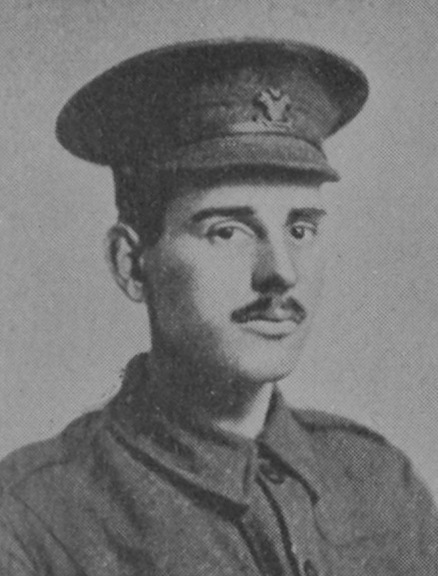
Taylor C H Pte 1785 15th London Regiment
TAYLOR, CLEMENT HAROLD, Private, No. 1785, 1/15th Battn. Prince of Wales’ Own (Civil Service Rifles) The London Regt. (T.F.), 3rd s. of Francis Taylor, of 6, Church Street, Leominster, Postmaster there, by his wife, Florence Annie, dau. of the late John Andrew Brewer, of Poulteney Gardens, Bath; b. Chippenham, co. Wilts, 9 Aug. 1892; educ. St. Paul’s National School, and Wiltshire County Secondary School, Chippenham; was a Civil Service 2nd Division Clerk in Comptroller and Accountant General’s Department of the G.P.O.; joined the Civil Service Rifles, in March, 1914; was in camp when war was declared on 4 Aug. 1914; went to France, 17 March, 1915, and died there, 25 July, 1915, of wounds received from an accidental bomb explosion; unm.
Buried at the Military Cemetery, Noeux-les-Mines. Lieut. Scott wrote that he was wounded on Saturday afternoon at about 3.30 p.m. and that although he lived till morning was unconscious the whole time, and continued: “It may be some consolation to you to know that he was one of the very best soldiers and one of the very best men in my platoon. He was always entirely reliable, and always willing and eager to undertake any job that was going. He proved his worth, especially on night patrols between our lines and the Germans, for which he would always volunteer whenever it fell to our platoon to furnish one. His loss is deeply felt by all his comrades whose admiration and affection he had soon won.” On the day before the accident he wrote to his mother: “The battalion has now done 16 days in the trenches and came out last night, I believe. I left on the 14th day with a small party to come here for a course of four days at a bombing school. Bombs are fast becoming a most important factor in trench warfare, so a good many men are being trained to use them. It is a nice change after a fortnight’s trench life, and very interesting, too.” Private C. H. Taylor, was a keen student of Economics, and in an examination held by the Society of Arts in 1914 he won first place in all England.
Source : De Ruvigny’s Roll Of Honour Vol 1